

8. REACTIONS OF INORGANIC SUBSTANCES
375
The latter reaction does not proceed very far in C. UmicoL· and
therefore appreciable quantities of elementary sulfur accumulate in the
cultures of this organism. The main difference between the two species,
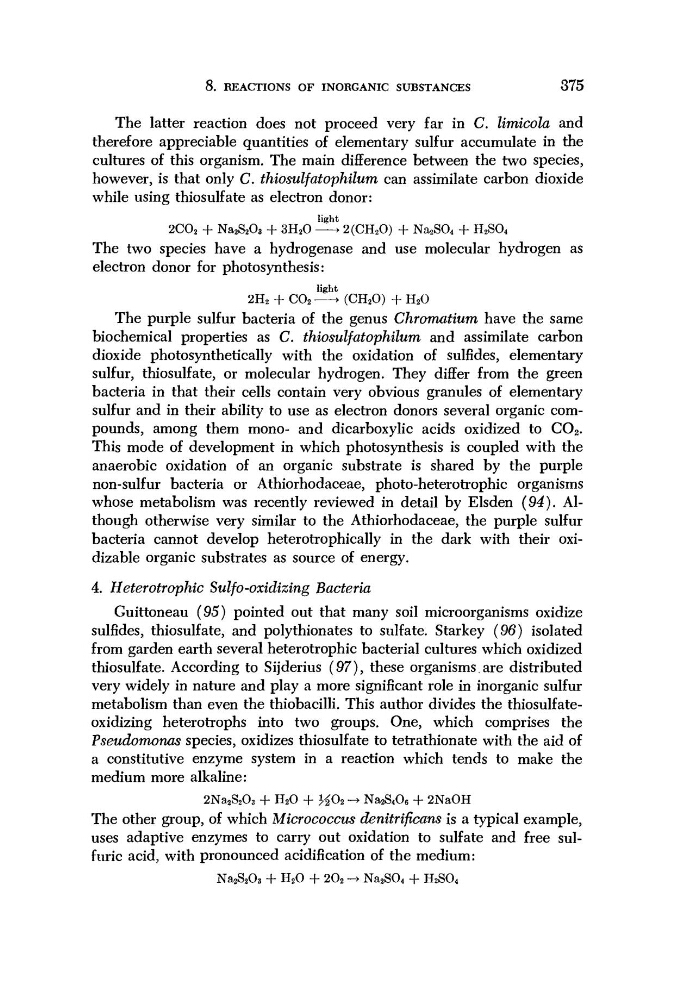
however, is that only C. thiosulfatophilum can assimilate carbon dioxide
while using thiosulfate as electron donor:
light
2C0 2 + Na 2 S 2 0 3 + 3H 2 0
> 2(CH 2 0) + Na 2 S0 4 + H 2 S0 4
The two species have a hydrogenase and use molecular hydrogen as
electron donor for photosynthesis:
light
2H 2 + C0 2
> (CH 2 0) + H 2 0
The purple sulfur bacteria of the genus Chromatium have the same
biochemical properties as C. thiosulfatophilum and assimilate carbon
dioxide photosynthetically with the oxidation of sulfides, elementary
sulfur, thiosulfate, or molecular hydrogen. They differ from the green
bacteria in that their cells contain very obvious granules of elementary
sulfur and in their ability to use as electron donors several organic compounds, among them mono- and dicarboxylic acids oxidized to C0 2 .
This mode of development in which photosynthesis is coupled with the
anaerobic oxidation of an organic substrate is shared by the purple
non-sulfur bacteria or Athiorhodaceae, photo-heterotrophic organisms
whose metabolism was recently reviewed in detail by Elsden (94). Although otherwise very similar to the Athiorhodaceae, the purple sulfur
bacteria cannot develop heterotrophically in the dark with their oxidizable organic substrates as source of energy.
4. Heterotrophic Sulfo-oxidizing Bacteria
Guittoneau (95) pointed out that many soil microorganisms oxidize
sulfides, thiosulfate, and polythionates to sulfate. Starkey (96) isolated
from garden earth several heterotrophic bacterial cultures which oxidized
thiosulfate. According to Sijderius (97), these organisms.are distributed
very widely in nature and play a more significant role in inorganic sulfur
metabolism than even the thiobacilli. This author divides the thiosulfateoxidizing heterotrophs into two groups. One, which comprises the
Pseudomonas species, oxidizes thiosulfate to tetrathionate with the aid of
a constitutive enzyme system in a reaction which tends to make the
medium more alkaline:
2Na 2 S 2 0 3 + H 2 0 + J^Oj -► Na 2 S 4 0 6 + 2NaOH
The other group, of which Micrococcus denitrificans is a typical example,
uses adaptive enzymes to carry out oxidation to sulfate and free sulfuric acid, with pronounced acidification of the medium:
Na 2 S 2 0 3 + H 2 0 + 20 2 -> Na 2 S0 4 + H 2 S0 4
375
The latter reaction does not proceed very far in C. UmicoL· and
therefore appreciable quantities of elementary sulfur accumulate in the
cultures of this organism. The main difference between the two species,
however, is that only C. thiosulfatophilum can assimilate carbon dioxide
while using thiosulfate as electron donor:
light
2C0 2 + Na 2 S 2 0 3 + 3H 2 0
> 2(CH 2 0) + Na 2 S0 4 + H 2 S0 4
The two species have a hydrogenase and use molecular hydrogen as
electron donor for photosynthesis:
light
2H 2 + C0 2
> (CH 2 0) + H 2 0
The purple sulfur bacteria of the genus Chromatium have the same
biochemical properties as C. thiosulfatophilum and assimilate carbon
dioxide photosynthetically with the oxidation of sulfides, elementary
sulfur, thiosulfate, or molecular hydrogen. They differ from the green
bacteria in that their cells contain very obvious granules of elementary
sulfur and in their ability to use as electron donors several organic compounds, among them mono- and dicarboxylic acids oxidized to C0 2 .
This mode of development in which photosynthesis is coupled with the
anaerobic oxidation of an organic substrate is shared by the purple
non-sulfur bacteria or Athiorhodaceae, photo-heterotrophic organisms
whose metabolism was recently reviewed in detail by Elsden (94). Although otherwise very similar to the Athiorhodaceae, the purple sulfur
bacteria cannot develop heterotrophically in the dark with their oxidizable organic substrates as source of energy.
4. Heterotrophic Sulfo-oxidizing Bacteria
Guittoneau (95) pointed out that many soil microorganisms oxidize
sulfides, thiosulfate, and polythionates to sulfate. Starkey (96) isolated
from garden earth several heterotrophic bacterial cultures which oxidized
thiosulfate. According to Sijderius (97), these organisms.are distributed
very widely in nature and play a more significant role in inorganic sulfur
metabolism than even the thiobacilli. This author divides the thiosulfateoxidizing heterotrophs into two groups. One, which comprises the
Pseudomonas species, oxidizes thiosulfate to tetrathionate with the aid of
a constitutive enzyme system in a reaction which tends to make the
medium more alkaline:
2Na 2 S 2 0 3 + H 2 0 + J^Oj -► Na 2 S 4 0 6 + 2NaOH
The other group, of which Micrococcus denitrificans is a typical example,
uses adaptive enzymes to carry out oxidation to sulfate and free sulfuric acid, with pronounced acidification of the medium:
Na 2 S 2 0 3 + H 2 0 + 20 2 -> Na 2 S0 4 + H 2 S0 4