

358
CLAUDE FROMAGEOT AND JACQUES C. SENEZ
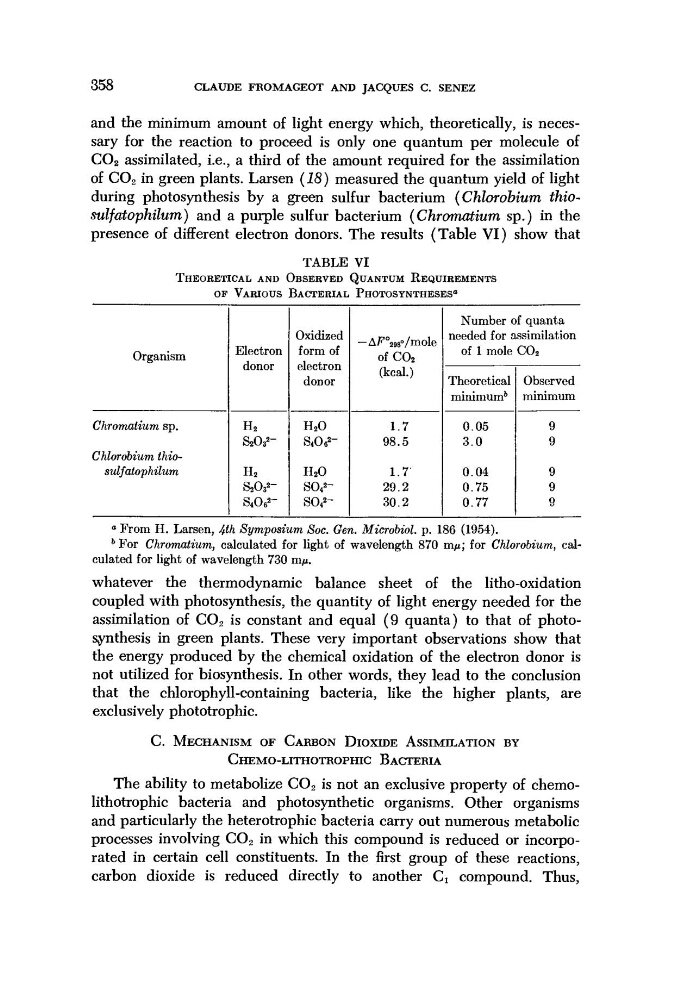
and the minimum amount of light energy which, theoretically, is necessary for the reaction to proceed is only one quantum per molecule of
C0 2 assimilated, i.e., a third of the amount required for the assimilation
of C0 2 in green plants. Larsen (18) measured the quantum yield of light
during photosynthesis by a green sulfur bacterium (Chlorobium thiosulfatophilum) and a purple sulfur bacterium (Chromatium sp.) in the
presence of different electron donors. The results (Table VI) show that
TABLE VI
THEORETICAL AND OBSERVED QUANTUM REQUIREMENTS
OF VARIOUS BACTERIAL PHOTOSYNTHESES
0
Organism
Chromatium sp.
Chlorobium thiosulfatophilum
Electron
donor
H 2
S2O3
2 -
H 2
S2O3
2 -
S 4 0 6
2 -
Oxidized
form of
electron
donor
H 2 0
s 4 o 6 *H 2 0
S0 4
2 "
S0 4
2 -
—AF°298°/mole
of C0 2
(kcal.)
1.7
98.5
1.7
29.2
30.2
Number of quanta
needed for assimilation
of 1 mole C0 2
Theoretical
minimum
6
0.05
3.0
0.04
0.75
0.77
Observed
minimum
9
9
9
9
9
α From H. Larsen, 4th Symposium Soc. Gen. Microbiol. p. 186 (1954).
6 For Chromatium, calculated for light of wavelength 870 m/x; for Chlorobium, calculated for light of wavelength 730 τημ.
whatever the thermodynamic balance sheet of the litho-oxidation
coupled with photosynthesis, the quantity of light energy needed for the
assimilation of C0 2 is constant and equal (9 quanta) to that of photosynthesis in green plants. These very important observations show that
the energy produced by the chemical oxidation of the electron donor is
not utilized for biosynthesis. In other words, they lead to the conclusion
that the chlorophyll-containing bacteria, like the higher plants, are
exclusively phototrophic.
C. MECHANISM OF CARBON DIOXIDE ASSIMILATION BY
CHEMO-LITHOTROPHIC BACTERIA
The ability to metabolize C0 2 is not an exclusive property of chemolithotrophic bacteria and photosynthetic organisms. Other organisms
and particularly the heterotrophic bacteria carry out numerous metabolic
processes involving C0 2 in which this compound is reduced or incorporated in certain cell constituents. In the first group of these reactions,
carbon dioxide is reduced directly to another d compound. Thus,
CLAUDE FROMAGEOT AND JACQUES C. SENEZ
and the minimum amount of light energy which, theoretically, is necessary for the reaction to proceed is only one quantum per molecule of
C0 2 assimilated, i.e., a third of the amount required for the assimilation
of C0 2 in green plants. Larsen (18) measured the quantum yield of light
during photosynthesis by a green sulfur bacterium (Chlorobium thiosulfatophilum) and a purple sulfur bacterium (Chromatium sp.) in the
presence of different electron donors. The results (Table VI) show that
TABLE VI
THEORETICAL AND OBSERVED QUANTUM REQUIREMENTS
OF VARIOUS BACTERIAL PHOTOSYNTHESES
0
Organism
Chromatium sp.
Chlorobium thiosulfatophilum
Electron
donor
H 2
S2O3
2 -
H 2
S2O3
2 -
S 4 0 6
2 -
Oxidized
form of
electron
donor
H 2 0
s 4 o 6 *H 2 0
S0 4
2 "
S0 4
2 -
—AF°298°/mole
of C0 2
(kcal.)
1.7
98.5
1.7
29.2
30.2
Number of quanta
needed for assimilation
of 1 mole C0 2
Theoretical
minimum
6
0.05
3.0
0.04
0.75
0.77
Observed
minimum
9
9
9
9
9
α From H. Larsen, 4th Symposium Soc. Gen. Microbiol. p. 186 (1954).
6 For Chromatium, calculated for light of wavelength 870 m/x; for Chlorobium, calculated for light of wavelength 730 τημ.
whatever the thermodynamic balance sheet of the litho-oxidation
coupled with photosynthesis, the quantity of light energy needed for the
assimilation of C0 2 is constant and equal (9 quanta) to that of photosynthesis in green plants. These very important observations show that
the energy produced by the chemical oxidation of the electron donor is
not utilized for biosynthesis. In other words, they lead to the conclusion
that the chlorophyll-containing bacteria, like the higher plants, are
exclusively phototrophic.
C. MECHANISM OF CARBON DIOXIDE ASSIMILATION BY
CHEMO-LITHOTROPHIC BACTERIA
The ability to metabolize C0 2 is not an exclusive property of chemolithotrophic bacteria and photosynthetic organisms. Other organisms
and particularly the heterotrophic bacteria carry out numerous metabolic
processes involving C0 2 in which this compound is reduced or incorporated in certain cell constituents. In the first group of these reactions,
carbon dioxide is reduced directly to another d compound. Thus,