

8. REACTIONS OF INORGANIC SUBSTANCES
355
the same unit efficiency for the two biosynthetic systems. The poor energy efficiency of the autotrophs can certainly be explained in large
measure by this consideration.
Moreover, it is worth emphasizing, as was done by Lees (14), that
the free energy efficiencies calculated by Baas-Becking and Parks correspond on the whole to metabolic balance sheets derived from old
cultures incubated for several weeks. Under these conditions the endogenous respiration of the bacteria is quite an appreciable factor, and the
quantity of carbon found in cell constituents at the end of the incubation is the difference between the quantity of carbon dioxide actually
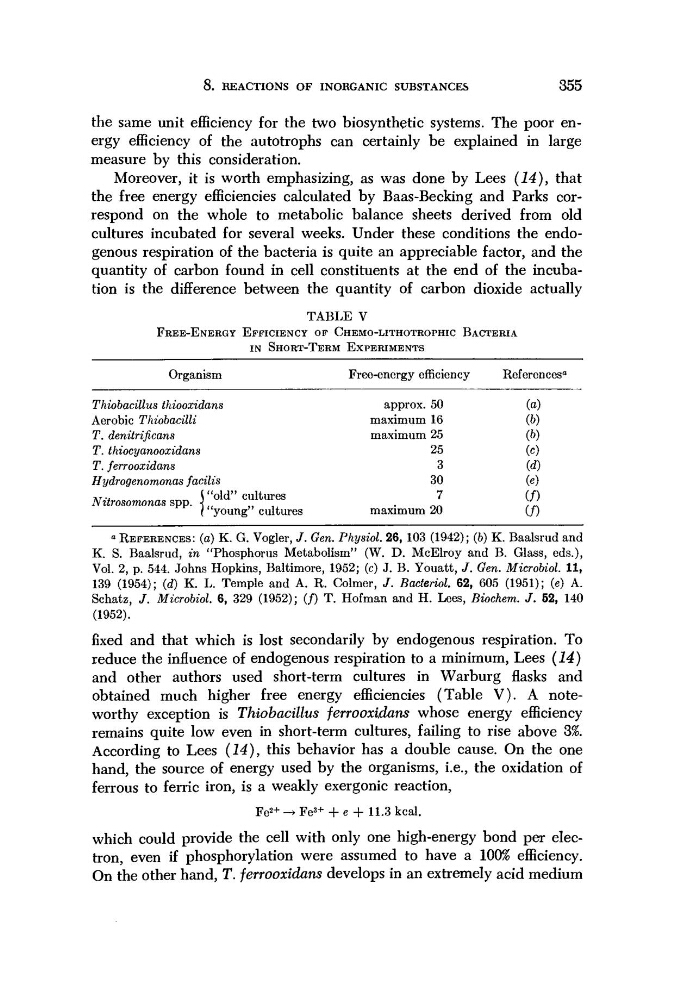
TABLE V
FREE-ENERGY EFFICIENCY OF CHEMO-LITHOTROPHIC BACTERIA
IN SHORT-TERM EXPERIMENTS
Organism
Thiobacillus thiooxidans
Aerobic Thiobacilli
T. denitrificans
T. thiocyanooxidans
T. ferrooxidans
Hydrogenomonas facilis
Nitrosomonas spp. \ „
I "you]
' cultures
rig" cultures
Free-energy efficiency
approx. 50
maximum 16
maximum 25
25
3
30
7
maximum 20
References"
(a)
(b)
(b)
(e)
(d)
(fl)
(/)
(/)
° REFERENCES: (a) K. G. Vogler, /. Gen. Physiol. 26, 103 (1942); (6) K. Baalsrud and
K. S. Baalsrud, in "Phosphorus Metabolism" (W. D. McElroy and B. Glass, eds.),
Vol. 2, p. 544. Johns Hopkins, Baltimore, 1952; (c) J. B. Youatt, J. Gen. Microhiol. 11,
139 (1954); (d) K. L. Temple and A. R. Colmer, J. Bacteriol. 62, 605 (1951); (e) A.
Schatz, /. Microhiol. 6, 329 (1952); (/) T. Hofman and H. Lees, Biochem. J. 52, 140
(1952).
fixed and that which is lost secondarily by endogenous respiration. To
reduce the influence of endogenous respiration to a minimum, Lees (14)
and other authors used short-term cultures in Warburg flasks and
obtained much higher free energy efficiencies (Table V). A noteworthy exception is Thiobacillus ferrooxidans whose energy efficiency
remains quite low even in short-term cultures, failing to rise above 3%.
According to Lees (14), this behavior has a double cause. On the one
hand, the source of energy used by the organisms, i.e., the oxidation of
ferrous to ferric iron, is a weakly exergonic reaction,
Fe
2+ -> Fe
3+ + e + 11.3 kcal.
which could provide the cell with only one high-energy bond per electron, even if phosphorylation were assumed to have a 100% efficiency.
On the other hand, T. ferrooxidans develops in an extremely acid medium
355
the same unit efficiency for the two biosynthetic systems. The poor energy efficiency of the autotrophs can certainly be explained in large
measure by this consideration.
Moreover, it is worth emphasizing, as was done by Lees (14), that
the free energy efficiencies calculated by Baas-Becking and Parks correspond on the whole to metabolic balance sheets derived from old
cultures incubated for several weeks. Under these conditions the endogenous respiration of the bacteria is quite an appreciable factor, and the
quantity of carbon found in cell constituents at the end of the incubation is the difference between the quantity of carbon dioxide actually
TABLE V
FREE-ENERGY EFFICIENCY OF CHEMO-LITHOTROPHIC BACTERIA
IN SHORT-TERM EXPERIMENTS
Organism
Thiobacillus thiooxidans
Aerobic Thiobacilli
T. denitrificans
T. thiocyanooxidans
T. ferrooxidans
Hydrogenomonas facilis
Nitrosomonas spp. \ „
I "you]
' cultures
rig" cultures
Free-energy efficiency
approx. 50
maximum 16
maximum 25
25
3
30
7
maximum 20
References"
(a)
(b)
(b)
(e)
(d)
(fl)
(/)
(/)
° REFERENCES: (a) K. G. Vogler, /. Gen. Physiol. 26, 103 (1942); (6) K. Baalsrud and
K. S. Baalsrud, in "Phosphorus Metabolism" (W. D. McElroy and B. Glass, eds.),
Vol. 2, p. 544. Johns Hopkins, Baltimore, 1952; (c) J. B. Youatt, J. Gen. Microhiol. 11,
139 (1954); (d) K. L. Temple and A. R. Colmer, J. Bacteriol. 62, 605 (1951); (e) A.
Schatz, /. Microhiol. 6, 329 (1952); (/) T. Hofman and H. Lees, Biochem. J. 52, 140
(1952).
fixed and that which is lost secondarily by endogenous respiration. To
reduce the influence of endogenous respiration to a minimum, Lees (14)
and other authors used short-term cultures in Warburg flasks and
obtained much higher free energy efficiencies (Table V). A noteworthy exception is Thiobacillus ferrooxidans whose energy efficiency
remains quite low even in short-term cultures, failing to rise above 3%.
According to Lees (14), this behavior has a double cause. On the one
hand, the source of energy used by the organisms, i.e., the oxidation of
ferrous to ferric iron, is a weakly exergonic reaction,
Fe
2+ -> Fe
3+ + e + 11.3 kcal.
which could provide the cell with only one high-energy bond per electron, even if phosphorylation were assumed to have a 100% efficiency.
On the other hand, T. ferrooxidans develops in an extremely acid medium