

342
GEORGE WALD
to living organisms; the proof is that we have one. It is also enormously
advantageous. Being both possible and advantageous, given enough
time, it is inevitable.
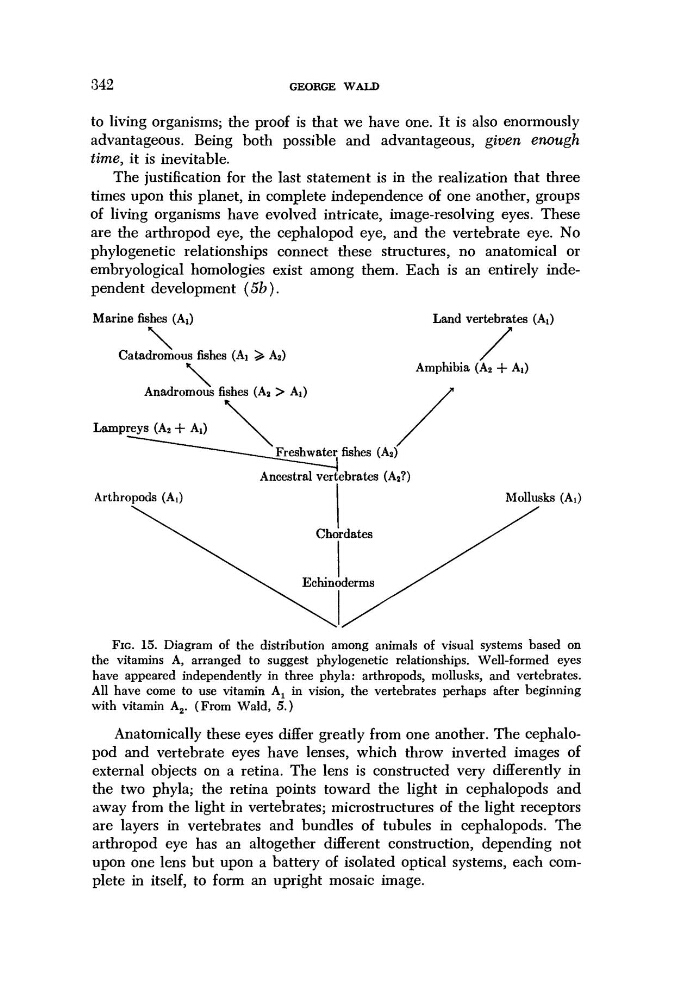
The justification for the last statement is in the realization that three
times upon this planet, in complete independence of one another, groups
of living organisms have evolved intricate, image-resolving eyes. These
are the arthropod eye, the cephalopod eye, and the vertebrate eye. No
phylogenetic relationships connect these structures, no anatomical or
embryological homologies exist among them. Each is an entirely independent development (5b).
Marine fishes (Ai)
Land vertebrates (Ai)
Catadromous fishes (Ai > A 2 )
\
Anadromous fishes (A 2 > Ai)
Lampreys (A 2 + Ai)
Amphibia (A 2 + A x )
Freshwater fishes (A 2 )
Ancestral vertebrates (A 2 ?)
Arthropods (Ai)
Mollusks (Ai)
FIG. 15. Diagram of the distribution among animals of visual systems based on
the vitamins A, arranged to suggest phylogenetic relationships. Well-formed eyes
have appeared independently in three phyla: arthropods, mollusks, and vertebrates.
All have come to use vitamin A x in vision, the vertebrates perhaps after beginning
with vitamin A 2 . (From Wald, 5.)
Anatomically these eyes differ greatly from one another. The cephalopod and vertebrate eyes have lenses, which throw inverted images of
external objects on a retina. The lens is constructed very differently in
the two phyla; the retina points toward the light in cephalopods and
away from the light in vertebrates; microstructures of the light receptors
are layers in vertebrates and bundles of tubules in cephalopods. The
arthropod eye has an altogether different construction, depending not
upon one lens but upon a battery of isolated optical systems, each complete in itself, to form an upright mosaic image.
GEORGE WALD
to living organisms; the proof is that we have one. It is also enormously
advantageous. Being both possible and advantageous, given enough
time, it is inevitable.
The justification for the last statement is in the realization that three
times upon this planet, in complete independence of one another, groups
of living organisms have evolved intricate, image-resolving eyes. These
are the arthropod eye, the cephalopod eye, and the vertebrate eye. No
phylogenetic relationships connect these structures, no anatomical or
embryological homologies exist among them. Each is an entirely independent development (5b).
Marine fishes (Ai)
Land vertebrates (Ai)
Catadromous fishes (Ai > A 2 )
\
Anadromous fishes (A 2 > Ai)
Lampreys (A 2 + Ai)
Amphibia (A 2 + A x )
Freshwater fishes (A 2 )
Ancestral vertebrates (A 2 ?)
Arthropods (Ai)
Mollusks (Ai)
FIG. 15. Diagram of the distribution among animals of visual systems based on
the vitamins A, arranged to suggest phylogenetic relationships. Well-formed eyes
have appeared independently in three phyla: arthropods, mollusks, and vertebrates.
All have come to use vitamin A x in vision, the vertebrates perhaps after beginning
with vitamin A 2 . (From Wald, 5.)
Anatomically these eyes differ greatly from one another. The cephalopod and vertebrate eyes have lenses, which throw inverted images of
external objects on a retina. The lens is constructed very differently in
the two phyla; the retina points toward the light in cephalopods and
away from the light in vertebrates; microstructures of the light receptors
are layers in vertebrates and bundles of tubules in cephalopods. The
arthropod eye has an altogether different construction, depending not
upon one lens but upon a battery of isolated optical systems, each complete in itself, to form an upright mosaic image.