

7. THE DISTRIBUTION AND EVOLUTION OF VISUAL SYSTEMS
339
not involve any genetic connection. The eyes of arthropods, mollusks,
and vertebrates are entirely separate developments, each the product of
its own evolution. No anatomical or embryological homologies connect
these organs with one another; nor does anyone now suppose that either
arthropods or mollusks were ancestors of the vertebrates. That all three
phyla, with their very different eyes, should have come to the same
substance, vitamin A—indeed, neo-b vitamin A—as the foundation of
their visual systems poses in its most acute form the question: what
constitutes the peculiar fitness of this molecule for vision? I have attempted to approach this question in the introductory section of the
present paper.
The first such system to be worked out was that of the squid, Loligo
pealii. Wald had found vitamin A x and retinenei in this retina, and
showed that on illumination a small amount of retinene was liberated
from a photosensitive combination with protein. Vitamin A itself did
not appear to take part immediately in this transformation. The entire
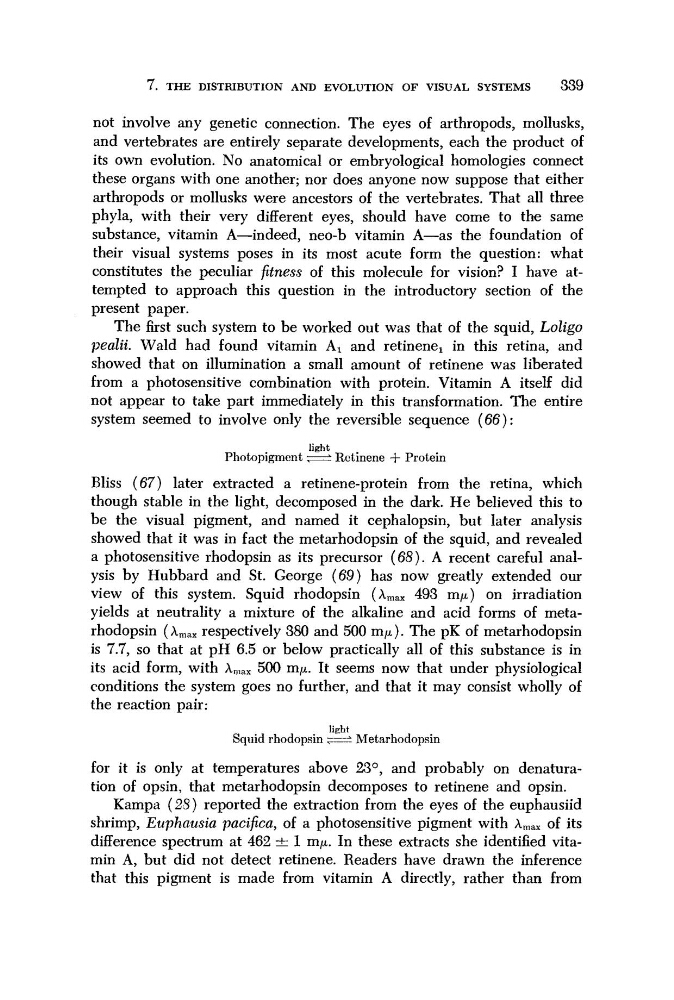
system seemed to involve only the reversible sequence (66):
light
Photopigment ;=± Retinene + Protein
Bliss (67) later extracted a retinene-protein from the retina, which
though stable in the light, decomposed in the dark. He believed this to
be the visual pigment, and named it cephalopsin, but later analysis
showed that it was in fact the metarhodopsin of the squid, and revealed
a photosensitive rhodopsin as its precursor (68). A recent careful analysis by Hubbard and St. George (69) has now greatly extended our
view of this system. Squid rhodopsin (A max 493 τημ) on irradiation
yields at neutrality a mixture of the alkaline and acid forms of metarhodopsin (A max respectively 380 and 500 πΐμ). The pK of metarhodopsin
is 7.7, so that at pH 6.5 or below practically all of this substance is in
its acid form, with A max 500 τημ. It seems now that under physiological
conditions the system goes no further, and that it may consist wholly of
the reaction pair:
light
Squid rhodopsin ,
Metarhodopsin
for it is only at temperatures above 23°, and probably on denaturation of opsin, that metarhodopsin decomposes to retinene and opsin.
Kampa (28) reported the extraction from the eyes of the euphausiid
shrimp, Euphausia pacified, of a photosensitive pigment with A max of its
difference spectrum at 462 ± 1 τημ. In these extracts she identified vitamin A, but did not detect retinene. Readers have drawn the inference
that this pigment is made from vitamin A directly, rather than from
339
not involve any genetic connection. The eyes of arthropods, mollusks,
and vertebrates are entirely separate developments, each the product of
its own evolution. No anatomical or embryological homologies connect
these organs with one another; nor does anyone now suppose that either
arthropods or mollusks were ancestors of the vertebrates. That all three
phyla, with their very different eyes, should have come to the same
substance, vitamin A—indeed, neo-b vitamin A—as the foundation of
their visual systems poses in its most acute form the question: what
constitutes the peculiar fitness of this molecule for vision? I have attempted to approach this question in the introductory section of the
present paper.
The first such system to be worked out was that of the squid, Loligo
pealii. Wald had found vitamin A x and retinenei in this retina, and
showed that on illumination a small amount of retinene was liberated
from a photosensitive combination with protein. Vitamin A itself did
not appear to take part immediately in this transformation. The entire
system seemed to involve only the reversible sequence (66):
light
Photopigment ;=± Retinene + Protein
Bliss (67) later extracted a retinene-protein from the retina, which
though stable in the light, decomposed in the dark. He believed this to
be the visual pigment, and named it cephalopsin, but later analysis
showed that it was in fact the metarhodopsin of the squid, and revealed
a photosensitive rhodopsin as its precursor (68). A recent careful analysis by Hubbard and St. George (69) has now greatly extended our
view of this system. Squid rhodopsin (A max 493 τημ) on irradiation
yields at neutrality a mixture of the alkaline and acid forms of metarhodopsin (A max respectively 380 and 500 πΐμ). The pK of metarhodopsin
is 7.7, so that at pH 6.5 or below practically all of this substance is in
its acid form, with A max 500 τημ. It seems now that under physiological
conditions the system goes no further, and that it may consist wholly of
the reaction pair:
light
Squid rhodopsin ,
Metarhodopsin
for it is only at temperatures above 23°, and probably on denaturation of opsin, that metarhodopsin decomposes to retinene and opsin.
Kampa (28) reported the extraction from the eyes of the euphausiid
shrimp, Euphausia pacified, of a photosensitive pigment with A max of its
difference spectrum at 462 ± 1 τημ. In these extracts she identified vitamin A, but did not detect retinene. Readers have drawn the inference
that this pigment is made from vitamin A directly, rather than from