

7. THE DISTRIBUTION AND EVOLUTION OF VISUAL SYSTEMS
325
dromous fish as one that, having spawned in fresh water, has the
capacity as an adult to migrate to the sea. A catadromous fish is one
that, having spawned in the sea, is able as an adult to migrate into fresh
water (30).
The examination of visual systems in such forms some years ago revealed the following situation. Members of three genera of salmonids
(the Eastern brook trout, the Pacific coast rainbow trout, and the
Pacific king salmon) all possess in their retinas mixtures of vitamins A a
and A 2 , of rhodopsin and porphyropsin, predominantly the latter—the
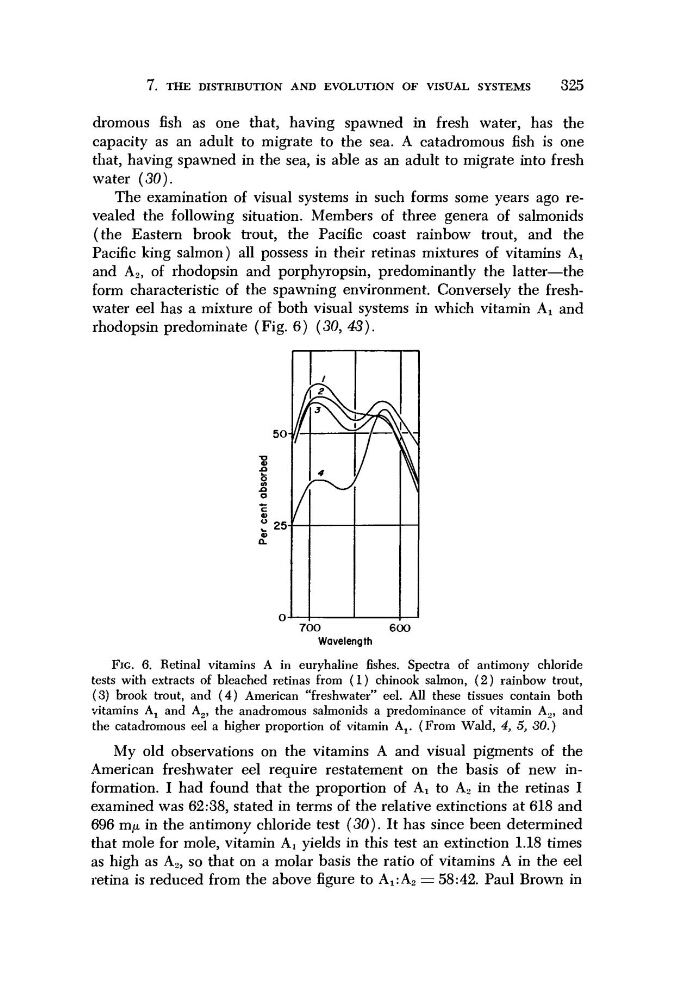
form characteristic of the spawning environment. Conversely the freshwater eel has a mixture of both visual systems in which vitamin Ai and
rhodopsin predominate (Fig. 6) (30, 43).
50
TJ
Φ
.o
o
ω
.o
σ
"c
a>
" 25
Φ
Q.
0
700
600
Wavelength
FIG. 6. Retinal vitamins A in euryhaline fishes. Spectra of antimony chloride
tests with extracts of bleached retinas from (1) chinook salmon, (2) rainbow trout,
(3) brook trout, and (4) American "freshwater" eel. All these tissues contain both
vitamins A 2 and A 2 , the anadromous salmonids a predominance of vitamin A 2 , and
the catadromous eel a higher proportion of vitamin A r (From Wald, 4, 5, 30.)
My old observations on the vitamins A and visual pigments of the
American freshwater eel require restatement on the basis of new information. I had found that the proportion of Ai to A 2 in the retinas I
examined was 62:38, stated in terms of the relative extinctions at 618 and
696 πΐμ in the antimony chloride test (30). It has since been determined
that mole for mole, vitamin A x yields in this test an extinction 1.18 times
as high as A 2 , so that on a molar basis the ratio of vitamins A in the eel
retina is reduced from the above figure to Ai:A 2 = 58:42. Paul Brown in
325
dromous fish as one that, having spawned in fresh water, has the
capacity as an adult to migrate to the sea. A catadromous fish is one
that, having spawned in the sea, is able as an adult to migrate into fresh
water (30).
The examination of visual systems in such forms some years ago revealed the following situation. Members of three genera of salmonids
(the Eastern brook trout, the Pacific coast rainbow trout, and the
Pacific king salmon) all possess in their retinas mixtures of vitamins A a
and A 2 , of rhodopsin and porphyropsin, predominantly the latter—the
form characteristic of the spawning environment. Conversely the freshwater eel has a mixture of both visual systems in which vitamin Ai and
rhodopsin predominate (Fig. 6) (30, 43).
50
TJ
Φ
.o
o
ω
.o
σ
"c
a>
" 25
Φ
Q.
0
700
600
Wavelength
FIG. 6. Retinal vitamins A in euryhaline fishes. Spectra of antimony chloride
tests with extracts of bleached retinas from (1) chinook salmon, (2) rainbow trout,
(3) brook trout, and (4) American "freshwater" eel. All these tissues contain both
vitamins A 2 and A 2 , the anadromous salmonids a predominance of vitamin A 2 , and
the catadromous eel a higher proportion of vitamin A r (From Wald, 4, 5, 30.)
My old observations on the vitamins A and visual pigments of the
American freshwater eel require restatement on the basis of new information. I had found that the proportion of Ai to A 2 in the retinas I
examined was 62:38, stated in terms of the relative extinctions at 618 and
696 πΐμ in the antimony chloride test (30). It has since been determined
that mole for mole, vitamin A x yields in this test an extinction 1.18 times
as high as A 2 , so that on a molar basis the ratio of vitamins A in the eel
retina is reduced from the above figure to Ai:A 2 = 58:42. Paul Brown in