

322
GEORGE WALD
Kampa has since reported finding porphyropsin, retinene 2 , and vitamin
A 2 in two species of the family Coridae, caught near Bermuda (37); and
goes on to say, "The position of this family is in considerable doubt,
and certain taxonomists feel that it should be included in the family
Labridae." Recently Munz (38) has reported finding a Pacific coast
labrid, the sheepshead, possessing a rhodopsin (i.e., a vitamin A x pigment) in its retina with A max 497 m/x, accompanied by a small amount of
i.o| 0.5c
X
LÜ
o700
600
Wavelength (ιτημ)
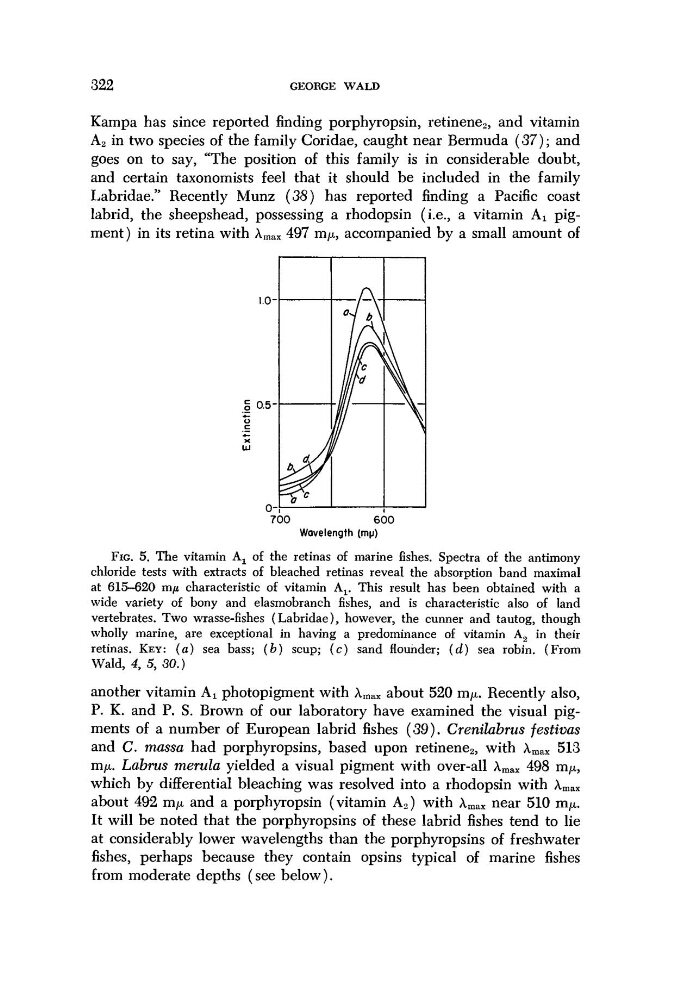
FIG. 5. The vitamin Α χ of the retinas of marine fishes. Spectra of the antimony
chloride tests with extracts of bleached retinas reveal the absorption band maximal
at 615-620 τημ characteristic of vitamin A r This result has been obtained with a
wide variety of bony and elasmobranch fishes, and is characteristic also of land
vertebrates. Two wrasse-fishes (Labridae), however, the cunner and tautog, though
wholly marine, are exceptional in having a predominance of vitamin A 2 in their
retinas. KEY: (a) sea bass; (b) scup; (c) sand flounder; (d) sea robin. (From
Wald, 4, 5, 30.)
another vitamin Ai photopigment with A max about 520 τημ. Recently also,
P. K. and P. S. Brown of our laboratory have examined the visual pigments of a number of European labrid fishes (39). Crenilabrus festivas
and C. massa had porphyropsins, based upon retinene 2 , with A max 513
πΐμ. Labrus merula yielded a visual pigment with over-all A max 498 m/x,
which by differential bleaching was resolved into a rhodopsin with A max
about 492 π\μ and a porphyropsin (vitamin A 2 ) with A max near 510 π\μ.
It will be noted that the porphyropsins of these labrid fishes tend to lie
at considerably lower wavelengths than the porphyropsins of freshwater
fishes, perhaps because they contain opsins typical of marine fishes
from moderate depths (see below).
GEORGE WALD
Kampa has since reported finding porphyropsin, retinene 2 , and vitamin
A 2 in two species of the family Coridae, caught near Bermuda (37); and
goes on to say, "The position of this family is in considerable doubt,
and certain taxonomists feel that it should be included in the family
Labridae." Recently Munz (38) has reported finding a Pacific coast
labrid, the sheepshead, possessing a rhodopsin (i.e., a vitamin A x pigment) in its retina with A max 497 m/x, accompanied by a small amount of
i.o| 0.5c
X
LÜ
o700
600
Wavelength (ιτημ)
FIG. 5. The vitamin Α χ of the retinas of marine fishes. Spectra of the antimony
chloride tests with extracts of bleached retinas reveal the absorption band maximal
at 615-620 τημ characteristic of vitamin A r This result has been obtained with a
wide variety of bony and elasmobranch fishes, and is characteristic also of land
vertebrates. Two wrasse-fishes (Labridae), however, the cunner and tautog, though
wholly marine, are exceptional in having a predominance of vitamin A 2 in their
retinas. KEY: (a) sea bass; (b) scup; (c) sand flounder; (d) sea robin. (From
Wald, 4, 5, 30.)
another vitamin Ai photopigment with A max about 520 τημ. Recently also,
P. K. and P. S. Brown of our laboratory have examined the visual pigments of a number of European labrid fishes (39). Crenilabrus festivas
and C. massa had porphyropsins, based upon retinene 2 , with A max 513
πΐμ. Labrus merula yielded a visual pigment with over-all A max 498 m/x,
which by differential bleaching was resolved into a rhodopsin with A max
about 492 π\μ and a porphyropsin (vitamin A 2 ) with A max near 510 π\μ.
It will be noted that the porphyropsins of these labrid fishes tend to lie
at considerably lower wavelengths than the porphyropsins of freshwater
fishes, perhaps because they contain opsins typical of marine fishes
from moderate depths (see below).