

312
GEORGE WALD
tion to which animals and plants are sensitive. The spectrum of electromagnetic radiation covers the enormous range of about 10
16 in wavelength, from gamma rays 10~
10 cm. long to radio waves several kilometers long. Within this vast domain, the radiations that stimulate
phototropism and vision include the almost negligible range of about 1
to 2 (about 350-700 τημ). Why just this range of wavelengths? The answer is that these responses of living organisms are adapted to sunlight.
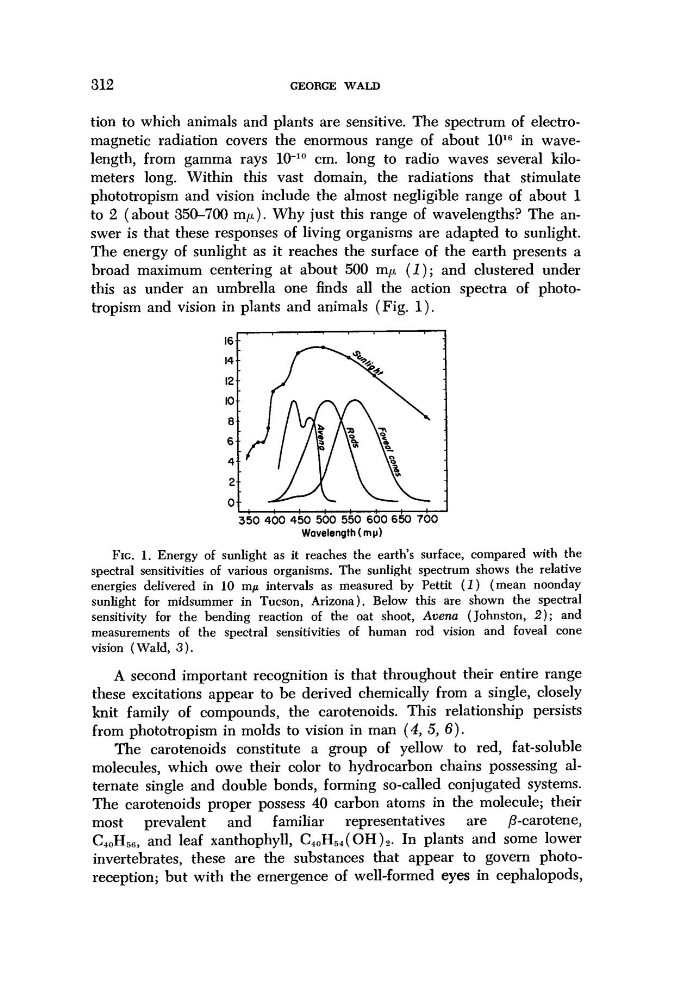
The energy of sunlight as it reaches the surface of the earth presents a
broad maximum centering at about 500 πΐμ (I); and clustered under
this as under an umbrella one finds all the action spectra of phototropism and vision in plants and animals (Fig. 1).
350 400 450 500 550 600 650 700
Wavelength (mp)
FIG. 1. Energy of sunlight as it reaches the earth's surface, compared with the
spectral sensitivities of various organisms. The sunlight spectrum shows the relative
energies delivered in 10 ιημ intervals as measured by Pettit (1) (mean noonday
sunlight for midsummer in Tucson, Arizona). Below this are shown the spectral
sensitivity for the bending reaction of the oat shoot, Avena (Johnston, 2); and
measurements of the spectral sensitivities of human rod vision and foveal cone
vision (Wald, 3).
A second important recognition is that throughout their entire range
these excitations appear to be derived chemically from a single, closely
knit family of compounds, the carotenoids. This relationship persists
from phototropism in molds to vision in man (4, 5, 6).
The carotenoids constitute a group of yellow to red, fat-soluble
molecules, which owe their color to hydrocarbon chains possessing alternate single and double bonds, forming so-called conjugated systems.
The carotenoids proper possess 40 carbon atoms in the molecule; their
most prevalent
and familiar
representatives
are
ß-carotene,
C 40 H 56 , and leaf xanthophyll, C^Hs^OH^. In plants and some lower
invertebrates, these are the substances that appear to govern photoreception; but with the emergence of well-formed eyes in cephalopods,
GEORGE WALD
tion to which animals and plants are sensitive. The spectrum of electromagnetic radiation covers the enormous range of about 10
16 in wavelength, from gamma rays 10~
10 cm. long to radio waves several kilometers long. Within this vast domain, the radiations that stimulate
phototropism and vision include the almost negligible range of about 1
to 2 (about 350-700 τημ). Why just this range of wavelengths? The answer is that these responses of living organisms are adapted to sunlight.
The energy of sunlight as it reaches the surface of the earth presents a
broad maximum centering at about 500 πΐμ (I); and clustered under
this as under an umbrella one finds all the action spectra of phototropism and vision in plants and animals (Fig. 1).
350 400 450 500 550 600 650 700
Wavelength (mp)
FIG. 1. Energy of sunlight as it reaches the earth's surface, compared with the
spectral sensitivities of various organisms. The sunlight spectrum shows the relative
energies delivered in 10 ιημ intervals as measured by Pettit (1) (mean noonday
sunlight for midsummer in Tucson, Arizona). Below this are shown the spectral
sensitivity for the bending reaction of the oat shoot, Avena (Johnston, 2); and
measurements of the spectral sensitivities of human rod vision and foveal cone
vision (Wald, 3).
A second important recognition is that throughout their entire range
these excitations appear to be derived chemically from a single, closely
knit family of compounds, the carotenoids. This relationship persists
from phototropism in molds to vision in man (4, 5, 6).
The carotenoids constitute a group of yellow to red, fat-soluble
molecules, which owe their color to hydrocarbon chains possessing alternate single and double bonds, forming so-called conjugated systems.
The carotenoids proper possess 40 carbon atoms in the molecule; their
most prevalent
and familiar
representatives
are
ß-carotene,
C 40 H 56 , and leaf xanthophyll, C^Hs^OH^. In plants and some lower
invertebrates, these are the substances that appear to govern photoreception; but with the emergence of well-formed eyes in cephalopods,