

300
KENNETH V. THIMANN AND GEORGE M. CURRY
CH2COOH hv + Rbf + 0 2 f
\
r.— CHO
Schardinger enzyme
y
-CO2 -H2O
l^.
"J
\\
+Η2Ο -2H
H
H
Indoleacetic acid
Indolealdehyde
COOH nhv + Rbf - 20 2 f
^_C00H
-2CO2
NH 2
IndolecarboxyHc acid
Anthranilic acid
(Π)
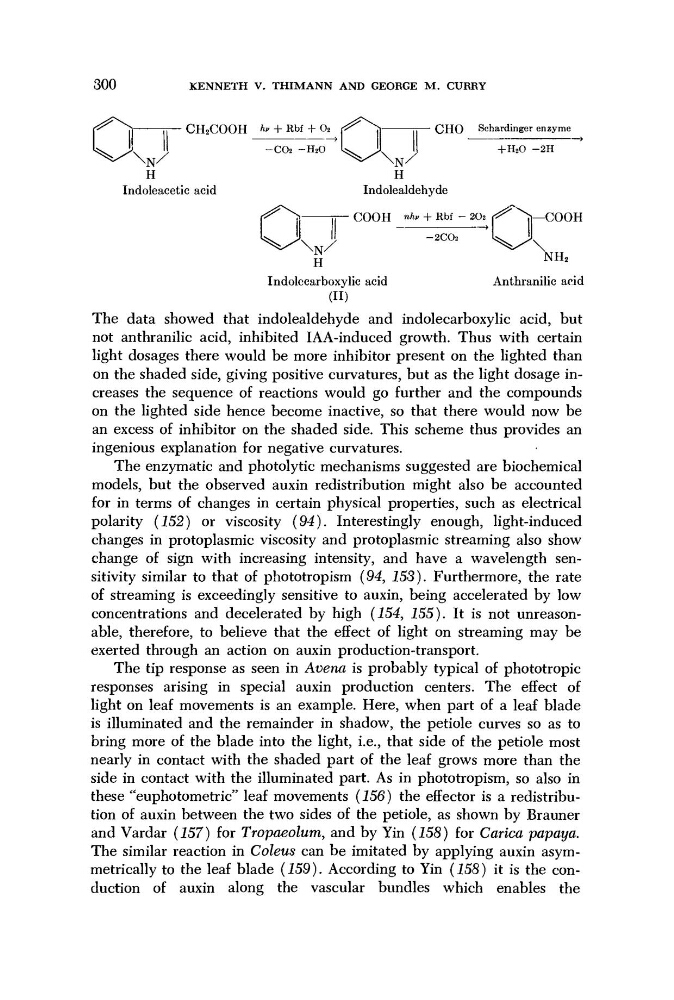
The data showed that indolealdehyde and indolecarboxylic acid, but
not anthranilic acid, inhibited IAA-induced growth. Thus with certain
light dosages there would be more inhibitor present on the lighted than
on the shaded side, giving positive curvatures, but as the light dosage increases the sequence of reactions would go further and the compounds
on the lighted side hence become inactive, so that there would now be
an excess of inhibitor on the shaded side. This scheme thus provides an
ingenious explanation for negative curvatures.
The enzymatic and photolytic mechanisms suggested are biochemical
models, but the observed auxin redistribution might also be accounted
for in terms of changes in certain physical properties, such as electrical
polarity (152) or viscosity (94). Interestingly enough, light-induced
changes in protoplasmic viscosity and protoplasmic streaming also show
change of sign with increasing intensity, and have a wavelength sensitivity similar to that of phototropism (94, 153). Furthermore, the rate
of streaming is exceedingly sensitive to auxin, being accelerated by low
concentrations and decelerated by high (154, 155). It is not unreasonable, therefore, to believe that the effect of light on streaming may be
exerted through an action on auxin production-transport.
The tip response as seen in Avena is probably typical of phototropic
responses arising in special auxin production centers. The effect of
light on leaf movements is an example. Here, when part of a leaf blade
is illuminated and the remainder in shadow, the petiole curves so as to
bring more of the blade into the light, i.e., that side of the petiole most
nearly in contact with the shaded part of the leaf grows more than the
side in contact with the illuminated part. As in phototropism, so also in
these "euphotometric" leaf movements (156) the effector is a redistribution of auxin between the two sides of the petiole, as shown by Brauner
and Vardar (157) for Tropaeolum, and by Yin (158) for Carica papaya.
The similar reaction in Coleus can be imitated by applying auxin asymmetrically to the leaf blade (159). According to Yin (158) it is the conduction of auxin along the vascular bundles which enables the
KENNETH V. THIMANN AND GEORGE M. CURRY
CH2COOH hv + Rbf + 0 2 f
\
r.— CHO
Schardinger enzyme
y
-CO2 -H2O
l^.
"J
\\
+Η2Ο -2H
H
H
Indoleacetic acid
Indolealdehyde
COOH nhv + Rbf - 20 2 f
^_C00H
-2CO2
NH 2
IndolecarboxyHc acid
Anthranilic acid
(Π)
The data showed that indolealdehyde and indolecarboxylic acid, but
not anthranilic acid, inhibited IAA-induced growth. Thus with certain
light dosages there would be more inhibitor present on the lighted than
on the shaded side, giving positive curvatures, but as the light dosage increases the sequence of reactions would go further and the compounds
on the lighted side hence become inactive, so that there would now be
an excess of inhibitor on the shaded side. This scheme thus provides an
ingenious explanation for negative curvatures.
The enzymatic and photolytic mechanisms suggested are biochemical
models, but the observed auxin redistribution might also be accounted
for in terms of changes in certain physical properties, such as electrical
polarity (152) or viscosity (94). Interestingly enough, light-induced
changes in protoplasmic viscosity and protoplasmic streaming also show
change of sign with increasing intensity, and have a wavelength sensitivity similar to that of phototropism (94, 153). Furthermore, the rate
of streaming is exceedingly sensitive to auxin, being accelerated by low
concentrations and decelerated by high (154, 155). It is not unreasonable, therefore, to believe that the effect of light on streaming may be
exerted through an action on auxin production-transport.
The tip response as seen in Avena is probably typical of phototropic
responses arising in special auxin production centers. The effect of
light on leaf movements is an example. Here, when part of a leaf blade
is illuminated and the remainder in shadow, the petiole curves so as to
bring more of the blade into the light, i.e., that side of the petiole most
nearly in contact with the shaded part of the leaf grows more than the
side in contact with the illuminated part. As in phototropism, so also in
these "euphotometric" leaf movements (156) the effector is a redistribution of auxin between the two sides of the petiole, as shown by Brauner
and Vardar (157) for Tropaeolum, and by Yin (158) for Carica papaya.
The similar reaction in Coleus can be imitated by applying auxin asymmetrically to the leaf blade (159). According to Yin (158) it is the conduction of auxin along the vascular bundles which enables the