

6. PHOTOTROPISM AND PHOTOTAXIS
291
1.4 r"
1.21—
1.0
£ 0.8
■£ 0.6 k0.4 r0.2 H
|—i
1
1
ι
[Γ
[h ° -'''/
t » \ / /
F
^~y
V\^y Γ" ■
H
Γ
1
1
1
1
1
—r
1
1
1
1
1
0
0
o / ^9
\
\
\
\
t
\
\
\
\
\
>
V
x
*,
_j
i
ι
x T-»
i
i
T
1
1 q
-J
H
J
H
H
-Ί
η
~H
-J
^.^^
"1
1
1
1 V
235 240 250 260 270 280 290 300 310 320 330 340 350 360 365
Wavelength in π\μ
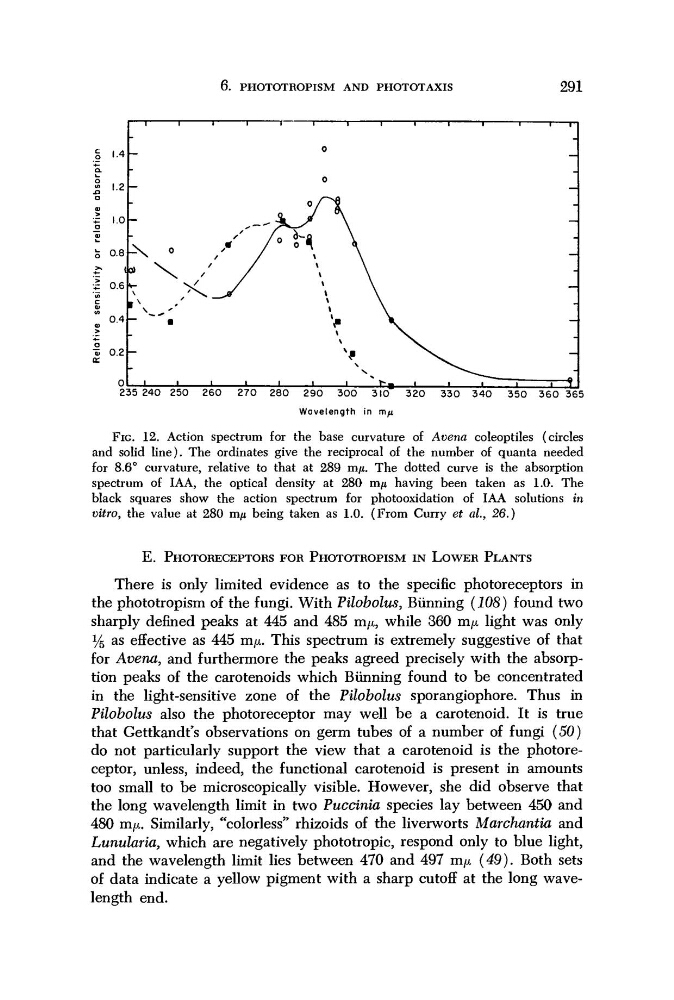
FIG. 12. Action spectrum for the base curvature of Avena coleoptiles (circles
and solid line). The ordinates give the reciprocal of the number of quanta needed
for 8.6° curvature, relative to that at 289 τημ. The dotted curve is the absorption
spectrum of IA A, the optical density at 280 τημ having been taken as 1.0. The
black squares show the action spectrum for photooxidation of IAA solutions in
vitro, the value at 280 πΐμ being taken as 1.0. (From Curry et al., 26.)
E. PHOTORECEPTORS FOR PHOTOTROPISM IN LOWER PLANTS
There is only limited evidence as to the specific photoreceptors in
the phototropism of the fungi. With Pilobolus, Biinning (108) found two
sharply defined peaks at 445 and 485 m/x, while 360 m/x light was only
y 5 as effective as 445 πΐμ. This spectrum is extremely suggestive of that
for Avena, and furthermore the peaks agreed precisely with the absorption peaks of the carotenoids which Biinning found to be concentrated
in the light-sensitive zone of the Pilobolus sporangiophore. Thus in
Pilobolus also the photoreceptor may well be a carotenoid. It is true
that Gettkandt's observations on germ tubes of a number of fungi (50)
do not particularly support the view that a carotenoid is the photoreceptor, unless, indeed, the functional carotenoid is present in amounts
too small to be microscopically visible. However, she did observe that
the long wavelength limit in two Puccinia species lay between 450 and
480 τημ. Similarly, "colorless" rhizoids of the liverworts Marchantia and
Lunularia, which are negatively phototropic, respond only to blue light,
and the wavelength limit lies between 470 and 497 m/x (49). Both sets
of data indicate a yellow pigment with a sharp cutoff at the long wavelength end.
291
1.4 r"
1.21—
1.0
£ 0.8
■£ 0.6 k0.4 r0.2 H
|—i
1
1
ι
[Γ
[h ° -'''/
t » \ / /
F
^~y
V\^y Γ" ■
H
Γ
1
1
1
1
1
—r
1
1
1
1
1
0
0
o / ^9
\
\
\
\
t
\
\
\
\
\
>
V
x
*,
_j
i
ι
x T-»
i
i
T
1
1 q
-J
H
J
H
H
-Ί
η
~H
-J
^.^^
"1
1
1
1 V
235 240 250 260 270 280 290 300 310 320 330 340 350 360 365
Wavelength in π\μ
FIG. 12. Action spectrum for the base curvature of Avena coleoptiles (circles
and solid line). The ordinates give the reciprocal of the number of quanta needed
for 8.6° curvature, relative to that at 289 τημ. The dotted curve is the absorption
spectrum of IA A, the optical density at 280 τημ having been taken as 1.0. The
black squares show the action spectrum for photooxidation of IAA solutions in
vitro, the value at 280 πΐμ being taken as 1.0. (From Curry et al., 26.)
E. PHOTORECEPTORS FOR PHOTOTROPISM IN LOWER PLANTS
There is only limited evidence as to the specific photoreceptors in
the phototropism of the fungi. With Pilobolus, Biinning (108) found two
sharply defined peaks at 445 and 485 m/x, while 360 m/x light was only
y 5 as effective as 445 πΐμ. This spectrum is extremely suggestive of that
for Avena, and furthermore the peaks agreed precisely with the absorption peaks of the carotenoids which Biinning found to be concentrated
in the light-sensitive zone of the Pilobolus sporangiophore. Thus in
Pilobolus also the photoreceptor may well be a carotenoid. It is true
that Gettkandt's observations on germ tubes of a number of fungi (50)
do not particularly support the view that a carotenoid is the photoreceptor, unless, indeed, the functional carotenoid is present in amounts
too small to be microscopically visible. However, she did observe that
the long wavelength limit in two Puccinia species lay between 450 and
480 τημ. Similarly, "colorless" rhizoids of the liverworts Marchantia and
Lunularia, which are negatively phototropic, respond only to blue light,
and the wavelength limit lies between 470 and 497 m/x (49). Both sets
of data indicate a yellow pigment with a sharp cutoff at the long wavelength end.