

288
KENNETH V. THIMANN AND GEORGE M. CURRY
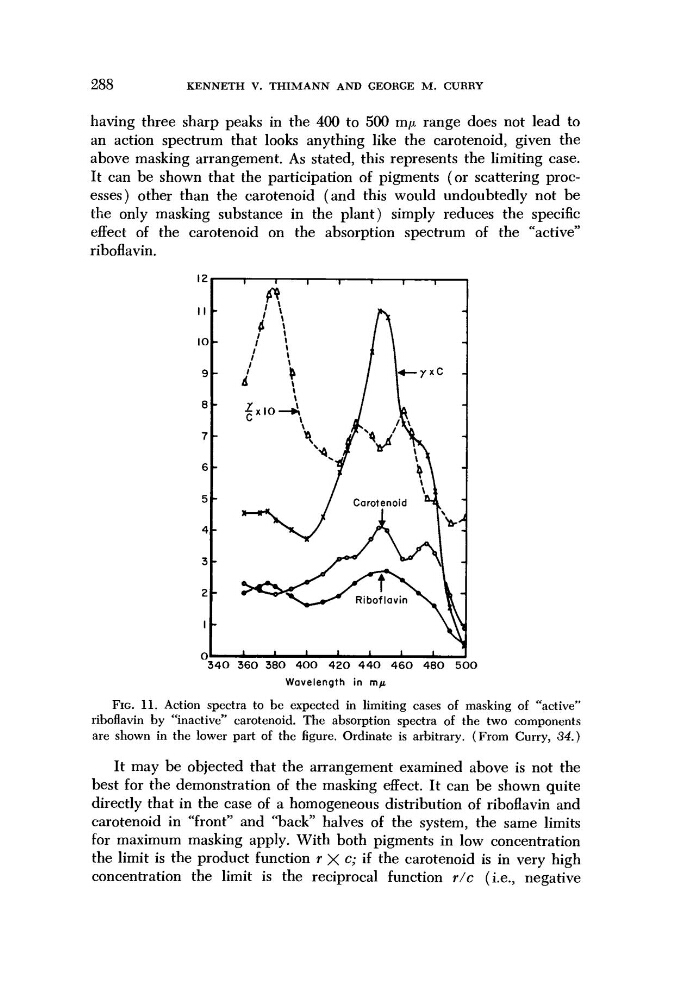
having three sharp peaks in the 400 to 500 m/x range does not lead to
an action spectrum that looks anything like the carotenoid, given the
above masking arrangement. As stated, this represents the limiting case.
It can be shown that the participation of pigments (or scattering processes) other than the carotenoid (and this would undoubtedly not be
the only masking substance in the plant) simply reduces the specific
effect of the carotenoid on the absorption spectrum of the "active"
riboflavin.
12
II
10
9
8
7
6
5
4
3
2
I
340 360 380 400 420 440 460 480 500
Wavelength in m/x
FIG. 11. Action spectra to be expected in limiting cases of masking of "active"
riboflavin by "inactive" carotenoid. The absorption spectra of the two components
are shown in the lower part of the figure. Ordinate is arbitrary. (From Curry, 34.)
It may be objected that the arrangement examined above is not the
best for the demonstration of the masking effect. It can be shown quite
directly that in the case of a homogeneous distribution of riboflavin and
carotenoid in "front" and "back" halves of the system, the same limits
for maximum masking apply. With both pigments in low concentration
the limit is the product function r X c; if the carotenoid is in very high
concentration the limit is the reciprocal function r/c (i.e., negative
KENNETH V. THIMANN AND GEORGE M. CURRY
having three sharp peaks in the 400 to 500 m/x range does not lead to
an action spectrum that looks anything like the carotenoid, given the
above masking arrangement. As stated, this represents the limiting case.
It can be shown that the participation of pigments (or scattering processes) other than the carotenoid (and this would undoubtedly not be
the only masking substance in the plant) simply reduces the specific
effect of the carotenoid on the absorption spectrum of the "active"
riboflavin.
12
II
10
9
8
7
6
5
4
3
2
I
340 360 380 400 420 440 460 480 500
Wavelength in m/x
FIG. 11. Action spectra to be expected in limiting cases of masking of "active"
riboflavin by "inactive" carotenoid. The absorption spectra of the two components
are shown in the lower part of the figure. Ordinate is arbitrary. (From Curry, 34.)
It may be objected that the arrangement examined above is not the
best for the demonstration of the masking effect. It can be shown quite
directly that in the case of a homogeneous distribution of riboflavin and
carotenoid in "front" and "back" halves of the system, the same limits
for maximum masking apply. With both pigments in low concentration
the limit is the product function r X c; if the carotenoid is in very high
concentration the limit is the reciprocal function r/c (i.e., negative