

6. PHOTOTROPISM AND PHOTOTAXIS
285
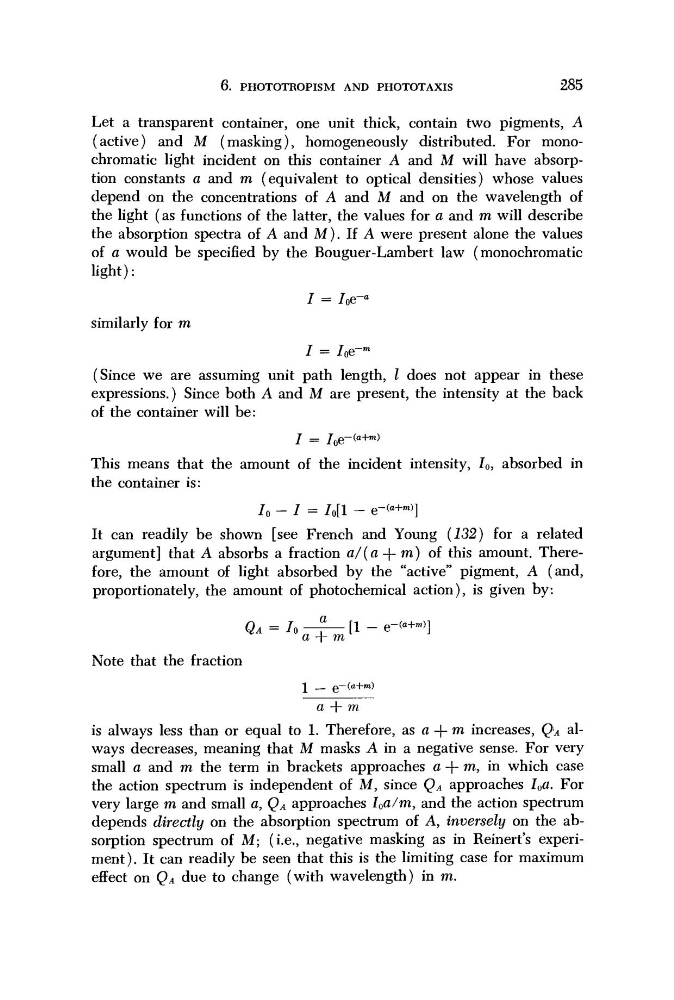
Let a transparent container, one unit thick, contain two pigments, A
(active) and M (masking), homogeneously distributed. For monochromatic light incident on this container A and M will have absorption constants a and m (equivalent to optical densities) whose values
depend on the concentrations of A and M and on the wavelength of
the light (as functions of the latter, the values for a and m will describe
the absorption spectra of A and M). If A were present alone the values
of a would be specified by the Bouguer-Lambert law (monochromatic
light):
/ = 7 0 e-«
similarly for m
I = I 0 em
(Since we are assuming unit path length, I does not appear in these
expressions.) Since both A and M are present, the intensity at the back
of the container will be:
I = 7 0 e(a+m)
This means that the amount of the incident intensity, Z 0 , absorbed in
the container is:
7o - / = 7 0 [1 - e-<"+*>]
It can readily be shown [see French and Young (132) for a related
argument] that A absorbs a fraction a/(a-\-m)
of this amount. Therefore, the amount of light absorbed by the "active" pigment, A (and,
proportionately, the amount of photochemical action), is given by:
QA = h —£— [1 - e-<«+»>]
a + m
Note that the fraction
\
Q— (a+m)
a + m
is always less than or equal to 1. Therefore, as a -f- m increases, Q A always decreases, meaning that M masks A in a negative sense. For very
small a and m the term in brackets approaches a-\- m, in which case
the action spectrum is independent of M, since Q A approaches I 0 a. For
very large m and small a, Q A approaches I 0 a/m, and the action spectrum
depends directly on the absorption spectrum of A, inversely on the absorption spectrum of M; (i.e., negative masking as in Reinert's experiment). It can readily be seen that this is the limiting case for maximum
effect on Q A due to change (with wavelength) in m.
285
Let a transparent container, one unit thick, contain two pigments, A
(active) and M (masking), homogeneously distributed. For monochromatic light incident on this container A and M will have absorption constants a and m (equivalent to optical densities) whose values
depend on the concentrations of A and M and on the wavelength of
the light (as functions of the latter, the values for a and m will describe
the absorption spectra of A and M). If A were present alone the values
of a would be specified by the Bouguer-Lambert law (monochromatic
light):
/ = 7 0 e-«
similarly for m
I = I 0 em
(Since we are assuming unit path length, I does not appear in these
expressions.) Since both A and M are present, the intensity at the back
of the container will be:
I = 7 0 e(a+m)
This means that the amount of the incident intensity, Z 0 , absorbed in
the container is:
7o - / = 7 0 [1 - e-<"+*>]
It can readily be shown [see French and Young (132) for a related
argument] that A absorbs a fraction a/(a-\-m)
of this amount. Therefore, the amount of light absorbed by the "active" pigment, A (and,
proportionately, the amount of photochemical action), is given by:
QA = h —£— [1 - e-<«+»>]
a + m
Note that the fraction
\
Q— (a+m)
a + m
is always less than or equal to 1. Therefore, as a -f- m increases, Q A always decreases, meaning that M masks A in a negative sense. For very
small a and m the term in brackets approaches a-\- m, in which case
the action spectrum is independent of M, since Q A approaches I 0 a. For
very large m and small a, Q A approaches I 0 a/m, and the action spectrum
depends directly on the absorption spectrum of A, inversely on the absorption spectrum of M; (i.e., negative masking as in Reinert's experiment). It can readily be seen that this is the limiting case for maximum
effect on Q A due to change (with wavelength) in m.