

272
KENNETH V. THIMANN AND GEORGE M. CURRY
action spectrum was the same for the negative as for the positive movement, but Biinning and Schneiderhöhn's Euglena (86) was found to
give an entirely different response with the greatest sensitivity at 415
τημ and three small subsidiary peaks towards longer wavelengths. However, the methods were not identical, since in positive phototaxis Biinning and Schneiderhöhn measured the intensity for threshold response,
100
50
n
—i '
/
S\
1
1
1
1
|
i
.
493
/^v'--\\A...
\ \
* \
'*\ \
' » \
«1
\
\
ι
ι
■
1
ι
4
1
1
|
1
1
1
— Platymonas
-DunalieUa
- Stephanoptera
l\ 1
1
1
1
1_
-
A
ΙΟΟι
o Ulva taeniata
x Ulva rigida
400
500
600
700
100
T—|—i—i—i—i
Prorocentrum
600
700
—I
1 1 1—r
-
Stephanoptera
'■' D. salina
i.\ /'
* D. viridis
400
500
600
Wavelength in nri/i
500
600
Wavelength in π\μ
700
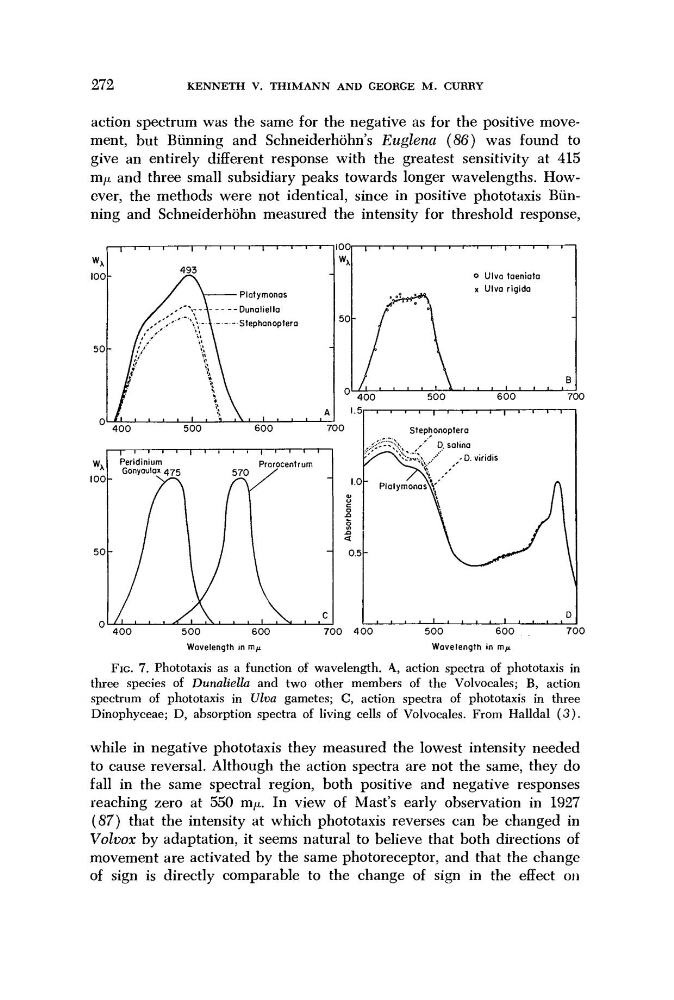
FIG. 7. Phototaxis as a function of wavelength. \, action spectra of phototaxis in
three species of DunalieUa and two other members of the Volvocales; B, action
spectrum of phototaxis in Ulva gametes; C, action spectra of phototaxis in three
Dinophyceae; D, absorption spectra of living cells of Volvocales. From Halldal (3).
while in negative phototaxis they measured the lowest intensity needed
to cause reversal. Although the action spectra are not the same, they do
fall in the same spectral region, both positive and negative responses
reaching zero at 550 πΐμ. In view of Mast's early observation in 1927
(87) that the intensity at which phototaxis reverses can be changed in
Volvox by adaptation, it seems natural to believe that both directions of
movement are activated by the same photoreceptor, and that the change
of sign is directly comparable to the change of sign in the effect on
KENNETH V. THIMANN AND GEORGE M. CURRY
action spectrum was the same for the negative as for the positive movement, but Biinning and Schneiderhöhn's Euglena (86) was found to
give an entirely different response with the greatest sensitivity at 415
τημ and three small subsidiary peaks towards longer wavelengths. However, the methods were not identical, since in positive phototaxis Biinning and Schneiderhöhn measured the intensity for threshold response,
100
50
n
—i '
/
S\
1
1
1
1
|
i
.
493
/^v'--\\A...
\ \
* \
'*\ \
' » \
«1
\
\
ι
ι
■
1
ι
4
1
1
|
1
1
1
— Platymonas
-DunalieUa
- Stephanoptera
l\ 1
1
1
1
1_
-
A
ΙΟΟι
o Ulva taeniata
x Ulva rigida
400
500
600
700
100
T—|—i—i—i—i
Prorocentrum
600
700
—I
1 1 1—r
-
Stephanoptera
'■' D. salina
i.\ /'
* D. viridis
400
500
600
Wavelength in nri/i
500
600
Wavelength in π\μ
700
FIG. 7. Phototaxis as a function of wavelength. \, action spectra of phototaxis in
three species of DunalieUa and two other members of the Volvocales; B, action
spectrum of phototaxis in Ulva gametes; C, action spectra of phototaxis in three
Dinophyceae; D, absorption spectra of living cells of Volvocales. From Halldal (3).
while in negative phototaxis they measured the lowest intensity needed
to cause reversal. Although the action spectra are not the same, they do
fall in the same spectral region, both positive and negative responses
reaching zero at 550 πΐμ. In view of Mast's early observation in 1927
(87) that the intensity at which phototaxis reverses can be changed in
Volvox by adaptation, it seems natural to believe that both directions of
movement are activated by the same photoreceptor, and that the change
of sign is directly comparable to the change of sign in the effect on