

6. PHOTOTROPISM AND PHOTOTAXIS
267
auxin molecules in the two sides (assuming none are inactivated in the
back side). The one-sided application of a 10 mm.
3 agar block containing
3-indoleacetic acid (IAA) at a concentration of 10 /xg./liter will produce
a 5° curvature in the standard Avena test. Since this concentration is
10 X 10
_6 /175 = 6χ 10~
8 molar, and the block volume is approx. 10 μ\. 9
the auxin differential required is 6 X 10
8 X 10~
5 X 6 X 10
23 = 4 X 10
11
molecules. However, since only 15% of the applied auxin goes in during
the 90 minutes (65), this becomes a little less than 10
11 molecules, or
a)
DARK
25.5°
b)
24.1
c
O
n
d)
262°
23.4
P
LIGHT
e)
^ f)
9> A
h
>
31.0· 12.5°
23.0° 24.7°
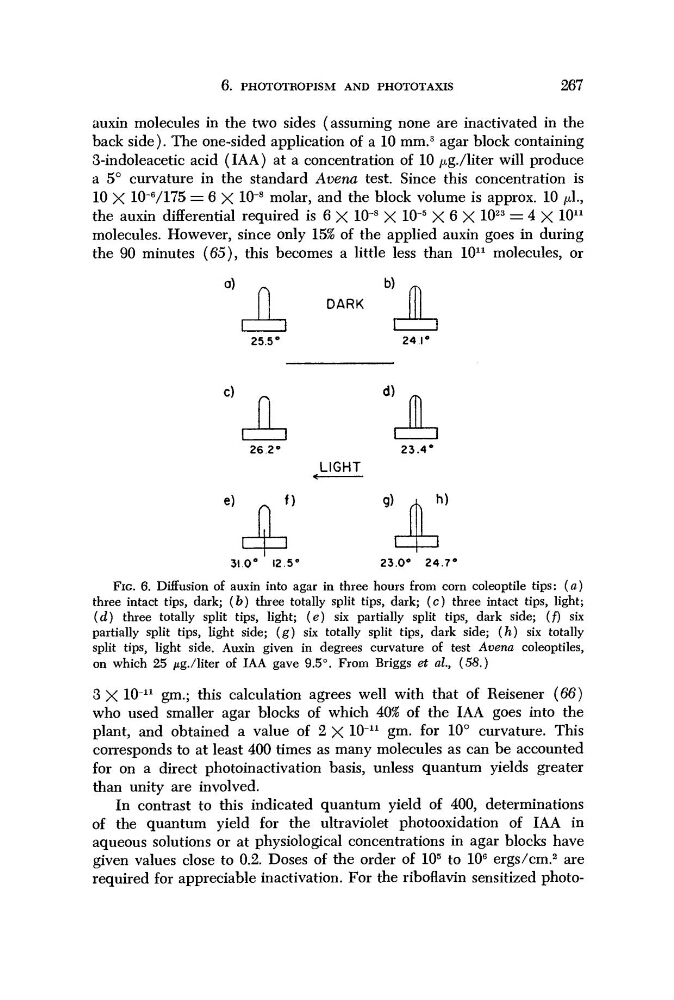
FIG. 6. Diffusion of auxin into agar in three hours from corn coleoptile tips: (a)
three intact tips, dark; (b) three totally split tips, dark; (c) three intact tips, light;
(d) three totally split tips, light; (e) six partially split tips, dark side; (/) six
partially split tips, light side; (g) six totally split tips, dark side; (h) six totally
split tips, light side. Auxin given in degrees curvature of test Avena coleoptiles,
on which 25 /xg./liter of IAA gave 9.5°. From Briggs et al., (58.)
3 X 10"
11 gm.; this calculation agrees well with that of Reisener (66)
who used smaller agar blocks of which 40% of the IAA goes into the
plant, and obtained a value of 2 X 10
11 gm. for 10° curvature. This
corresponds to at least 400 times as many molecules as can be accounted
for on a direct photoinactivation basis, unless quantum yields greater
than unity are involved.
In contrast to this indicated quantum yield of 400, determinations
of the quantum yield for the ultraviolet photooxidation of IAA in
aqueous solutions or at physiological concentrations in agar blocks have
given values close to 0.2. Doses of the order of 10
5 to 10
6 ergs/cm.
2 are
required for appreciable inactivation. For the riboflavin sensitized photo-
267
auxin molecules in the two sides (assuming none are inactivated in the
back side). The one-sided application of a 10 mm.
3 agar block containing
3-indoleacetic acid (IAA) at a concentration of 10 /xg./liter will produce
a 5° curvature in the standard Avena test. Since this concentration is
10 X 10
_6 /175 = 6χ 10~
8 molar, and the block volume is approx. 10 μ\. 9
the auxin differential required is 6 X 10
8 X 10~
5 X 6 X 10
23 = 4 X 10
11
molecules. However, since only 15% of the applied auxin goes in during
the 90 minutes (65), this becomes a little less than 10
11 molecules, or
a)
DARK
25.5°
b)
24.1
c
O
n
d)
262°
23.4
P
LIGHT
e)
^ f)
9> A
h
>
31.0· 12.5°
23.0° 24.7°
FIG. 6. Diffusion of auxin into agar in three hours from corn coleoptile tips: (a)
three intact tips, dark; (b) three totally split tips, dark; (c) three intact tips, light;
(d) three totally split tips, light; (e) six partially split tips, dark side; (/) six
partially split tips, light side; (g) six totally split tips, dark side; (h) six totally
split tips, light side. Auxin given in degrees curvature of test Avena coleoptiles,
on which 25 /xg./liter of IAA gave 9.5°. From Briggs et al., (58.)
3 X 10"
11 gm.; this calculation agrees well with that of Reisener (66)
who used smaller agar blocks of which 40% of the IAA goes into the
plant, and obtained a value of 2 X 10
11 gm. for 10° curvature. This
corresponds to at least 400 times as many molecules as can be accounted
for on a direct photoinactivation basis, unless quantum yields greater
than unity are involved.
In contrast to this indicated quantum yield of 400, determinations
of the quantum yield for the ultraviolet photooxidation of IAA in
aqueous solutions or at physiological concentrations in agar blocks have
given values close to 0.2. Doses of the order of 10
5 to 10
6 ergs/cm.
2 are
required for appreciable inactivation. For the riboflavin sensitized photo-