

6. PHOTOTROPISM AND PHOTOTAXIS
263
lower regions. Asymmetrical interference would lead to asymmetrical
distribution of this factor, hence curvature. Additionally, there is some
evidence that high-intensity light may remove this interference (cf.
decreasing light-growth reaction), possibly accounting for negative
curvatures, i.e., more interference on the shaded side than on the illuminated side after a short high-intensity exposure. This aspect of the
phototropic responses will now be taken up in detail.
V. The Role of Auxin in Phototropism of Plants
In contrast to the Blaauw theory, the Cholodny-Went theory (54, 55)
postulated that any tropistic curvature, whether caused by light or
gravity, is due to the lateral displacement of the growth-controlling substance (now termed auxin). In the normal geotropic curvature of shoots
auxin would move towards the lower side; in positive phototropism auxin
would move to the dark side. This movement of auxin necessarily would
cause light-growth reactions on both sides, a deceleration on the bright
side and an acceleration on the dark side.
TABLE IV
DISTRIBUTION OF AUXIN ON THE TWO SIDES OF THE Avena COLEOPTILE AS A
RESULT OF LIGHT TREATMENTS CAUSING FIRST POSITIVE, INDIFFERENT,
NEGATIVE, AND SECOND POSITIVE CURVATURES
Amount of light
(meter-candle-seconds)
a
0
20
100
1,000
1,500
10,000
11,400
?
150,000
Phototropic
curvature —
degrees
0
approx. +10
+ +
+48
+50
approx. 0
-15
-20
+20
Auxin distribution in per cent
Light side
49.9
41.0
26.0
32.0
17.0
49.0
62.0
58.0
36.0
Dark side
50.1
59.0
74.0
68.0
83.0
51.0
38.0
42.0
64.0
Author
Asana (56)
Went (55)
Went (55)
Went (55)
Wilden (57)
Went (55)
Wilden (57)
Asana (56)
Wilden (57)
a One meter-candle-second of white light is phototropically equivalent to about
0.04 erg/cm.
2 of blue light.
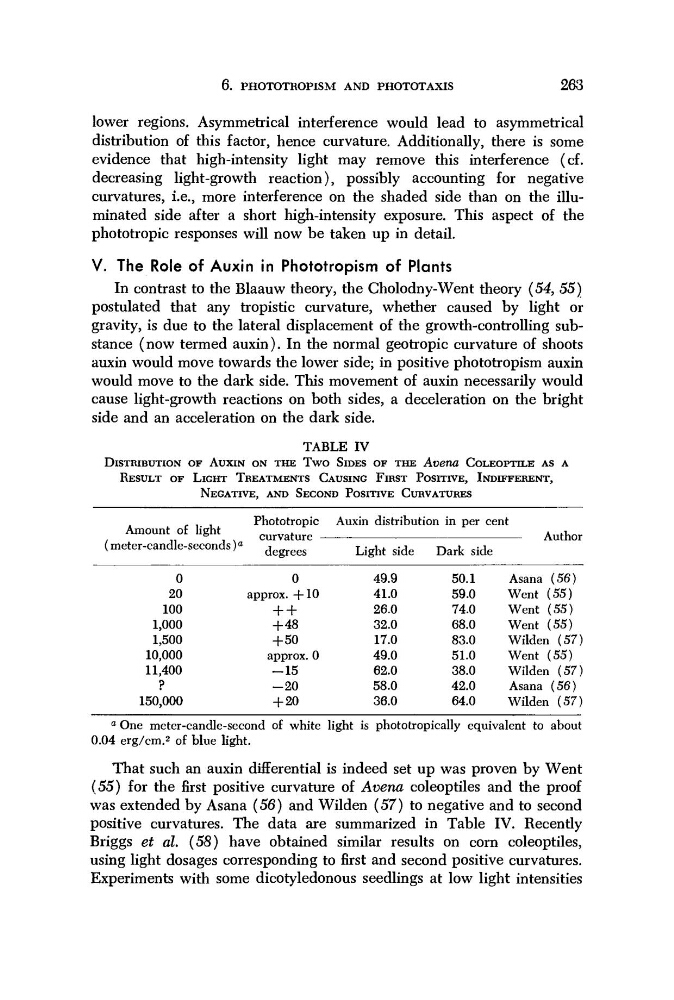
That such an auxin differential is indeed set up was proven by Went
(55) for the first positive curvature of Avena coleoptiles and the proof
was extended by Asana (56) and Wilden (57) to negative and to second
positive curvatures. The data are summarized in Table IV. Recently
Briggs et al. (58) have obtained similar results on corn coleoptiles,
using light dosages corresponding to first and second positive curvatures.
Experiments with some dicotyledonous seedlings at low light intensities
263
lower regions. Asymmetrical interference would lead to asymmetrical
distribution of this factor, hence curvature. Additionally, there is some
evidence that high-intensity light may remove this interference (cf.
decreasing light-growth reaction), possibly accounting for negative
curvatures, i.e., more interference on the shaded side than on the illuminated side after a short high-intensity exposure. This aspect of the
phototropic responses will now be taken up in detail.
V. The Role of Auxin in Phototropism of Plants
In contrast to the Blaauw theory, the Cholodny-Went theory (54, 55)
postulated that any tropistic curvature, whether caused by light or
gravity, is due to the lateral displacement of the growth-controlling substance (now termed auxin). In the normal geotropic curvature of shoots
auxin would move towards the lower side; in positive phototropism auxin
would move to the dark side. This movement of auxin necessarily would
cause light-growth reactions on both sides, a deceleration on the bright
side and an acceleration on the dark side.
TABLE IV
DISTRIBUTION OF AUXIN ON THE TWO SIDES OF THE Avena COLEOPTILE AS A
RESULT OF LIGHT TREATMENTS CAUSING FIRST POSITIVE, INDIFFERENT,
NEGATIVE, AND SECOND POSITIVE CURVATURES
Amount of light
(meter-candle-seconds)
a
0
20
100
1,000
1,500
10,000
11,400
?
150,000
Phototropic
curvature —
degrees
0
approx. +10
+ +
+48
+50
approx. 0
-15
-20
+20
Auxin distribution in per cent
Light side
49.9
41.0
26.0
32.0
17.0
49.0
62.0
58.0
36.0
Dark side
50.1
59.0
74.0
68.0
83.0
51.0
38.0
42.0
64.0
Author
Asana (56)
Went (55)
Went (55)
Went (55)
Wilden (57)
Went (55)
Wilden (57)
Asana (56)
Wilden (57)
a One meter-candle-second of white light is phototropically equivalent to about
0.04 erg/cm.
2 of blue light.
That such an auxin differential is indeed set up was proven by Went
(55) for the first positive curvature of Avena coleoptiles and the proof
was extended by Asana (56) and Wilden (57) to negative and to second
positive curvatures. The data are summarized in Table IV. Recently
Briggs et al. (58) have obtained similar results on corn coleoptiles,
using light dosages corresponding to first and second positive curvatures.
Experiments with some dicotyledonous seedlings at low light intensities