

5. ONIUM COMPOUNDS
231
H
CO
N
C
/ \ / V
/ \
H 2 N
C
X
HC
C—CONH 2
||
CH + DPN© -> ||
|
+ ΗΘ +
(24)
C
/
HC
CH
/ \ /
\ X
H,N
N
N
\ H
CO
N
/ \ / V
H 2 N
C
X CH
c
/ \ /
H 2 N
N £H(CHOH) 2 CH
CH 2
O
NH 2
I
I
0=P—OH
N
C
i
y \ / x
O
/
C
N
I
HC
||
I
0=P—OH
\
C
CH
i
o
\ / \ y
O
/ \
N
N
I
/
\ /
CH 2 —CH(CHOH) 2 CH
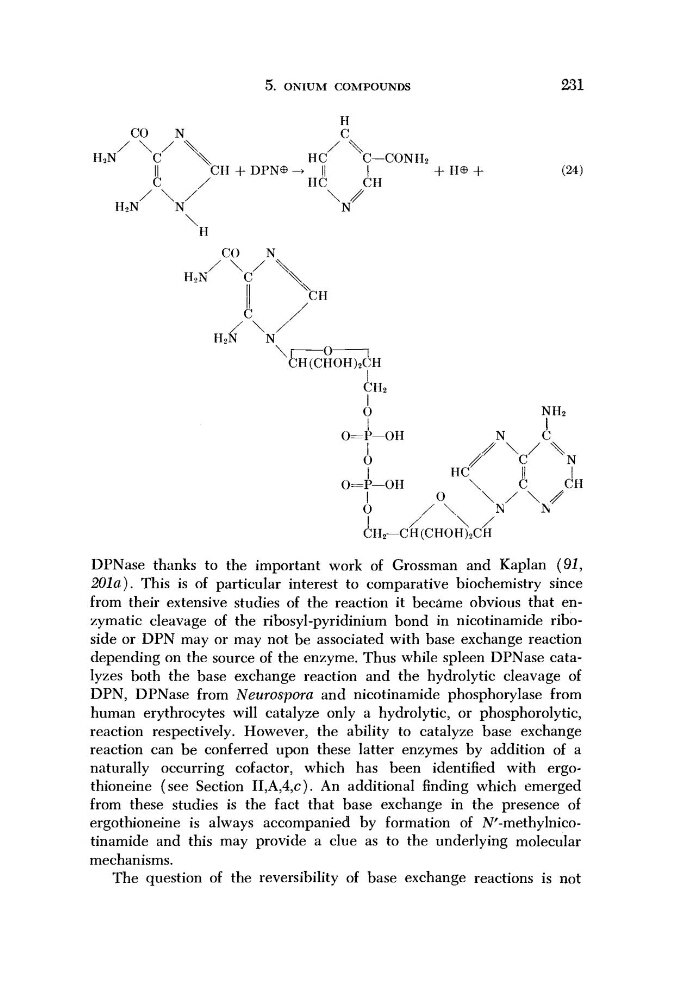
DPNase thanks to the important work of Grossman and Kaplan (91,
201a). This is of particular interest to comparative biochemistry since
from their extensive studies of the reaction it became obvious that enzymatic cleavage of the ribosyl-pyridinium bond in nicotinamide riboside or DPN may or may not be associated with base exchange reaction
depending on the source of the enzyme. Thus while spleen DPNase catalyzes both the base exchange reaction and the hydrolytic cleavage of
DPN, DPNase from Neurospora and nicotinamide phosphorylase from
human erythrocytes will catalyze only a hydrolytic, or phosphorolytic,
reaction respectively. However, the ability to catalyze base exchange
reaction can be conferred upon these latter enzymes by addition of a
naturally occurring cofactor, which has been identified with ergothioneine (see Section II,A,4,c). An additional finding which emerged
from these studies is the fact that base exchange in the presence of
ergothioneine is always accompanied by formation of N'-methylnicotinamide and this may provide a clue as to the underlying molecular
mechanisms.
The question of the reversibility of base exchange reactions is not
231
H
CO
N
C
/ \ / V
/ \
H 2 N
C
X
HC
C—CONH 2
||
CH + DPN© -> ||
|
+ ΗΘ +
(24)
C
/
HC
CH
/ \ /
\ X
H,N
N
N
\ H
CO
N
/ \ / V
H 2 N
C
X CH
c
/ \ /
H 2 N
N £H(CHOH) 2 CH
CH 2
O
NH 2
I
I
0=P—OH
N
C
i
y \ / x
O
/
C
N
I
HC
||
I
0=P—OH
\
C
CH
i
o
\ / \ y
O
/ \
N
N
I
/
\ /
CH 2 —CH(CHOH) 2 CH
DPNase thanks to the important work of Grossman and Kaplan (91,
201a). This is of particular interest to comparative biochemistry since
from their extensive studies of the reaction it became obvious that enzymatic cleavage of the ribosyl-pyridinium bond in nicotinamide riboside or DPN may or may not be associated with base exchange reaction
depending on the source of the enzyme. Thus while spleen DPNase catalyzes both the base exchange reaction and the hydrolytic cleavage of
DPN, DPNase from Neurospora and nicotinamide phosphorylase from
human erythrocytes will catalyze only a hydrolytic, or phosphorolytic,
reaction respectively. However, the ability to catalyze base exchange
reaction can be conferred upon these latter enzymes by addition of a
naturally occurring cofactor, which has been identified with ergothioneine (see Section II,A,4,c). An additional finding which emerged
from these studies is the fact that base exchange in the presence of
ergothioneine is always accompanied by formation of N'-methylnicotinamide and this may provide a clue as to the underlying molecular
mechanisms.
The question of the reversibility of base exchange reactions is not