

216
G. L. CANTONI
cellular steady state concentration of methionine. Alternatively it might
be postulated that S-methylmethionine can react enzymatically with
S-adenosylhomocysteine to form adenosylmethionine directly, although
there is at present no positive evidence that such a reaction takes place.
As has been noted, the chemical degradation of both adenosylmethionine and S-methylmethionine can result in the formation of
(Π)
(IE)
(E)
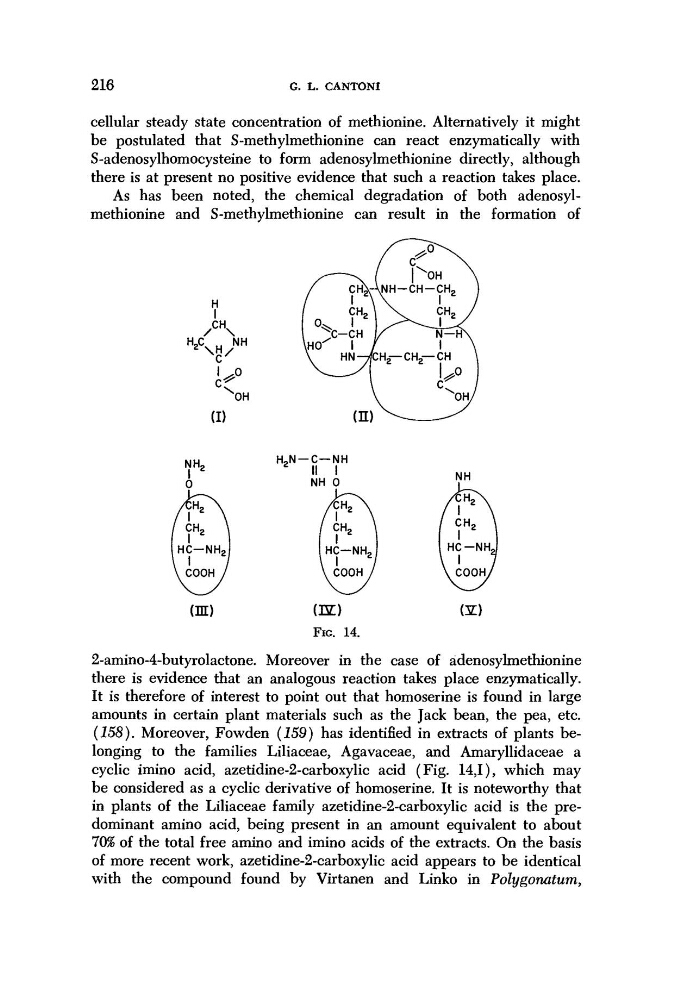
FIG. 14.
2-amino-4-butyrolactone. Moreover in the case of adenosylmethionine
there is evidence that an analogous reaction takes place enzymatically.
It is therefore of interest to point out that homoserine is found in large
amounts in certain plant materials such as the Jack bean, the pea, etc.
(158). Moreover, Fowden (159) has identified in extracts of plants belonging to the families Liliaceae, Agavaceae, and Amaryllidaceae a
cyclic imino acid, azetidine-2-carboxylic acid (Fig. 14,1), which may
be considered as a cyclic derivative of homoserine. It is noteworthy that
in plants of the Liliaceae family azetidine-2-carboxylic acid is the predominant amino acid, being present in an amount equivalent to about
70% of the total free amino and imino acids of the extracts. On the basis
of more recent work, azetidine-2-carboxylic acid appears to be identical
with the compound found by Virtanen and Linko in Folygonatum,
G. L. CANTONI
cellular steady state concentration of methionine. Alternatively it might
be postulated that S-methylmethionine can react enzymatically with
S-adenosylhomocysteine to form adenosylmethionine directly, although
there is at present no positive evidence that such a reaction takes place.
As has been noted, the chemical degradation of both adenosylmethionine and S-methylmethionine can result in the formation of
(Π)
(IE)
(E)
FIG. 14.
2-amino-4-butyrolactone. Moreover in the case of adenosylmethionine
there is evidence that an analogous reaction takes place enzymatically.
It is therefore of interest to point out that homoserine is found in large
amounts in certain plant materials such as the Jack bean, the pea, etc.
(158). Moreover, Fowden (159) has identified in extracts of plants belonging to the families Liliaceae, Agavaceae, and Amaryllidaceae a
cyclic imino acid, azetidine-2-carboxylic acid (Fig. 14,1), which may
be considered as a cyclic derivative of homoserine. It is noteworthy that
in plants of the Liliaceae family azetidine-2-carboxylic acid is the predominant amino acid, being present in an amount equivalent to about
70% of the total free amino and imino acids of the extracts. On the basis
of more recent work, azetidine-2-carboxylic acid appears to be identical
with the compound found by Virtanen and Linko in Folygonatum,