

5. ONIUM COMPOUNDS
205
sion in boiling water, Challenger and Simpson suggested that the evolution of dimethylsulfide is an enzymatic process.
This suggestion was recently confirmed by Cantoni and Anderson
(111) who established that cell-free extracts of P. lanosa catalyze the
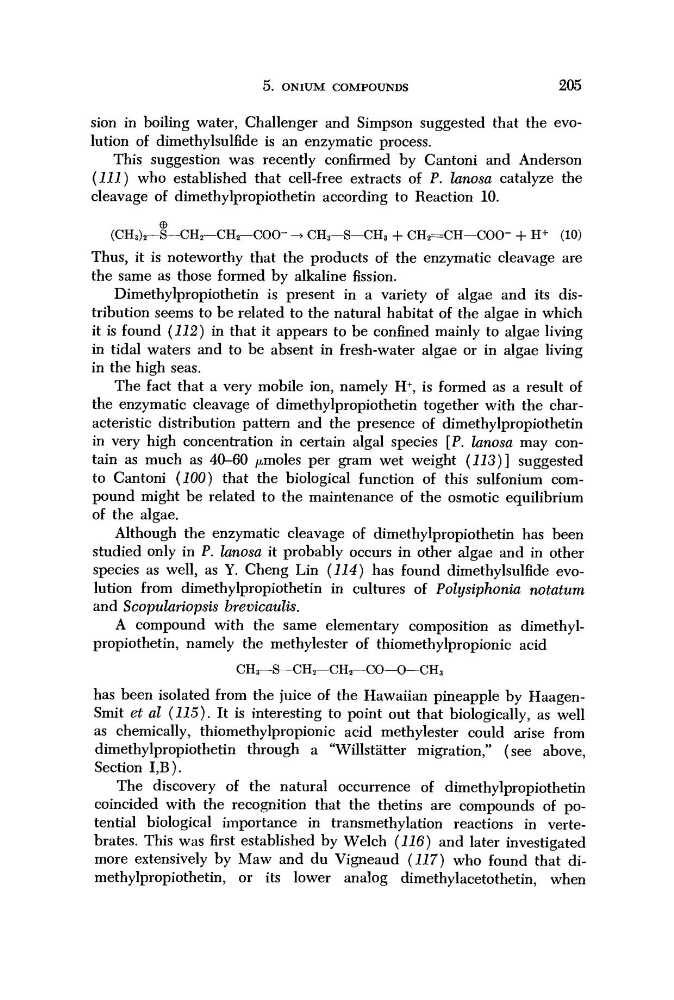
cleavage of dimethylpropiothetin according to Reaction 10.
(CH 3 ) 2 —S—CH 2 —CH 2 —COO" -* CH 3 —S—CH 3 + CH^CH—COO" + H+ (10)
Thus, it is noteworthy that the products of the enzymatic cleavage are
the same as those formed by alkaline fission.
Dimethylpropiothetin is present in a variety of algae and its distribution seems to be related to the natural habitat of the algae in which
it is found (112) in that it appears to be confined mainly to algae living
in tidal waters and to be absent in fresh-water algae or in algae living
in the high seas.
The fact that a very mobile ion, namely H
+ , is formed as a result of
the enzymatic cleavage of dimethylpropiothetin together with the characteristic distribution pattern and the presence of dimethylpropiothetin
in very high concentration in certain algal species [P. lanosa may contain as much as 40-60 /xmoles per gram wet weight (113)] suggested
to Cantoni (100) that the biological function of this sulfonium compound might be related to the maintenance of the osmotic equilibrium
of the algae.
Although the enzymatic cleavage of dimethylpropiothetin has been
studied only in P. lanosa it probably occurs in other algae and in other
species as well, as Y. Cheng Lin (114) has found dimethylsulfide evolution from dimethylpropiothetin in cultures of Polysiphonia notatum
and Scopulariopsis brevicaulis.
A compound with the same elementary composition as dimethylpropiothetin, namely the methylester of thiomethylpropionic acid
CH 3 —S—CH 2 —CH 2 —CO—O—CH 3
has been isolated from the juice of the Hawaiian pineapple by HaagenSmit et al (115). It is interesting to point out that biologically, as well
as chemically, thiomethylpropionic acid methylester could arise from
dimethylpropiothetin through a "Willstätter migration," (see above,
Section I,B).
The discovery of the natural occurrence of dimethylpropiothetin
coincided with the recognition that the thetins are compounds of potential biological importance in transmethylation reactions in vertebrates. This was first established by Welch (116) and later investigated
more extensively by Maw and du Vigneaud (117) who found that dimethylpropiothetin, or its lower analog dimethylacetothetin, when
205
sion in boiling water, Challenger and Simpson suggested that the evolution of dimethylsulfide is an enzymatic process.
This suggestion was recently confirmed by Cantoni and Anderson
(111) who established that cell-free extracts of P. lanosa catalyze the
cleavage of dimethylpropiothetin according to Reaction 10.
(CH 3 ) 2 —S—CH 2 —CH 2 —COO" -* CH 3 —S—CH 3 + CH^CH—COO" + H+ (10)
Thus, it is noteworthy that the products of the enzymatic cleavage are
the same as those formed by alkaline fission.
Dimethylpropiothetin is present in a variety of algae and its distribution seems to be related to the natural habitat of the algae in which
it is found (112) in that it appears to be confined mainly to algae living
in tidal waters and to be absent in fresh-water algae or in algae living
in the high seas.
The fact that a very mobile ion, namely H
+ , is formed as a result of
the enzymatic cleavage of dimethylpropiothetin together with the characteristic distribution pattern and the presence of dimethylpropiothetin
in very high concentration in certain algal species [P. lanosa may contain as much as 40-60 /xmoles per gram wet weight (113)] suggested
to Cantoni (100) that the biological function of this sulfonium compound might be related to the maintenance of the osmotic equilibrium
of the algae.
Although the enzymatic cleavage of dimethylpropiothetin has been
studied only in P. lanosa it probably occurs in other algae and in other
species as well, as Y. Cheng Lin (114) has found dimethylsulfide evolution from dimethylpropiothetin in cultures of Polysiphonia notatum
and Scopulariopsis brevicaulis.
A compound with the same elementary composition as dimethylpropiothetin, namely the methylester of thiomethylpropionic acid
CH 3 —S—CH 2 —CH 2 —CO—O—CH 3
has been isolated from the juice of the Hawaiian pineapple by HaagenSmit et al (115). It is interesting to point out that biologically, as well
as chemically, thiomethylpropionic acid methylester could arise from
dimethylpropiothetin through a "Willstätter migration," (see above,
Section I,B).
The discovery of the natural occurrence of dimethylpropiothetin
coincided with the recognition that the thetins are compounds of potential biological importance in transmethylation reactions in vertebrates. This was first established by Welch (116) and later investigated
more extensively by Maw and du Vigneaud (117) who found that dimethylpropiothetin, or its lower analog dimethylacetothetin, when