

162
F. M. HUENNEKENS AND H. R. WHITELEY
fungi (424), yeast (99, 100), numerous microorganisms (50, 101),
protozoa (425, 426), arthropods (103, 104, 427, 428), annelids (105),
echinoderms (102, 429), and all classes of vertebrates (62, 93-96,
106-108). The presence of ATP in cells from which it has not been
specifically isolated may be inferred from the ability of these cells to
carry out reactions which either yield or utilize ATP. For example, the
existence of "energy-rich" N-phosphate compounds in certain cells
(Tables II and III) implies the concomitant existence of ATP since the
N-phosphate compounds are only known to be synthesized or utilized
by transphosphorylation with ATP.
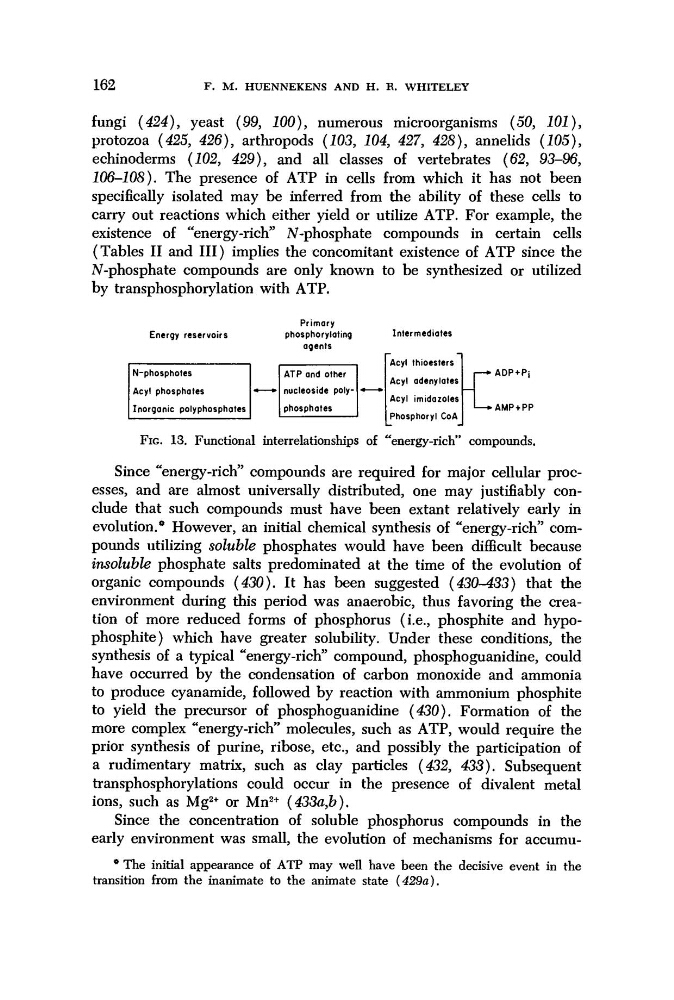
Energy reservoirs
N-phosphates
Acyl phosphates
Inorganic polyphosphates
« »
Primary
phosphorylating
agents
ATP and other
nucleoside polyphosphates
*—H
Intermediates
Acyl thioesters
Acyl adenylates
Acyl imidazoles
Phosphoryl CoA
r—» ADP + Pj
•AMP+PP
FIG. 13. Functional interrelationships of "energy-rich" compounds.
Since "energy-rich" compounds are required for major cellular processes, and are almost universally distributed, one may justifiably conclude that such compounds must have been extant relatively early in
evolution.* However, an initial chemical synthesis of "energy-rich" compounds utilizing soluble phosphates would have been difficult because
insoluble phosphate salts predominated at the time of the evolution of
organic compounds (430). It has been suggested (430-433) that the
environment during this period was anaerobic, thus favoring the creation of more reduced forms of phosphorus (i.e., phosphite and hypophosphite) which have greater solubility. Under these conditions, the
synthesis of a typical "energy-rich" compound, phosphoguanidine, could
have occurred by the condensation of carbon monoxide and ammonia
to produce cyanamide, followed by reaction with ammonium phosphite
to yield the precursor of phosphoguanidine (430). Formation of the
more complex "energy-rich" molecules, such as ATP, would require the
prior synthesis of purine, ribose, etc., and possibly the participation of
a rudimentary matrix, such as clay particles (432, 433). Subsequent
transphosphorylations could occur in the presence of divalent metal
ions, such as Mg
2+ or Mn
2+
(433a,b).
Since the concentration of soluble phosphorus compounds in the
early environment was small, the evolution of mechanisms for accumu* The initial appearance of ATP may well have been the decisive event in the
transition from the inanimate to the animate state (429a).
F. M. HUENNEKENS AND H. R. WHITELEY
fungi (424), yeast (99, 100), numerous microorganisms (50, 101),
protozoa (425, 426), arthropods (103, 104, 427, 428), annelids (105),
echinoderms (102, 429), and all classes of vertebrates (62, 93-96,
106-108). The presence of ATP in cells from which it has not been
specifically isolated may be inferred from the ability of these cells to
carry out reactions which either yield or utilize ATP. For example, the
existence of "energy-rich" N-phosphate compounds in certain cells
(Tables II and III) implies the concomitant existence of ATP since the
N-phosphate compounds are only known to be synthesized or utilized
by transphosphorylation with ATP.
Energy reservoirs
N-phosphates
Acyl phosphates
Inorganic polyphosphates
« »
Primary
phosphorylating
agents
ATP and other
nucleoside polyphosphates
*—H
Intermediates
Acyl thioesters
Acyl adenylates
Acyl imidazoles
Phosphoryl CoA
r—» ADP + Pj
•AMP+PP
FIG. 13. Functional interrelationships of "energy-rich" compounds.
Since "energy-rich" compounds are required for major cellular processes, and are almost universally distributed, one may justifiably conclude that such compounds must have been extant relatively early in
evolution.* However, an initial chemical synthesis of "energy-rich" compounds utilizing soluble phosphates would have been difficult because
insoluble phosphate salts predominated at the time of the evolution of
organic compounds (430). It has been suggested (430-433) that the
environment during this period was anaerobic, thus favoring the creation of more reduced forms of phosphorus (i.e., phosphite and hypophosphite) which have greater solubility. Under these conditions, the
synthesis of a typical "energy-rich" compound, phosphoguanidine, could
have occurred by the condensation of carbon monoxide and ammonia
to produce cyanamide, followed by reaction with ammonium phosphite
to yield the precursor of phosphoguanidine (430). Formation of the
more complex "energy-rich" molecules, such as ATP, would require the
prior synthesis of purine, ribose, etc., and possibly the participation of
a rudimentary matrix, such as clay particles (432, 433). Subsequent
transphosphorylations could occur in the presence of divalent metal
ions, such as Mg
2+ or Mn
2+
(433a,b).
Since the concentration of soluble phosphorus compounds in the
early environment was small, the evolution of mechanisms for accumu* The initial appearance of ATP may well have been the decisive event in the
transition from the inanimate to the animate state (429a).