

152
F. M. HUENNEKENS AND H. R. WHITELEY
d. Distribution. Interest in the distribution of the N-phosphate compounds in various species of animals stems from attempts to correlate
the presence of phosphocreatine and phosphoarginine in animal phyla
with certain phylogenetic relationships (342, 357, 371, 372). These
relationships (for example, of the echinoderms to hemichordates and
to vertebrates) were originally postulated on the basis of morphological
and embryological comparisons (372, 373) and appeared, at first, to
receive support from the pattern of distribution of the "energy-rich"
amidine phosphates.
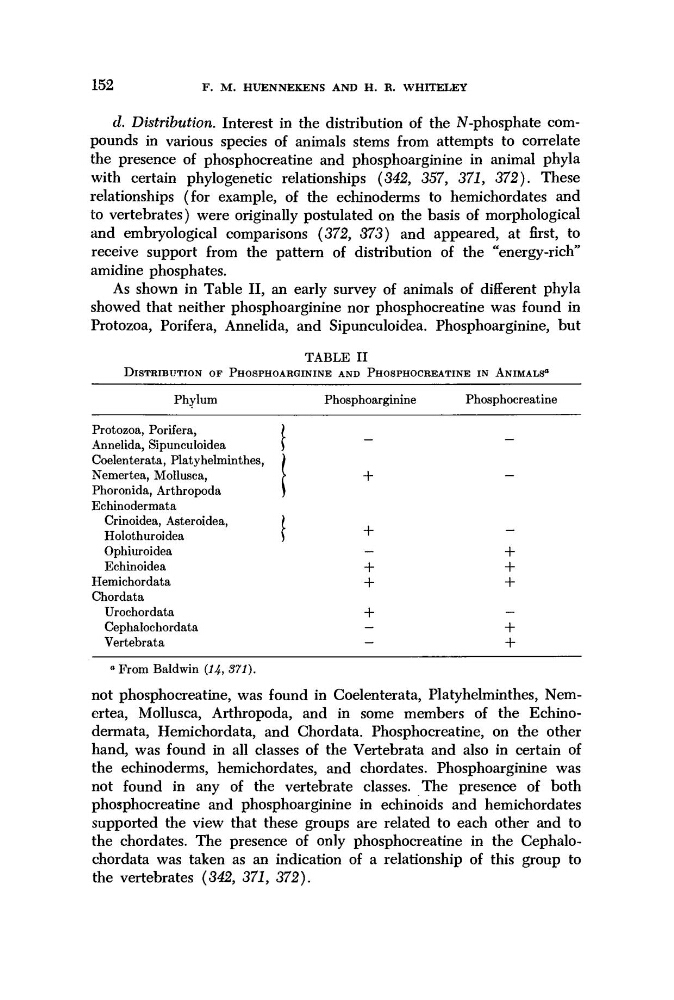
As shown in Table II, an early survey of animals of different phyla
showed that neither phosphoarginine nor phosphocreatine was found in
Protozoa, Porifera, Annelida, and Sipunculoidea. Phosphoarginine, but
TABLE II
DlSTHIBUTION OF PHOSPHOARGININE AND PHOSPHOCREATINE IN ANIMALS"
Phylum
Phosphoarginine
Phosphocreatine
Protozoa, Porifera,
)
Annelida, Sipunculoidea
)
""
~~
Coelenterata, Platyhelminthes, )
Nemertea, Mollusca,
>
+
—
Phoronida, Arthropoda
j
Echinodermata
Crinoidea, Asteroidea,
)
Holothuroidea
)
"*"
~~
Ophiuroidea
—
-f
Echinoidea
+
+
Hemichordata
+
+
Chordata
Urochordata
+
—
Cephalochordata
—
+
Vertebrata
—
+
«From Baldwin (14,371).
not phosphocreatine, was found in Coelenterata, Platyhelminthes, Nemertea, Mollusca, Arthropoda, and in some members of the Echinodermata, Hemichordata, and Chordata. Phosphocreatine, on the other
hand, was found in all classes of the Vertebrata and also in certain of
the echinoderms, hemichordates, and chordates. Phosphoarginine was
not found in any of the vertebrate classes. The presence of both
phosphocreatine and phosphoarginine in echinoids and hemichordates
supported the view that these groups are related to each other and to
the chordates. The presence of only phosphocreatine in the Cephalochordata was taken as an indication of a relationship of this group to
the vertebrates (342, 371, 372).
F. M. HUENNEKENS AND H. R. WHITELEY
d. Distribution. Interest in the distribution of the N-phosphate compounds in various species of animals stems from attempts to correlate
the presence of phosphocreatine and phosphoarginine in animal phyla
with certain phylogenetic relationships (342, 357, 371, 372). These
relationships (for example, of the echinoderms to hemichordates and
to vertebrates) were originally postulated on the basis of morphological
and embryological comparisons (372, 373) and appeared, at first, to
receive support from the pattern of distribution of the "energy-rich"
amidine phosphates.
As shown in Table II, an early survey of animals of different phyla
showed that neither phosphoarginine nor phosphocreatine was found in
Protozoa, Porifera, Annelida, and Sipunculoidea. Phosphoarginine, but
TABLE II
DlSTHIBUTION OF PHOSPHOARGININE AND PHOSPHOCREATINE IN ANIMALS"
Phylum
Phosphoarginine
Phosphocreatine
Protozoa, Porifera,
)
Annelida, Sipunculoidea
)
""
~~
Coelenterata, Platyhelminthes, )
Nemertea, Mollusca,
>
+
—
Phoronida, Arthropoda
j
Echinodermata
Crinoidea, Asteroidea,
)
Holothuroidea
)
"*"
~~
Ophiuroidea
—
-f
Echinoidea
+
+
Hemichordata
+
+
Chordata
Urochordata
+
—
Cephalochordata
—
+
Vertebrata
—
+
«From Baldwin (14,371).
not phosphocreatine, was found in Coelenterata, Platyhelminthes, Nemertea, Mollusca, Arthropoda, and in some members of the Echinodermata, Hemichordata, and Chordata. Phosphocreatine, on the other
hand, was found in all classes of the Vertebrata and also in certain of
the echinoderms, hemichordates, and chordates. Phosphoarginine was
not found in any of the vertebrate classes. The presence of both
phosphocreatine and phosphoarginine in echinoids and hemichordates
supported the view that these groups are related to each other and to
the chordates. The presence of only phosphocreatine in the Cephalochordata was taken as an indication of a relationship of this group to
the vertebrates (342, 371, 372).