

140
F. M. HUENNEKENS AND H. R. WHITELEY
209) and purified from plant material (210-212). All these enzymes
require Mg
2+ , are inhibited by sulfhydryl reagents, and require DPN,
except the enzyme from Chlorella pyrenoidosa and from spinach leaves,
which is TPN-specific. Purified enzyme preparations can oxidize glyceraldehyde, acetaldehyde, propionaldehyde, and butyraldehyde (194) to
the corresponding acyl phosphates.
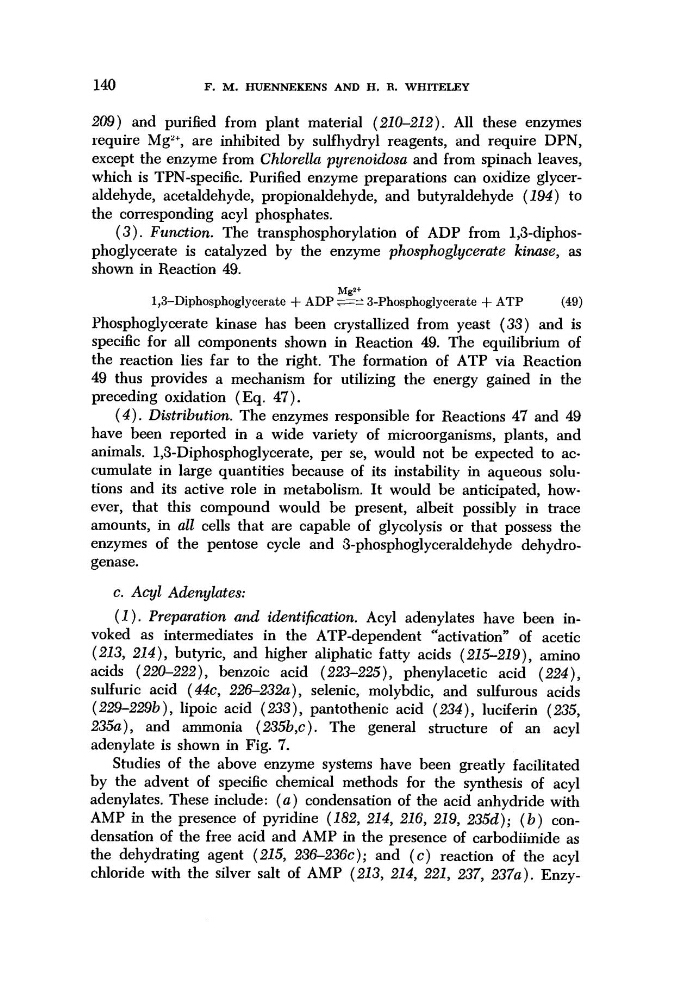
(3). Function. The transphosphorylation of ADP from 1,3-diphosphoglycerate is catalyzed by the enzyme phosphoglycerate kinase, as
shown in Reaction 49.
Mg2+
1,3-Diphosphoglycerate + ADP ^==± 3-Phosphoglycerate + ATP
(49)
Phosphoglycerate kinase has been crystallized from yeast (33) and is
specific for all components shown in Reaction 49. The equilibrium of
the reaction lies far to the right. The formation of ATP via Reaction
49 thus provides a mechanism for utilizing the energy gained in the
preceding oxidation (Eq. 47).
(4). Distribution. The enzymes responsible for Reactions 47 and 49
have been reported in a wide variety of microorganisms, plants, and
animals. 1,3-Diphosphoglycerate, per se, would not be expected to accumulate in large quantities because of its instability in aqueous solutions and its active role in metabolism. It would be anticipated, however, that this compound would be present, albeit possibly in trace
amounts, in all cells that are capable of glycolysis or that possess the
enzymes of the pentose cycle and 3-phosphoglyceraldehyde dehydrogenase.
c. Acyl Adenylates:
(1). Preparation and identification. Acyl adenylates have been invoked as intermediates in the ATP-dependent "activation" of acetic
(213, 214), butyric, and higher aliphatic fatty acids (215-219), amino
acids (220-222), benzoic acid (223-225), phenylacetic acid (224),
sulfuric acid (44c, 226-232a), selenic, molybdic, and sulfurous acids
(229-229b), lipoic acid (233), pantothenic acid (234), luciferin (235,
235a), and ammonia (235b,c). The general structure of an acyl
adenylate is shown in Fig. 7.
Studies of the above enzyme systems have been greatly facilitated
by the advent of specific chemical methods for the synthesis of acyl
adenylates. These include: (a) condensation of the acid anhydride with
AMP in the presence of pyridine (182, 214, 216, 219, 235d); (b) condensation of the free acid and AMP in the presence of carbodiimide as
the dehydrating agent (215, 236-236c); and (c) reaction of the acyl
chloride with the silver salt of AMP (213, 214, 221, 237, 237a). Enzy-
F. M. HUENNEKENS AND H. R. WHITELEY
209) and purified from plant material (210-212). All these enzymes
require Mg
2+ , are inhibited by sulfhydryl reagents, and require DPN,
except the enzyme from Chlorella pyrenoidosa and from spinach leaves,
which is TPN-specific. Purified enzyme preparations can oxidize glyceraldehyde, acetaldehyde, propionaldehyde, and butyraldehyde (194) to
the corresponding acyl phosphates.
(3). Function. The transphosphorylation of ADP from 1,3-diphosphoglycerate is catalyzed by the enzyme phosphoglycerate kinase, as
shown in Reaction 49.
Mg2+
1,3-Diphosphoglycerate + ADP ^==± 3-Phosphoglycerate + ATP
(49)
Phosphoglycerate kinase has been crystallized from yeast (33) and is
specific for all components shown in Reaction 49. The equilibrium of
the reaction lies far to the right. The formation of ATP via Reaction
49 thus provides a mechanism for utilizing the energy gained in the
preceding oxidation (Eq. 47).
(4). Distribution. The enzymes responsible for Reactions 47 and 49
have been reported in a wide variety of microorganisms, plants, and
animals. 1,3-Diphosphoglycerate, per se, would not be expected to accumulate in large quantities because of its instability in aqueous solutions and its active role in metabolism. It would be anticipated, however, that this compound would be present, albeit possibly in trace
amounts, in all cells that are capable of glycolysis or that possess the
enzymes of the pentose cycle and 3-phosphoglyceraldehyde dehydrogenase.
c. Acyl Adenylates:
(1). Preparation and identification. Acyl adenylates have been invoked as intermediates in the ATP-dependent "activation" of acetic
(213, 214), butyric, and higher aliphatic fatty acids (215-219), amino
acids (220-222), benzoic acid (223-225), phenylacetic acid (224),
sulfuric acid (44c, 226-232a), selenic, molybdic, and sulfurous acids
(229-229b), lipoic acid (233), pantothenic acid (234), luciferin (235,
235a), and ammonia (235b,c). The general structure of an acyl
adenylate is shown in Fig. 7.
Studies of the above enzyme systems have been greatly facilitated
by the advent of specific chemical methods for the synthesis of acyl
adenylates. These include: (a) condensation of the acid anhydride with
AMP in the presence of pyridine (182, 214, 216, 219, 235d); (b) condensation of the free acid and AMP in the presence of carbodiimide as
the dehydrating agent (215, 236-236c); and (c) reaction of the acyl
chloride with the silver salt of AMP (213, 214, 221, 237, 237a). Enzy-