

130
F. M. HUENNEKENS AND H. R. WHITELEY
tion techniques of tissues and cells for phosphorus compounds yield
two polyphosphate fractions (112-118). One fraction is extracted b]
cold trichloracetic acid ("soluble fraction"), whereas the other fractioi
is extracted only by treatment with alkali or hot trichloracetic acid ("in
soluble fraction"). Selective precipitation techniques are required t<
separate the polyphosphates from the other phosphorus compound
OH
OH
OH
OH
OH
I
I
I
I
I
0=P-0-P=0
0=P-0-P-0-P=0
OH
OH
o H
0
OH
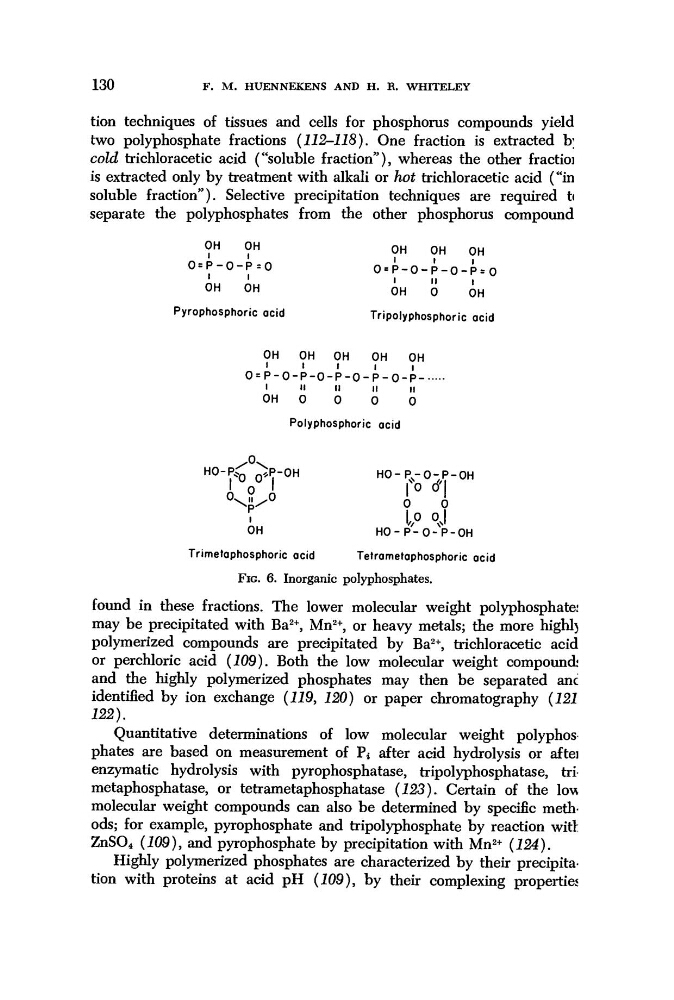
Pyrophosphoric acid
Tripolyphosphoric acid
OH
OH OH
OH
OH
i
i
i
i
i
= P-0-P-0-P-0-P-0-P-··
■
ii
ii
ii
ii
OH
0
0
0
0
Polyphosphoric acid
H °-^0 0*
Ρ Γ°
Η
H0-P N -0-P-0H
I 0 I
i
s o o'
O^o
o 6
IP oj
OH
ΗΟ-Ρ-0-Ρ-ΟΗ
Trimetaphosphoric acid
Tetrametaphosphoric acid
FIG. 6. Inorganic polyphosphates.
found in these fractions. The lower molecular weight polyphosphatej
may be precipitated with Ba
2+ , Mn
2+ , or heavy metals; the more highl)
polymerized compounds are precipitated by Ba
2+ , trichloracetic acid
or perchloric acid (109). Both the low molecular weight compound
and the highly polymerized phosphates may then be separated anc
identified by ion exchange (119, 120) or paper chromatography (121
122).
Quantitative determinations of low molecular weight polyphos
phates are based on measurement of Pi after acid hydrolysis or aftei
enzymatic hydrolysis with pyrophosphatase, tripolyphosphatase, tri
metaphosphatase, or tetrametaphosphatase (123). Certain of the low
molecular weight compounds can also be determined by specific methods; for example, pyrophosphate and tripolyphosphate by reaction witl
ZnS0 4 (109), and pyrophosphate by precipitation with Mn
2+ (124).
Highly polymerized phosphates are characterized by their precipitation with proteins at acid pH (109), by their complexing properties
F. M. HUENNEKENS AND H. R. WHITELEY
tion techniques of tissues and cells for phosphorus compounds yield
two polyphosphate fractions (112-118). One fraction is extracted b]
cold trichloracetic acid ("soluble fraction"), whereas the other fractioi
is extracted only by treatment with alkali or hot trichloracetic acid ("in
soluble fraction"). Selective precipitation techniques are required t<
separate the polyphosphates from the other phosphorus compound
OH
OH
OH
OH
OH
I
I
I
I
I
0=P-0-P=0
0=P-0-P-0-P=0
OH
OH
o H
0
OH
Pyrophosphoric acid
Tripolyphosphoric acid
OH
OH OH
OH
OH
i
i
i
i
i
= P-0-P-0-P-0-P-0-P-··
■
ii
ii
ii
ii
OH
0
0
0
0
Polyphosphoric acid
H °-^0 0*
Ρ Γ°
Η
H0-P N -0-P-0H
I 0 I
i
s o o'
O^o
o 6
IP oj
OH
ΗΟ-Ρ-0-Ρ-ΟΗ
Trimetaphosphoric acid
Tetrametaphosphoric acid
FIG. 6. Inorganic polyphosphates.
found in these fractions. The lower molecular weight polyphosphatej
may be precipitated with Ba
2+ , Mn
2+ , or heavy metals; the more highl)
polymerized compounds are precipitated by Ba
2+ , trichloracetic acid
or perchloric acid (109). Both the low molecular weight compound
and the highly polymerized phosphates may then be separated anc
identified by ion exchange (119, 120) or paper chromatography (121
122).
Quantitative determinations of low molecular weight polyphos
phates are based on measurement of Pi after acid hydrolysis or aftei
enzymatic hydrolysis with pyrophosphatase, tripolyphosphatase, tri
metaphosphatase, or tetrametaphosphatase (123). Certain of the low
molecular weight compounds can also be determined by specific methods; for example, pyrophosphate and tripolyphosphate by reaction witl
ZnS0 4 (109), and pyrophosphate by precipitation with Mn
2+ (124).
Highly polymerized phosphates are characterized by their precipitation with proteins at acid pH (109), by their complexing properties