

4. ENERGY-RICH COMPOUNDS
121
where the terms for water and HP0 4
2 ~ in the individual hydrolytic reactions are cancelled out, and also the pK values for the two conjugate
pairs of substances in the equation are nearly equal. Owing to the
latter fact, the effect of pH upon the equilibrium of a coupled reaction
is usually less pronounced than in the hydrolysis of either of the two
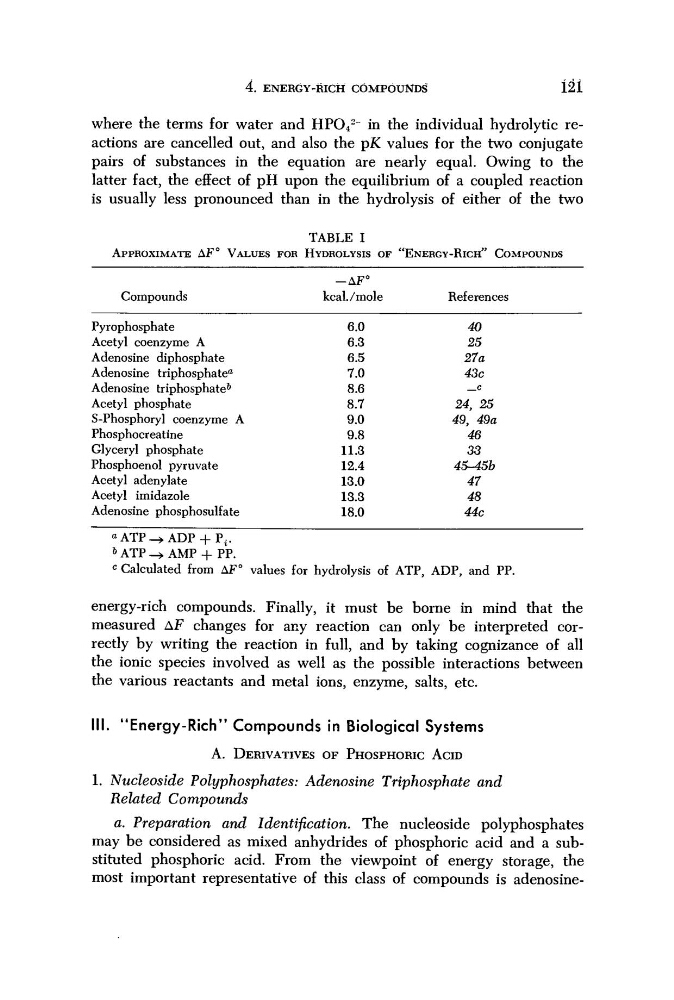
TABLE I
APPROXIMATE AF° VALUES FOR HYDROLYSIS OF "ENERGY-RICH" COMPOUNDS
Compounds
Pyrophosphate
Acetyl coenzyme A
Adenosine diphosphate
Adenosine triphosphate
a
Adenosine triphosphate
0
Acetyl phosphate
S-Phosphoryl coenzyme A
Phosphocreatine
Glyceryl phosphate
Phosphoenol pyruvate
Acetyl adenylate
Acetyl imidazole
Adenosine phosphosulfate
-AF°
kcal./mole
6.0
6.3
6.5
7.0
8.6
8.7
9.0
9.8
11.3
12.4
13.0
13.3
18.0
References
40
25
27a
43c
c
24, 25
49, 49a
46
33
45-45b
47
48
44c
"ATP^ADP + P^
δ ΑΤΡ->ΑΜΡ + ΡΡ.
c Calculated from AF° values for hydrolysis of ATP, ADP, and PP.
energy-rich compounds. Finally, it must be borne in mind that the
measured AF changes for any reaction can only be interpreted correctly by writing the reaction in full, and by taking cognizance of all
the ionic species involved as well as the possible interactions between
the various reactants and metal ions, enzyme, salts, etc.
III. "Energy-Rich" Compounds in Biological Systems
A. DERIVATIVES OF PHOSPHORIC ACID
1. Nucleoside Polyphosphates: Adenosine Triphosphate and
Related Compounds
a. Preparation and Identification. The nucleoside polyphosphates
may be considered as mixed anhydrides of phosphoric acid and a substituted phosphoric acid. From the viewpoint of energy storage, the
most important representative of this class of compounds is adenosine-
121
where the terms for water and HP0 4
2 ~ in the individual hydrolytic reactions are cancelled out, and also the pK values for the two conjugate
pairs of substances in the equation are nearly equal. Owing to the
latter fact, the effect of pH upon the equilibrium of a coupled reaction
is usually less pronounced than in the hydrolysis of either of the two
TABLE I
APPROXIMATE AF° VALUES FOR HYDROLYSIS OF "ENERGY-RICH" COMPOUNDS
Compounds
Pyrophosphate
Acetyl coenzyme A
Adenosine diphosphate
Adenosine triphosphate
a
Adenosine triphosphate
0
Acetyl phosphate
S-Phosphoryl coenzyme A
Phosphocreatine
Glyceryl phosphate
Phosphoenol pyruvate
Acetyl adenylate
Acetyl imidazole
Adenosine phosphosulfate
-AF°
kcal./mole
6.0
6.3
6.5
7.0
8.6
8.7
9.0
9.8
11.3
12.4
13.0
13.3
18.0
References
40
25
27a
43c
c
24, 25
49, 49a
46
33
45-45b
47
48
44c
"ATP^ADP + P^
δ ΑΤΡ->ΑΜΡ + ΡΡ.
c Calculated from AF° values for hydrolysis of ATP, ADP, and PP.
energy-rich compounds. Finally, it must be borne in mind that the
measured AF changes for any reaction can only be interpreted correctly by writing the reaction in full, and by taking cognizance of all
the ionic species involved as well as the possible interactions between
the various reactants and metal ions, enzyme, salts, etc.
III. "Energy-Rich" Compounds in Biological Systems
A. DERIVATIVES OF PHOSPHORIC ACID
1. Nucleoside Polyphosphates: Adenosine Triphosphate and
Related Compounds
a. Preparation and Identification. The nucleoside polyphosphates
may be considered as mixed anhydrides of phosphoric acid and a substituted phosphoric acid. From the viewpoint of energy storage, the
most important representative of this class of compounds is adenosine-