

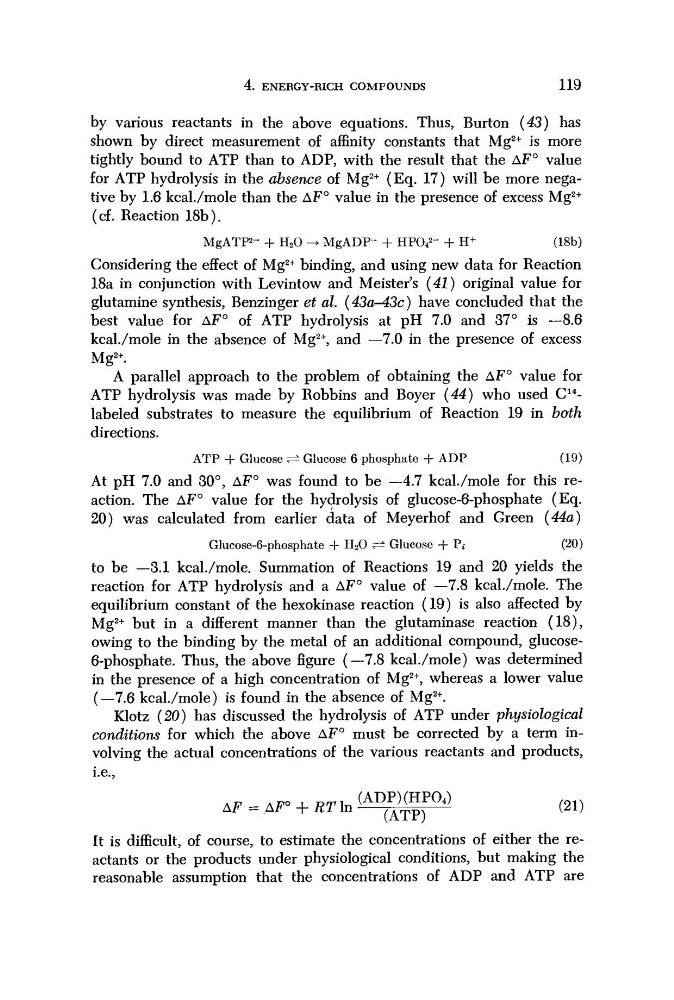
4. ENERGY-RICH COMPOUNDS
119
by various reactants in the above equations. Thus, Burton (43) has
shown by direct measurement of aifinity constants that Mg
2+ is more
tightly bound to ATP than to ADP, with the result that the AF° value
for ATP hydrolysis in the absence of Mg
2+ (Eq. 17) will be more negative by 1.6 kcal./mole than the AF° value in the presence of excess Mg
2+
(cf. Reaction 18b).
MgATP
2 - + H 2 0 -> MgADP- + HP0 4
2 - + H+
(18b)
Considering the effect of Mg
2+ binding, and using new data for Reaction
18a in conjunction with Levintow and Meister's (41) original value for
glutamine synthesis, Benzinger et al. (43a-43c) have concluded that the
best value for AF° of ATP hydrolysis at pH 7.0 and 37° is —8.6
kcal./mole in the absence of Mg
2+ , and —7.0 in the presence of excess
Mg
2+ .
A parallel approach to the problem of obtaining the AF° value for
ATP hydrolysis was made by Robbins and Boyer (44) who used C
14 -
labeled substrates to measure the equilibrium of Reaction 19 in both
directions.
ATP + Glucose ^± Glucose 6 phosphate + ADP
(19)
At pH 7.0 and 30°, AF° was found to be —4.7 kcal./mole for this reaction. The AF° value for the hydrolysis of glucose-6-phosphate (Eq.
20) was calculated from earlier data of Meyerhof and Green (44a)
Glucose-6-phosphate + H 2 0 ^± Glucose + P;
(20)
to be —3.1 kcal./mole. Summation of Reactions 19 and 20 yields the
reaction for ATP hydrolysis and a AF° value of —7.8 kcal./mole. The
equilibrium constant of the hexokinase reaction (19) is also affected by
Mg
2+ but in a different manner than the glutaminase reaction (18),
owing to the binding by the metal of an additional compound, glucose6-phosphate. Thus, the above figure (—7.8 kcal./mole) was determined
in the presence of a high concentration of Mg
2+ , whereas a lower value
(—7.6 kcal./mole) is found in the absence of Mg
2+ .
Klotz (20) has discussed the hydrolysis of ATP under physiological
conditions for which the above AF° must be corrected by a term involving the actual concentrations of the various reactants and products,
i.e.,
AF-AF' + R T l n ^ ^
(21)
It is difficult, of course, to estimate the concentrations of either the reactants or the products under physiological conditions, but making the
reasonable assumption that the concentrations of ADP and ATP are
119
by various reactants in the above equations. Thus, Burton (43) has
shown by direct measurement of aifinity constants that Mg
2+ is more
tightly bound to ATP than to ADP, with the result that the AF° value
for ATP hydrolysis in the absence of Mg
2+ (Eq. 17) will be more negative by 1.6 kcal./mole than the AF° value in the presence of excess Mg
2+
(cf. Reaction 18b).
MgATP
2 - + H 2 0 -> MgADP- + HP0 4
2 - + H+
(18b)
Considering the effect of Mg
2+ binding, and using new data for Reaction
18a in conjunction with Levintow and Meister's (41) original value for
glutamine synthesis, Benzinger et al. (43a-43c) have concluded that the
best value for AF° of ATP hydrolysis at pH 7.0 and 37° is —8.6
kcal./mole in the absence of Mg
2+ , and —7.0 in the presence of excess
Mg
2+ .
A parallel approach to the problem of obtaining the AF° value for
ATP hydrolysis was made by Robbins and Boyer (44) who used C
14 -
labeled substrates to measure the equilibrium of Reaction 19 in both
directions.
ATP + Glucose ^± Glucose 6 phosphate + ADP
(19)
At pH 7.0 and 30°, AF° was found to be —4.7 kcal./mole for this reaction. The AF° value for the hydrolysis of glucose-6-phosphate (Eq.
20) was calculated from earlier data of Meyerhof and Green (44a)
Glucose-6-phosphate + H 2 0 ^± Glucose + P;
(20)
to be —3.1 kcal./mole. Summation of Reactions 19 and 20 yields the
reaction for ATP hydrolysis and a AF° value of —7.8 kcal./mole. The
equilibrium constant of the hexokinase reaction (19) is also affected by
Mg
2+ but in a different manner than the glutaminase reaction (18),
owing to the binding by the metal of an additional compound, glucose6-phosphate. Thus, the above figure (—7.8 kcal./mole) was determined
in the presence of a high concentration of Mg
2+ , whereas a lower value
(—7.6 kcal./mole) is found in the absence of Mg
2+ .
Klotz (20) has discussed the hydrolysis of ATP under physiological
conditions for which the above AF° must be corrected by a term involving the actual concentrations of the various reactants and products,
i.e.,
AF-AF' + R T l n ^ ^
(21)
It is difficult, of course, to estimate the concentrations of either the reactants or the products under physiological conditions, but making the
reasonable assumption that the concentrations of ADP and ATP are