

4. ENERGY-RICH COMPOUNDS
115
B. THERMODYNAMIC CONCEPTS AND TERMINOLOGY*
Any reversible chemical reaction may be fully defined, in a thermodynamic sense, by three parameters: (a) the change in free energy,
AF, which is the maximum amount of energy available as useful work;
(b) the change in heat content, or enthalpy, AH, the total energy; and
(c) the change in entropy, AS, or the unavailable energy. At a given
temperature, T, these fundamental quantities are related by the wellknown equation emerging from the Second Law of Thermodynamics:
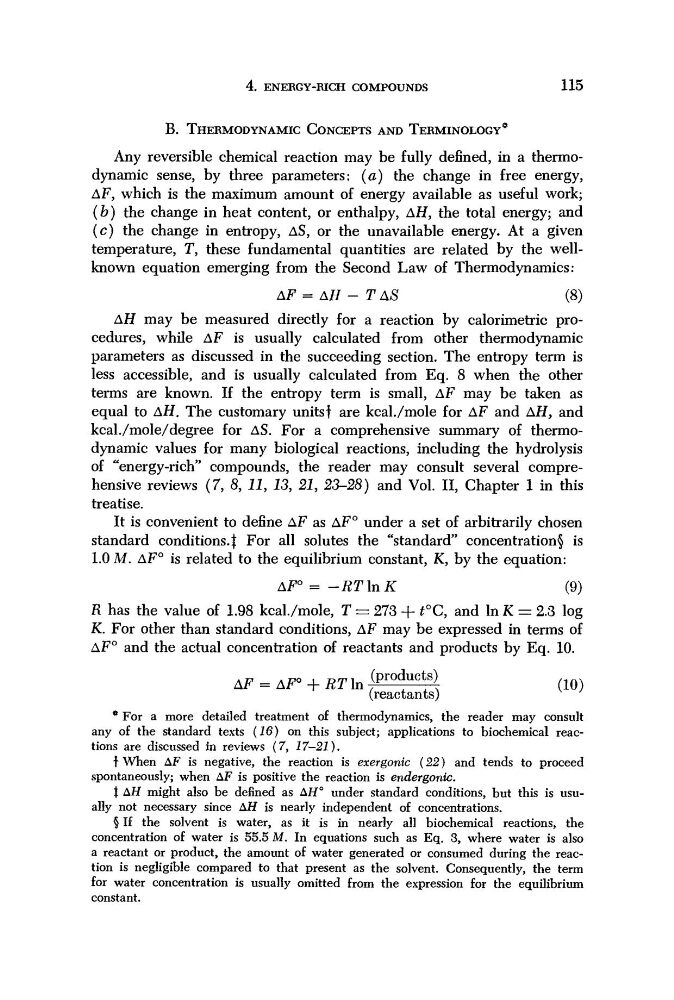
AF = AH - TAS
(8)
AH may be measured directly for a reaction by calorimetric procedures, while AF is usually calculated from other thermodynamic
parameters as discussed in the succeeding section. The entropy term is
less accessible, and is usually calculated from Eq. 8 when the other
terms are known. If the entropy term is small, AF may be taken as
equal to AH. The customary unitsf are kcal./mole for AF and AH, and
kcal./mole/degree for AS. For a comprehensive summary of thermodynamic values for many biological reactions, including the hydrolysis
of "energy-rich" compounds, the reader may consult several comprehensive reviews (7, 8, 11, 13, 21, 23-28) and Vol. II, Chapter 1 in this
treatise.
It is convenient to define AF as AF° under a set of arbitrarily chosen
standard conditions. $ For all solutes the "standard" concentration § is
1.0 M. AF° is related to the equilibrium constant, K, by the equation:
AF° = - RT In K
(9)
R has the value of 1.98 kcal./mole, T = 273 + t°C, and In K = 2.3 log
K. For other than standard conditions, AF may be expressed in terms of
AF° and the actual concentration of reactants and products by Eq. 10.
AF = AF° + RTln^
r0d ^\
(10)
* For a more detailed treatment of thermodynamics, the reader may consult
any of the standard texts (16) on this subject; applications to biochemical reactions are discussed in reviews (7, 17—21).
f When AF is negative, the reaction is exergonic (22) and tends to proceed
spontaneously; when AF is positive the reaction is endergonic.
t AH might also be defined as AH ° under standard conditions, but this is usually not necessary since AH is nearly independent of concentrations.
§ If the solvent is water, as it is in nearly all biochemical reactions, the
concentration of water is 55.5 M. In equations such as Eq. 3, where water is also
a reactant or product, the amount of water generated or consumed during the reaction is negligible compared to that present as the solvent. Consequently, the term
for water concentration is usually omitted from the expression for the equilibrium
constant.
115
B. THERMODYNAMIC CONCEPTS AND TERMINOLOGY*
Any reversible chemical reaction may be fully defined, in a thermodynamic sense, by three parameters: (a) the change in free energy,
AF, which is the maximum amount of energy available as useful work;
(b) the change in heat content, or enthalpy, AH, the total energy; and
(c) the change in entropy, AS, or the unavailable energy. At a given
temperature, T, these fundamental quantities are related by the wellknown equation emerging from the Second Law of Thermodynamics:
AF = AH - TAS
(8)
AH may be measured directly for a reaction by calorimetric procedures, while AF is usually calculated from other thermodynamic
parameters as discussed in the succeeding section. The entropy term is
less accessible, and is usually calculated from Eq. 8 when the other
terms are known. If the entropy term is small, AF may be taken as
equal to AH. The customary unitsf are kcal./mole for AF and AH, and
kcal./mole/degree for AS. For a comprehensive summary of thermodynamic values for many biological reactions, including the hydrolysis
of "energy-rich" compounds, the reader may consult several comprehensive reviews (7, 8, 11, 13, 21, 23-28) and Vol. II, Chapter 1 in this
treatise.
It is convenient to define AF as AF° under a set of arbitrarily chosen
standard conditions. $ For all solutes the "standard" concentration § is
1.0 M. AF° is related to the equilibrium constant, K, by the equation:
AF° = - RT In K
(9)
R has the value of 1.98 kcal./mole, T = 273 + t°C, and In K = 2.3 log
K. For other than standard conditions, AF may be expressed in terms of
AF° and the actual concentration of reactants and products by Eq. 10.
AF = AF° + RTln^
r0d ^\
(10)
* For a more detailed treatment of thermodynamics, the reader may consult
any of the standard texts (16) on this subject; applications to biochemical reactions are discussed in reviews (7, 17—21).
f When AF is negative, the reaction is exergonic (22) and tends to proceed
spontaneously; when AF is positive the reaction is endergonic.
t AH might also be defined as AH ° under standard conditions, but this is usually not necessary since AH is nearly independent of concentrations.
§ If the solvent is water, as it is in nearly all biochemical reactions, the
concentration of water is 55.5 M. In equations such as Eq. 3, where water is also
a reactant or product, the amount of water generated or consumed during the reaction is negligible compared to that present as the solvent. Consequently, the term
for water concentration is usually omitted from the expression for the equilibrium
constant.