

108
F. M. HUENNEKENS AND H. R. WHITELEY
living systems as those in which the replicative process is dependent
upon energy derived from the breakdown of metabolites. In addition,
most living systems require energy for maintenance during nonreplicative phases. Specifically, energy is utilized for chemical purposes such
as the synthesis of metabolites or structural materials, or it may be
used for mechanical work, as represented by the transport of materials
or the movement of structural proteins. All types of energy-requiring
reactions ultimately depend upon a rather small and highly specialized
group of "energy-rich" chemical compounds to supply the driving
force. From a structural viewpoint, these compounds are limited to
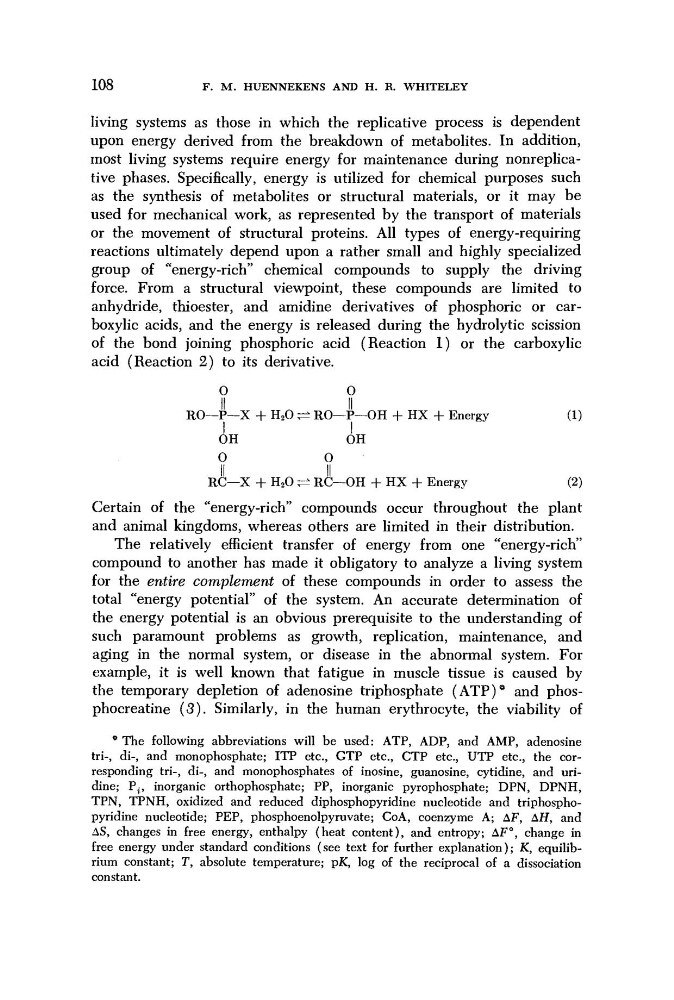
anhydride, thioester, and amidine derivatives of phosphoric or carboxylic acids, and the energy is released during the hydrolytic scission
of the bond joining phosphoric acid (Reaction 1) or the carboxylic
acid (Reaction 2) to its derivative.
O
O
RO—P—X + H 2 0 ^± RO—P—OH + HX + Energy
(1)
OH
OH
O
O
II
II
RC—X + H 2 0 ;=± RC—OH + HX + Energy
(2)
Certain of the "energy-rich" compounds occur throughout the plant
and animal kingdoms, whereas others are limited in their distribution.
The relatively efficient transfer of energy from one "energy-rich"
compound to another has made it obligatory to analyze a living system
for the entire complement of these compounds in order to assess the
total "energy potential" of the system. An accurate determination of
the energy potential is an obvious prerequisite to the understanding of
such paramount problems as growth, replication, maintenance, and
aging in the normal system, or disease in the abnormal system. For
example, it is well known that fatigue in muscle tissue is caused by
the temporary depletion of adenosine triphosphate (ATP)* and phosphocreatine (3). Similarly, in the human erythrocyte, the viability of
* The following abbreviations will be used: ATP, ADP, and AMP, adenosine
tri-, di-, and monophosphate; ITP etc., GTP etc., CTP etc., UTP etc., the corresponding tri-, di-, and monophosphates of inosine, guanosine, cytidine, and uridine; P i? inorganic orthophosphate; PP, inorganic pyrophosphate; DPN, DPNH,
TPN, TPNH, oxidized and reduced diphosphopyridine nucleotide and triphosphopyridine nucleotide; PEP, phosphoenolpyruvate; Co A, coenzyme A; AF, AH, and
AS, changes in free energy, enthalpy (heat content), and entropy; AF°, change in
free energy under standard conditions (see text for further explanation); K, equilibrium constant; T, absolute temperature; pK, log of the reciprocal of a dissociation
constant.
F. M. HUENNEKENS AND H. R. WHITELEY
living systems as those in which the replicative process is dependent
upon energy derived from the breakdown of metabolites. In addition,
most living systems require energy for maintenance during nonreplicative phases. Specifically, energy is utilized for chemical purposes such
as the synthesis of metabolites or structural materials, or it may be
used for mechanical work, as represented by the transport of materials
or the movement of structural proteins. All types of energy-requiring
reactions ultimately depend upon a rather small and highly specialized
group of "energy-rich" chemical compounds to supply the driving
force. From a structural viewpoint, these compounds are limited to
anhydride, thioester, and amidine derivatives of phosphoric or carboxylic acids, and the energy is released during the hydrolytic scission
of the bond joining phosphoric acid (Reaction 1) or the carboxylic
acid (Reaction 2) to its derivative.
O
O
RO—P—X + H 2 0 ^± RO—P—OH + HX + Energy
(1)
OH
OH
O
O
II
II
RC—X + H 2 0 ;=± RC—OH + HX + Energy
(2)
Certain of the "energy-rich" compounds occur throughout the plant
and animal kingdoms, whereas others are limited in their distribution.
The relatively efficient transfer of energy from one "energy-rich"
compound to another has made it obligatory to analyze a living system
for the entire complement of these compounds in order to assess the
total "energy potential" of the system. An accurate determination of
the energy potential is an obvious prerequisite to the understanding of
such paramount problems as growth, replication, maintenance, and
aging in the normal system, or disease in the abnormal system. For
example, it is well known that fatigue in muscle tissue is caused by
the temporary depletion of adenosine triphosphate (ATP)* and phosphocreatine (3). Similarly, in the human erythrocyte, the viability of
* The following abbreviations will be used: ATP, ADP, and AMP, adenosine
tri-, di-, and monophosphate; ITP etc., GTP etc., CTP etc., UTP etc., the corresponding tri-, di-, and monophosphates of inosine, guanosine, cytidine, and uridine; P i? inorganic orthophosphate; PP, inorganic pyrophosphate; DPN, DPNH,
TPN, TPNH, oxidized and reduced diphosphopyridine nucleotide and triphosphopyridine nucleotide; PEP, phosphoenolpyruvate; Co A, coenzyme A; AF, AH, and
AS, changes in free energy, enthalpy (heat content), and entropy; AF°, change in
free energy under standard conditions (see text for further explanation); K, equilibrium constant; T, absolute temperature; pK, log of the reciprocal of a dissociation
constant.