

3. MECHANISMS FOR FATTY ACID OXIDATION
95
basic equation of the energy-yielding reactions of the bacterium is as
follows:
Ethanol + Acetate —> Butyrate + Caproate + Acetate + H 2 + H 2 0
(29)
Ethanol is specifically required for the fermentation, but acetate can
be replaced by propionate, in which case the end products are valeric
and heptanoic acids, 5- and 7-carbon compounds respectively. The organisms must be supplied with C0 2 , nutrient salts, and minute quantities of biotin and p-aminobenzoic acid. Air must be excluded completely from the cultures. A small amount of hydrogen is produced
from ethanol by the reaction:
Ethanol + H 2 0 -> Acetic acid + 2 H 2
(30)
However, about 90% of the ethanol metabolized is accounted for by its
conversion to acetate and ultimately to longer chain fatty acids. This
latter process is an oxidation-reduction reaction in which ethanol is
oxidized to acetate, the acetate formed condenses with other acetate
molecules, and the intermediates of the condensation are reduced to
butyric and caproic acids through the reducing power of the original
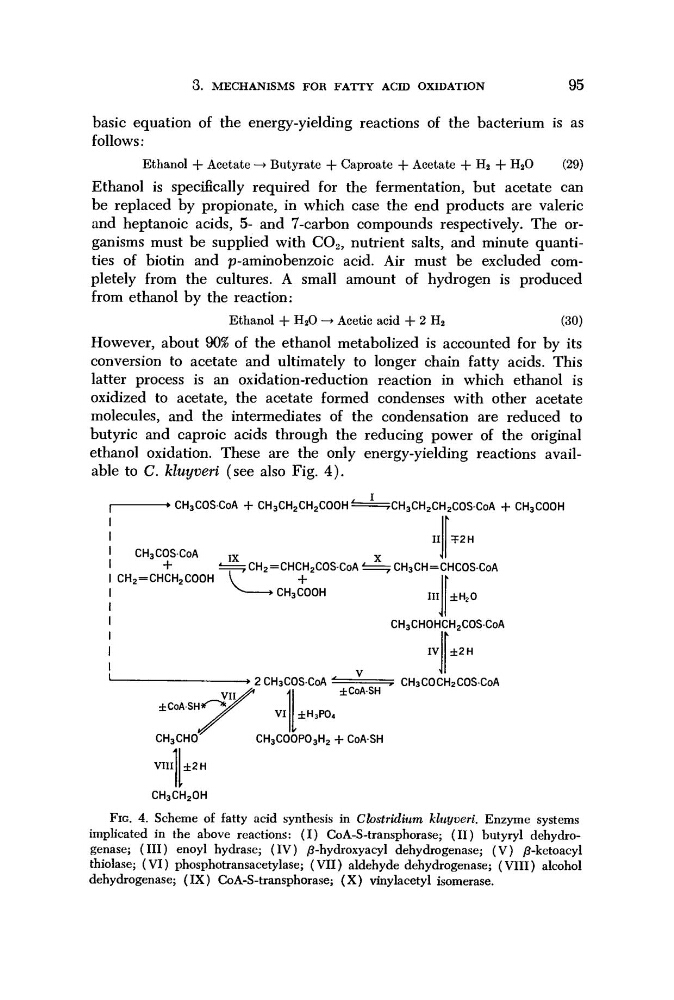
ethanol oxidation. These are the only energy-yielding reactions available to C. kluyveri (see also Fig. 4).
-► CH3COS-C0A + CHgCH^XHsCOOHrCH3CH2CH2COS-CoA + CH3COOH
II T2H
CH3COS-C0A
ιχ
χ
+
f=p^CH2=CHCH2COS-CoAf=^CH3CH = CHCOS-CoA
CH2 = CHCH2C00H
l
+
If
► CH3COOH
m
±H2O
CH3CHOHCH2COS-CoA
IV ±2H
-> 2 CH3COS-C0A -
VI
±CoA-SH
CH3COCH2COS-CoA
±H3P04
CH3CHO
CH3C00P03H2 + CoA-SH
VIII ±2H
CH3CH20H
FIG. 4. Scheme of fatty acid synthesis in Chstridium
kluyveri. Enzyme systems
implicated in the above reactions: (I) CoA-S-transphorase; (II) butyryl dehydrogenase; (III) enoyl hydrase; (IV) /?-hydroxyacyl dehydrogenase; (V) /?-ketoacyl
thiolase; (VI) phosphotransacetylase; (VII) aldehyde dehydrogenase; (VIII) alcohol
dehydrogenase; (IX) CoA-S-transphorase; (X) vinylacetyl isomerase.
95
basic equation of the energy-yielding reactions of the bacterium is as
follows:
Ethanol + Acetate —> Butyrate + Caproate + Acetate + H 2 + H 2 0
(29)
Ethanol is specifically required for the fermentation, but acetate can
be replaced by propionate, in which case the end products are valeric
and heptanoic acids, 5- and 7-carbon compounds respectively. The organisms must be supplied with C0 2 , nutrient salts, and minute quantities of biotin and p-aminobenzoic acid. Air must be excluded completely from the cultures. A small amount of hydrogen is produced
from ethanol by the reaction:
Ethanol + H 2 0 -> Acetic acid + 2 H 2
(30)
However, about 90% of the ethanol metabolized is accounted for by its
conversion to acetate and ultimately to longer chain fatty acids. This
latter process is an oxidation-reduction reaction in which ethanol is
oxidized to acetate, the acetate formed condenses with other acetate
molecules, and the intermediates of the condensation are reduced to
butyric and caproic acids through the reducing power of the original
ethanol oxidation. These are the only energy-yielding reactions available to C. kluyveri (see also Fig. 4).
-► CH3COS-C0A + CHgCH^XHsCOOHrCH3CH2CH2COS-CoA + CH3COOH
II T2H
CH3COS-C0A
ιχ
χ
+
f=p^CH2=CHCH2COS-CoAf=^CH3CH = CHCOS-CoA
CH2 = CHCH2C00H
l
+
If
► CH3COOH
m
±H2O
CH3CHOHCH2COS-CoA
IV ±2H
-> 2 CH3COS-C0A -
VI
±CoA-SH
CH3COCH2COS-CoA
±H3P04
CH3CHO
CH3C00P03H2 + CoA-SH
VIII ±2H
CH3CH20H
FIG. 4. Scheme of fatty acid synthesis in Chstridium
kluyveri. Enzyme systems
implicated in the above reactions: (I) CoA-S-transphorase; (II) butyryl dehydrogenase; (III) enoyl hydrase; (IV) /?-hydroxyacyl dehydrogenase; (V) /?-ketoacyl
thiolase; (VI) phosphotransacetylase; (VII) aldehyde dehydrogenase; (VIII) alcohol
dehydrogenase; (IX) CoA-S-transphorase; (X) vinylacetyl isomerase.