

3. MECHANISMS FOR FATTY ACID OXIDATION
93
C
I
C
C 2
Methylmalonate pathway (animal)
{55a)
I
/
S
...Q...
> CCCOOH —> ß-Hydroxypropionate pathway (plant)
(56)
I
/3-oxidation
\
Q
/3-Hydroxypropionyl-CoA pathway (bacteria) (56b)
COOH
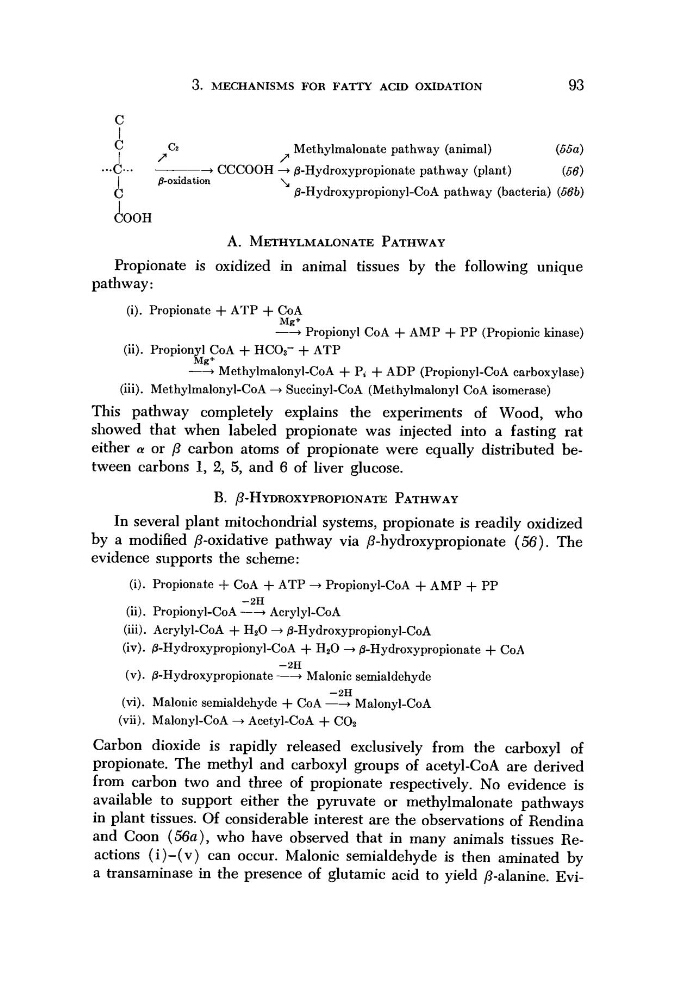
A. METHYLMALONATE PATHWAY
Propionate is oxidized in animal tissues by the following unique
pathway:
(i). Propionate + ATP + Co A
> Propionyl Co A -{- AMP + PP (Propionic kinase)
(ii). Propionyl CoA + HCOr + ATP
> Methylmalonyl-CoA + P t + ADP (Propionyl-CoA carboxylase)
(iii). Methylmalonyl-CoA —> Succinyl-CoA (Methylmalonyl CoA isomerase)
This pathway completely explains the experiments of Wood, who
showed that when labeled propionate was injected into a fasting rat
either a or ß carbon atoms of propionate were equally distributed between carbons 1, 2, 5, and 6 of liver glucose.
B. /?-HYDROXYPROPIONATE PATHWAY
In several plant mitochondrial systems, propionate is readily oxidized
by a modified β-oxidative pathway via ß-hydroxypropionate (56). The
evidence supports the scheme:
(i). Propionate -f CoA + ATP -> Propionyl-CoA + AMP + PP
-2H
(ii). Propionyl-CoA
> Acrylyl-CoA
(iii). Acrylyl-CoA + H 2 0 —* /3-Hydroxypropionyl-CoA
(iv). ß-Hydroxypropionyl-CoA + H 2 0 —> jS-Hydroxypropionate + CoA
-2H
(v). /3-Hydroxypropionate
> Malonic semialdehyde
-2H
(vi). Malonic semialdehyde + CoA
> Malonyl-CoA
(vii). Malonyl-CoA -* Acetyl-CoA + C0 2
Carbon dioxide is rapidly released exclusively from the carboxyl of
propionate. The methyl and carboxyl groups of acetyl-CoA are derived
from carbon two and three of propionate respectively. No evidence is
available to support either the pyruvate or methylmalonate pathways
in plant tissues. Of considerable interest are the observations of Rendina
and Coon (56a), who have observed that in many animals tissues Reactions (i)-(v) can occur. Malonic semialdehyde is then aminated by
a transaminase in the presence of glutamic acid to yield /?-alanine. Evi-
93
C
I
C
C 2
Methylmalonate pathway (animal)
{55a)
I
/
S
...Q...
> CCCOOH —> ß-Hydroxypropionate pathway (plant)
(56)
I
/3-oxidation
\
Q
/3-Hydroxypropionyl-CoA pathway (bacteria) (56b)
COOH
A. METHYLMALONATE PATHWAY
Propionate is oxidized in animal tissues by the following unique
pathway:
(i). Propionate + ATP + Co A
> Propionyl Co A -{- AMP + PP (Propionic kinase)
(ii). Propionyl CoA + HCOr + ATP
> Methylmalonyl-CoA + P t + ADP (Propionyl-CoA carboxylase)
(iii). Methylmalonyl-CoA —> Succinyl-CoA (Methylmalonyl CoA isomerase)
This pathway completely explains the experiments of Wood, who
showed that when labeled propionate was injected into a fasting rat
either a or ß carbon atoms of propionate were equally distributed between carbons 1, 2, 5, and 6 of liver glucose.
B. /?-HYDROXYPROPIONATE PATHWAY
In several plant mitochondrial systems, propionate is readily oxidized
by a modified β-oxidative pathway via ß-hydroxypropionate (56). The
evidence supports the scheme:
(i). Propionate -f CoA + ATP -> Propionyl-CoA + AMP + PP
-2H
(ii). Propionyl-CoA
> Acrylyl-CoA
(iii). Acrylyl-CoA + H 2 0 —* /3-Hydroxypropionyl-CoA
(iv). ß-Hydroxypropionyl-CoA + H 2 0 —> jS-Hydroxypropionate + CoA
-2H
(v). /3-Hydroxypropionate
> Malonic semialdehyde
-2H
(vi). Malonic semialdehyde + CoA
> Malonyl-CoA
(vii). Malonyl-CoA -* Acetyl-CoA + C0 2
Carbon dioxide is rapidly released exclusively from the carboxyl of
propionate. The methyl and carboxyl groups of acetyl-CoA are derived
from carbon two and three of propionate respectively. No evidence is
available to support either the pyruvate or methylmalonate pathways
in plant tissues. Of considerable interest are the observations of Rendina
and Coon (56a), who have observed that in many animals tissues Reactions (i)-(v) can occur. Malonic semialdehyde is then aminated by
a transaminase in the presence of glutamic acid to yield /?-alanine. Evi-