

82
P. K. STUMPF AND G. A. BARBER
chain length. This is a very favorable condition for the extraction of
utilizable energy from fatty acids.
B. FORMATION OF THE ETHYLENIC GROUP
There are two approaches in the synthesis of the important 2ethylenic bond in fatty acids: (a) by an a-ß dehydrogenation, and (b)
by a dehydration reaction.
1. Dehydrogenation
The primary oxidation of acyl Co A involves at least two steps: (a)
the removal of hydrogen from the a-ß carbons of the acyl group by a
specific dehydrogenase; and (b) the transfer of these hydrogens by a
specific flavoprotein, the electron transfer flavoprotein (ETF), to a
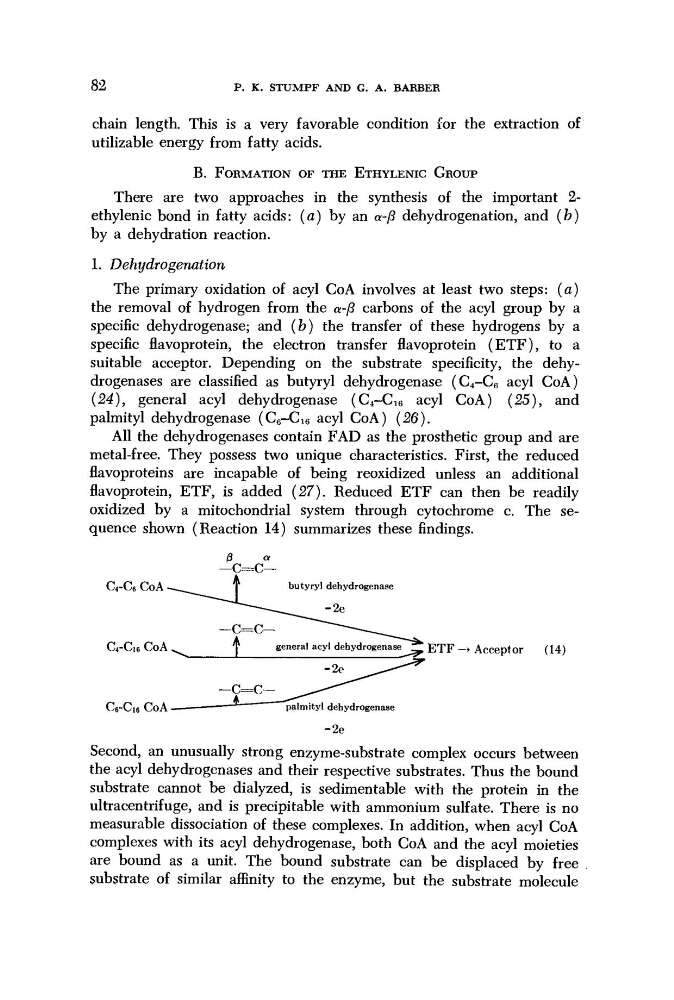
suitable acceptor. Depending on the substrate specificity, the dehydrogenases are classified as butyryl dehydrogenase (C 4 -C 6 acyl CoA)
(24), general acyl dehydrogenase (C 4 -Cie acyl CoA) (25), and
palmityl dehydrogenase (C 6 -C 16 acyl CoA) (26).
All the dehydrogenases contain FAD as the prosthetic group and are
metal-free. They possess two unique characteristics. First, the reduced
flavoproteins are incapable of being reoxidized unless an additional
flavoprotein, ETF, is added (27). Reduced ETF can then be readily
oxidized by a mitochondrial system through cytochrome c. The sequence shown (Reaction 14) summarizes these findings.
C 4 -C 6 CoA
C 4 -C, 6 CoA
C 6 -Ci6 CoA
butyryl dehydrogenase
—c=cΎ
general acyl dehydrogenase
ETF -* Acceptor
(14)
palmityl dehydrogenase
-2e
Second, an unusually strong enzyme-substrate complex occurs between
the acyl dehydrogenases and their respective substrates. Thus the bound
substrate cannot be dialyzed, is sedimentable with the protein in the
ultracentrifuge, and is precipitable with ammonium sulfate. There is no
measurable dissociation of these complexes. In addition, when acyl CoA
complexes with its acyl dehydrogenase, both CoA and the acyl moieties
are bound as a unit. The bound substrate can be displaced by free
substrate of similar affinity to the enzyme, but the substrate molecule
P. K. STUMPF AND G. A. BARBER
chain length. This is a very favorable condition for the extraction of
utilizable energy from fatty acids.
B. FORMATION OF THE ETHYLENIC GROUP
There are two approaches in the synthesis of the important 2ethylenic bond in fatty acids: (a) by an a-ß dehydrogenation, and (b)
by a dehydration reaction.
1. Dehydrogenation
The primary oxidation of acyl Co A involves at least two steps: (a)
the removal of hydrogen from the a-ß carbons of the acyl group by a
specific dehydrogenase; and (b) the transfer of these hydrogens by a
specific flavoprotein, the electron transfer flavoprotein (ETF), to a
suitable acceptor. Depending on the substrate specificity, the dehydrogenases are classified as butyryl dehydrogenase (C 4 -C 6 acyl CoA)
(24), general acyl dehydrogenase (C 4 -Cie acyl CoA) (25), and
palmityl dehydrogenase (C 6 -C 16 acyl CoA) (26).
All the dehydrogenases contain FAD as the prosthetic group and are
metal-free. They possess two unique characteristics. First, the reduced
flavoproteins are incapable of being reoxidized unless an additional
flavoprotein, ETF, is added (27). Reduced ETF can then be readily
oxidized by a mitochondrial system through cytochrome c. The sequence shown (Reaction 14) summarizes these findings.
C 4 -C 6 CoA
C 4 -C, 6 CoA
C 6 -Ci6 CoA
butyryl dehydrogenase
—c=cΎ
general acyl dehydrogenase
ETF -* Acceptor
(14)
palmityl dehydrogenase
-2e
Second, an unusually strong enzyme-substrate complex occurs between
the acyl dehydrogenases and their respective substrates. Thus the bound
substrate cannot be dialyzed, is sedimentable with the protein in the
ultracentrifuge, and is precipitable with ammonium sulfate. There is no
measurable dissociation of these complexes. In addition, when acyl CoA
complexes with its acyl dehydrogenase, both CoA and the acyl moieties
are bound as a unit. The bound substrate can be displaced by free
substrate of similar affinity to the enzyme, but the substrate molecule