

30
THOMAS
S.
ARGYRIS
activity. Tsanev (1963) suggests that for a cell to divide it must receive
a critical amount of sublethal damage, which results in a series of
reversible intracellular changes leading to the stimulation of cell division.
If cells are lethally damaged the intracellular changes are irreversible
and lead to cell death. What the molecular mechanisms involved in RNA
degradation are and how they are associated with the stimulus for cell
division will be considered below in our discussion of the molecular basis
of damaged-induced growth (Section IV,B).
iooh
-60 -
-80 -
-IOQ
1
' ' I ?
— I
1
1
123
20
48
72 hours
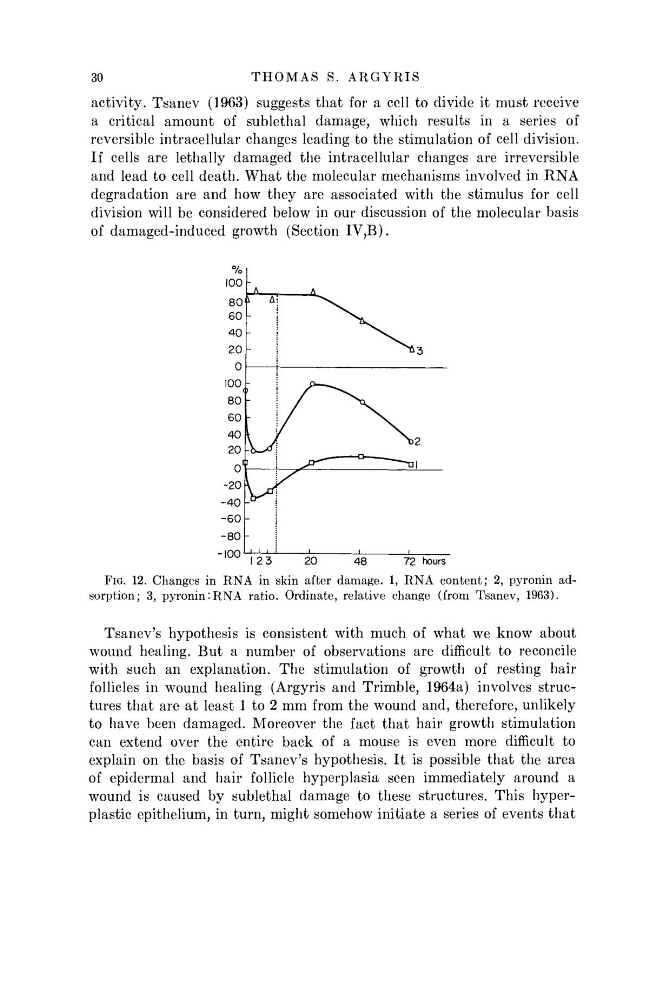
FIG. 12. Changes in RNA in skin after damage. 1, RNA content; 2, pyronin adsorption; 3, pyronin:RNA ratio. Ordinate, relative change (from Tsanev, 1963).
Tsanev's hypothesis is consistent with much of what we know about
wound healing. But a number of observations are difficult to reconcile
with such an explanation. The stimulation of growth of resting hair
follicles in wound healing (Argyris and Trimble, 1964a) involves structures that are at least 1 to 2 mm from the wound and, therefore, unlikely
to have been damaged. Moreover the fact that hair growth stimulation
can extend over the entire back of a mouse is even more difficult to
explain on the basis of Tsanev's hypothesis. It is possible that the area
of epidermal and hair follicle hyperplasia seen immediately around a
wound is caused by sublethal damage to these structures. This hyperplastic epithelium, in turn, might somehow initiate a series of events that
THOMAS
S.
ARGYRIS
activity. Tsanev (1963) suggests that for a cell to divide it must receive
a critical amount of sublethal damage, which results in a series of
reversible intracellular changes leading to the stimulation of cell division.
If cells are lethally damaged the intracellular changes are irreversible
and lead to cell death. What the molecular mechanisms involved in RNA
degradation are and how they are associated with the stimulus for cell
division will be considered below in our discussion of the molecular basis
of damaged-induced growth (Section IV,B).
iooh
-60 -
-80 -
-IOQ
1
' ' I ?
— I
1
1
123
20
48
72 hours
FIG. 12. Changes in RNA in skin after damage. 1, RNA content; 2, pyronin adsorption; 3, pyronin:RNA ratio. Ordinate, relative change (from Tsanev, 1963).
Tsanev's hypothesis is consistent with much of what we know about
wound healing. But a number of observations are difficult to reconcile
with such an explanation. The stimulation of growth of resting hair
follicles in wound healing (Argyris and Trimble, 1964a) involves structures that are at least 1 to 2 mm from the wound and, therefore, unlikely
to have been damaged. Moreover the fact that hair growth stimulation
can extend over the entire back of a mouse is even more difficult to
explain on the basis of Tsanev's hypothesis. It is possible that the area
of epidermal and hair follicle hyperplasia seen immediately around a
wound is caused by sublethal damage to these structures. This hyperplastic epithelium, in turn, might somehow initiate a series of events that