

324
LIONEL F. JAFFE
times faster than the Fucus rhizoid [3 mm/hour for Neurospora
(Slayman, 1966) vs. about 2 /x/hour for Fucus]. So a similar relationship
between current and elongation would be plausible.
By using intracellular salt bridges, Kinosita has recorded fields of
about 1 volt/cm within fish melanophores as well as iridocytes. These
develop before, are in the right direction, and seem large enough to
account for both the distal and the proximal migration of the pigment
granules within both these cell types via electrophoresis (Kinosita,
1963). Again, in principle, such fields might arise from fixed-charge
gradients instead of membrane drive currents. However, these fields may
reverse completely within a few minutes. Such changes could be produced
by the rearrangement of a small number of surface molecules if the
fields arose from membrane-driven currents; but they would require a
change in most of the cell's macromolecules if the fields arose from
fixed-charge gradients. Hence currents are quite probably the cause of
these remarkable fields.
Although these granule movements are reversible and, hence, by
definition, are not developmental, their physiology may otherwise resemble that of the developmentally critical, ooplasmic segregation movements and thus be an important model for embryologists.
B. Control of Cell Polarity by Applied Fields
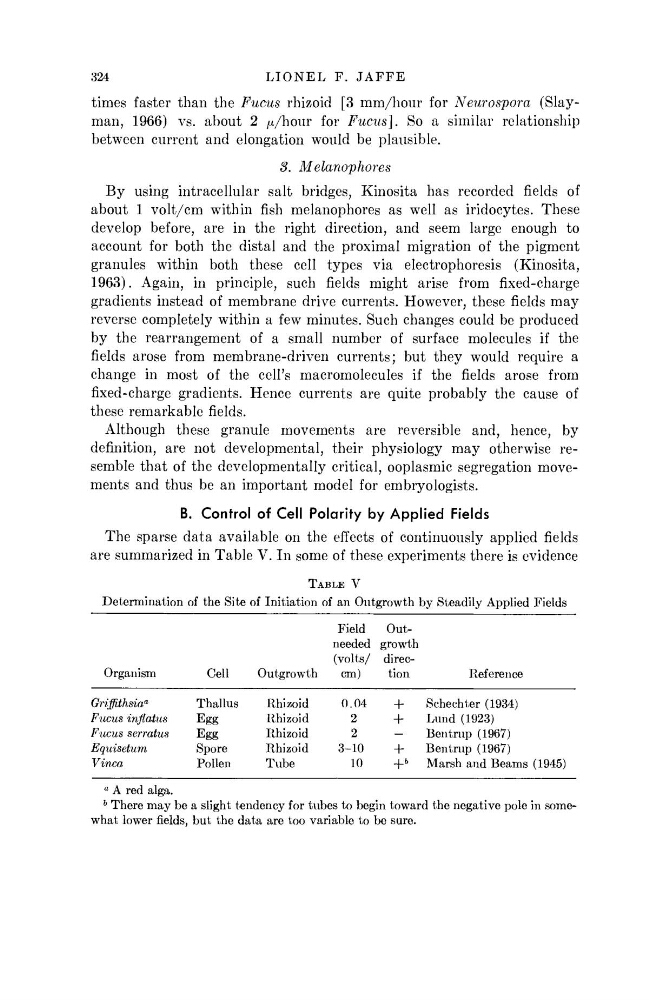
The sparse data available on the effects of continuously applied fields
are summarized in Table V. In some of these experiments there is evidence
Determination of the Site of Initiation of an Outgrowth by Steadily Applied Fields
8.
Melanophores
TABLE V
Organism
Cell
Outgrowth
Field
Outneeded growth
(volts/ direccm)
tion
Reference
Griffithsia
a
Fucus inflatus
Fucus serratus
Equisetum
Vinca
Thallus
Egg
Egg
Spore
Pollen
Rhizoid
Rhizoid
Rhizoid
Rhizoid
Tube
0.04
2
2
3-10
10
+
Schechter (1934)
+
Lund (1923)
+
&
Marsh and Beams (1945)
-
Bentrup (1967)
+
Bentrup (1967)
a
A red alga.
b
There may be a slight tendency for tubes to begin toward the negative pole in somewhat lower fields, but the data are too variable to be sure.
LIONEL F. JAFFE
times faster than the Fucus rhizoid [3 mm/hour for Neurospora
(Slayman, 1966) vs. about 2 /x/hour for Fucus]. So a similar relationship
between current and elongation would be plausible.
By using intracellular salt bridges, Kinosita has recorded fields of
about 1 volt/cm within fish melanophores as well as iridocytes. These
develop before, are in the right direction, and seem large enough to
account for both the distal and the proximal migration of the pigment
granules within both these cell types via electrophoresis (Kinosita,
1963). Again, in principle, such fields might arise from fixed-charge
gradients instead of membrane drive currents. However, these fields may
reverse completely within a few minutes. Such changes could be produced
by the rearrangement of a small number of surface molecules if the
fields arose from membrane-driven currents; but they would require a
change in most of the cell's macromolecules if the fields arose from
fixed-charge gradients. Hence currents are quite probably the cause of
these remarkable fields.
Although these granule movements are reversible and, hence, by
definition, are not developmental, their physiology may otherwise resemble that of the developmentally critical, ooplasmic segregation movements and thus be an important model for embryologists.
B. Control of Cell Polarity by Applied Fields
The sparse data available on the effects of continuously applied fields
are summarized in Table V. In some of these experiments there is evidence
Determination of the Site of Initiation of an Outgrowth by Steadily Applied Fields
8.
Melanophores
TABLE V
Organism
Cell
Outgrowth
Field
Outneeded growth
(volts/ direccm)
tion
Reference
Griffithsia
a
Fucus inflatus
Fucus serratus
Equisetum
Vinca
Thallus
Egg
Egg
Spore
Pollen
Rhizoid
Rhizoid
Rhizoid
Rhizoid
Tube
0.04
2
2
3-10
10
+
Schechter (1934)
+
Lund (1923)
+
&
Marsh and Beams (1945)
-
Bentrup (1967)
+
Bentrup (1967)
a
A red alga.
b
There may be a slight tendency for tubes to begin toward the negative pole in somewhat lower fields, but the data are too variable to be sure.