

LOCALIZATION IN THE DEVELOPING FUCUS EGG
313
401
i
I
i
I
1
1
1
1
0
2
4
6
8
MILLIMETERS FROM THALLUS —
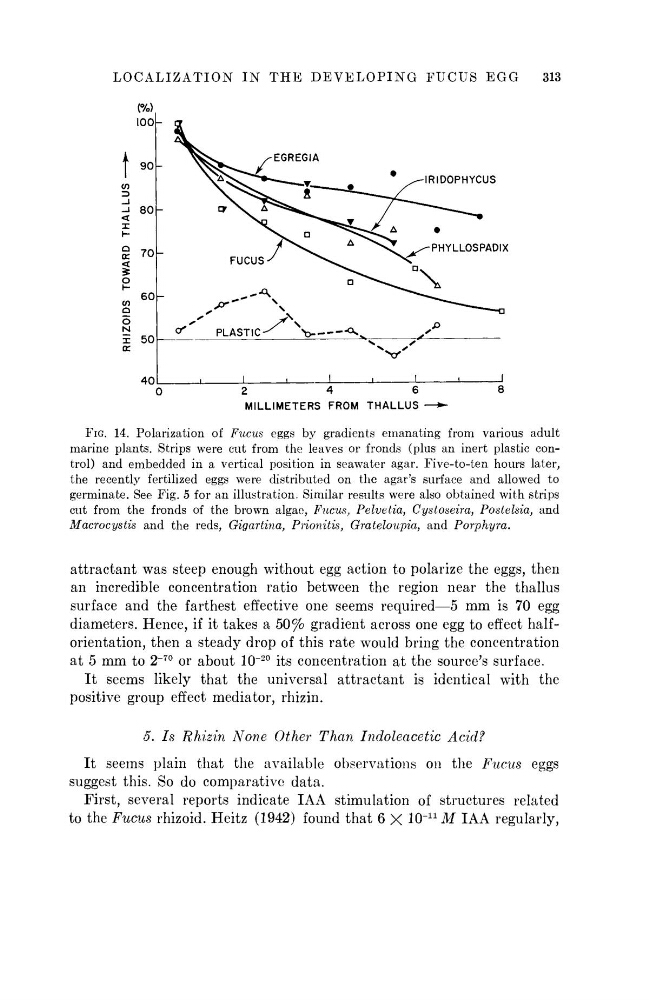
FIG. 14. Polarization of Fucus eggs by gradients emanating from various adult
marine plants. Strips were cut from the leaves or fronds (plus an inert plastic control) and embedded in a vertical position in seawater agar. Five-to-ten hours later,
the recently fertilized eggs were distributed on the agar's surface and allowed to
germinate. See Fig. 5 for an illustration. Similar results were also obtained with strips
cut from the fronds of the brown algae, Fucus, Pelvetia, Cystoseira, Postelsia, and
Macrocystis and the reds, Gigartina, Prionitis, Grateloupia, and Porphyra.
attractant was steep enough without egg action to polarize the eggs, then
an incredible concentration ratio between the region near the thallus
surface and the farthest effective one seems required—5 mm is 70 egg
diameters. Hence, if it takes a 50% gradient across one egg to effect halforientation, then a steady drop of this rate would bring the concentration
at 5 mm to 2
- 7 0 or about 10~
20 its concentration at the source's surface.
It seems likely that the universal attractant is identical with the
positive group effect mediator, rhizin.
5. Is Rhizin None Other Than Indoleacetic
Acid?
It seems plain that the available observations on the Fucus eggs
suggest this. So do comparative data.
First, several reports indicate IAA stimulation of structures related
to the Fucus rhizoid. Heitz (1942) found that 6 X 10
- 1 1 Af IAA regularly,
RHIZOIDS TOWARD THALLUS -
313
401
i
I
i
I
1
1
1
1
0
2
4
6
8
MILLIMETERS FROM THALLUS —
FIG. 14. Polarization of Fucus eggs by gradients emanating from various adult
marine plants. Strips were cut from the leaves or fronds (plus an inert plastic control) and embedded in a vertical position in seawater agar. Five-to-ten hours later,
the recently fertilized eggs were distributed on the agar's surface and allowed to
germinate. See Fig. 5 for an illustration. Similar results were also obtained with strips
cut from the fronds of the brown algae, Fucus, Pelvetia, Cystoseira, Postelsia, and
Macrocystis and the reds, Gigartina, Prionitis, Grateloupia, and Porphyra.
attractant was steep enough without egg action to polarize the eggs, then
an incredible concentration ratio between the region near the thallus
surface and the farthest effective one seems required—5 mm is 70 egg
diameters. Hence, if it takes a 50% gradient across one egg to effect halforientation, then a steady drop of this rate would bring the concentration
at 5 mm to 2
- 7 0 or about 10~
20 its concentration at the source's surface.
It seems likely that the universal attractant is identical with the
positive group effect mediator, rhizin.
5. Is Rhizin None Other Than Indoleacetic
Acid?
It seems plain that the available observations on the Fucus eggs
suggest this. So do comparative data.
First, several reports indicate IAA stimulation of structures related
to the Fucus rhizoid. Heitz (1942) found that 6 X 10
- 1 1 Af IAA regularly,
RHIZOIDS TOWARD THALLUS -