

308
LIONEL F. JAFFE
TABLE
III
Germination of Fucus Eggs Away from Egg Water
% Rhizoids toward medium exposed to
No. of
Illuminated
Dark
pH
Buffer
test eggs
No eggs
eggs
eggs
8.2
0.05 M tris
19, 61, 19
42 ± 11
13+5
25 + 9
7.6
None
33, 47, 46
40 + 9
10+4
25+6
7.6
0.05 M tris
—, 23, 59
—
9 ± 6
18 + 5
6.4
0.01 M phosphate
54, 73, 27
45+7
24 + 5
39+9
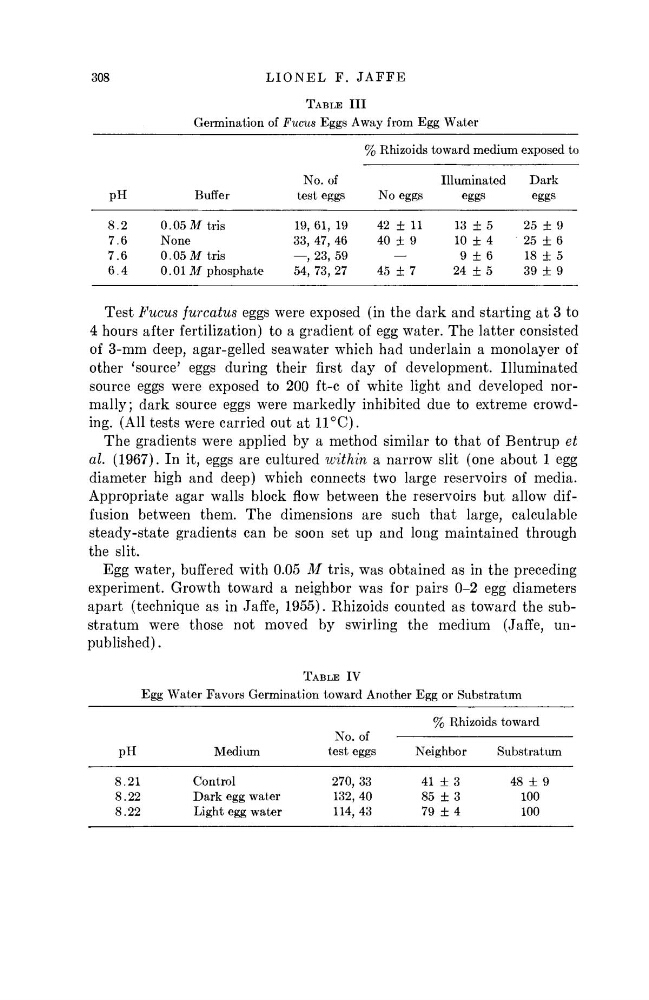
Test Fucus furcatus eggs were exposed (in the dark and starting at 3 to
4 hours after fertilization) to a gradient of egg water. The latter consisted
of 3-mm deep, agar-gelled seawater which had underlain a monolayer of
other 'source' eggs during their first day of development. Illuminated
source eggs were exposed to 200 ft-c of white light and developed normally; dark source eggs were markedly inhibited due to extreme crowding. (All tests were carried out at 11°C).
The gradients were applied by a method similar to that of Bentrup et
al. (1967). In it, eggs are cultured within a narrow slit (one about 1 egg
diameter high and deep) which connects two large reservoirs of media.
Appropriate agar walls block flow between the reservoirs but allow diffusion between them. The dimensions are such that large, calculable
steady-state gradients can be soon set up and long maintained through
the slit.
Egg water, buffered with 0.05 M tris, was obtained as in the preceding
experiment. Growth toward a neighbor was for pairs 0-2 egg diameters
apart (technique as in Jaffe, 1955). Rhizoids counted as toward the substratum were those not moved by swirling the medium (Jaffe, unpublished) .
TABLE IV
Egg Water Favors Germination toward Another Egg or Substratum
% Rhizoids toward
No. of
pH
Medium
test eggs
Neighbor
Substratum
8.21
Control
270, 33
41+3
48 + 9
8.22
Dark egg water
132, 40
85 + 3
100
8.22
Light egg water
114, 43
79 + 4
100
LIONEL F. JAFFE
TABLE
III
Germination of Fucus Eggs Away from Egg Water
% Rhizoids toward medium exposed to
No. of
Illuminated
Dark
pH
Buffer
test eggs
No eggs
eggs
eggs
8.2
0.05 M tris
19, 61, 19
42 ± 11
13+5
25 + 9
7.6
None
33, 47, 46
40 + 9
10+4
25+6
7.6
0.05 M tris
—, 23, 59
—
9 ± 6
18 + 5
6.4
0.01 M phosphate
54, 73, 27
45+7
24 + 5
39+9
Test Fucus furcatus eggs were exposed (in the dark and starting at 3 to
4 hours after fertilization) to a gradient of egg water. The latter consisted
of 3-mm deep, agar-gelled seawater which had underlain a monolayer of
other 'source' eggs during their first day of development. Illuminated
source eggs were exposed to 200 ft-c of white light and developed normally; dark source eggs were markedly inhibited due to extreme crowding. (All tests were carried out at 11°C).
The gradients were applied by a method similar to that of Bentrup et
al. (1967). In it, eggs are cultured within a narrow slit (one about 1 egg
diameter high and deep) which connects two large reservoirs of media.
Appropriate agar walls block flow between the reservoirs but allow diffusion between them. The dimensions are such that large, calculable
steady-state gradients can be soon set up and long maintained through
the slit.
Egg water, buffered with 0.05 M tris, was obtained as in the preceding
experiment. Growth toward a neighbor was for pairs 0-2 egg diameters
apart (technique as in Jaffe, 1955). Rhizoids counted as toward the substratum were those not moved by swirling the medium (Jaffe, unpublished) .
TABLE IV
Egg Water Favors Germination toward Another Egg or Substratum
% Rhizoids toward
No. of
pH
Medium
test eggs
Neighbor
Substratum
8.21
Control
270, 33
41+3
48 + 9
8.22
Dark egg water
132, 40
85 + 3
100
8.22
Light egg water
114, 43
79 + 4
100