

280
L A U R I S A X E N E T A L .
provide a means for synchronous and coordinated cytodifferentiation,
since cells linked b y junctional complexes act as units of ionic environments rather than as individual cells.
H o w much the increased amounts of R N A and protein noticed in the
aggregating cells reflect the onset of a homotypic interaction is a matter
of speculation, as they can already be detected before the formation of
the junctional complexes. On the other hand, later protein markers as
well as the morphological orientation of the cell constituents m a y well be
connected with homotypic interaction.
As mentioned, the next step in the differentiation of the aggregate is
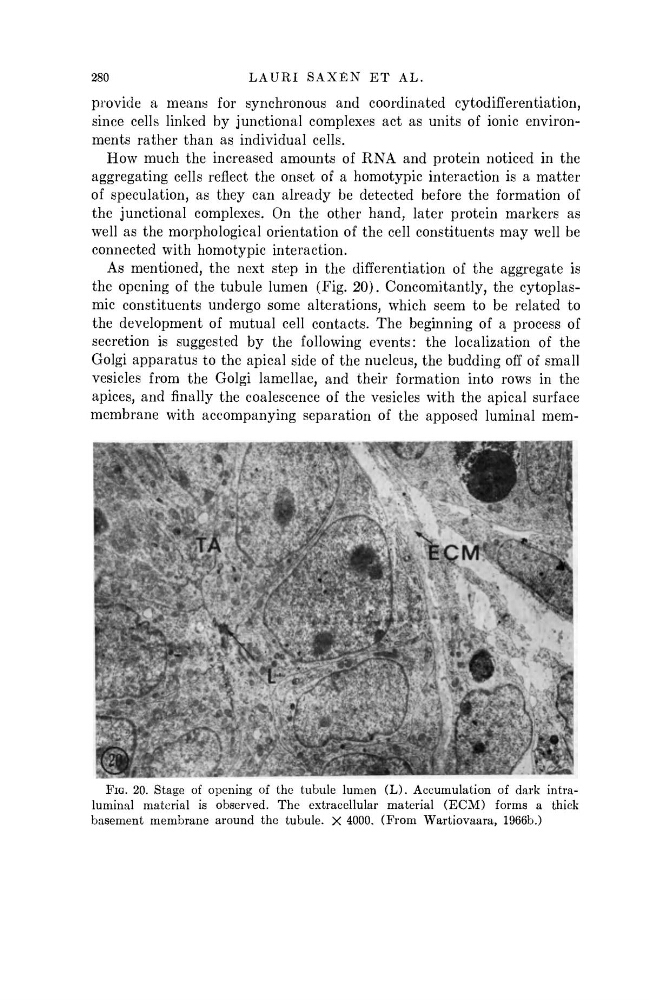
the opening of the tubule lumen (Fig. 2 0 ) . Concomitantly, the cytoplasmic constituents undergo some alterations, which seem to be related to
the development of mutual cell contacts. T h e beginning of a process of
secretion is suggested b y the following events: the localization of the
Golgi apparatus to the apical side of the nucleus, the budding off of small
vesicles from the Golgi lamellae, and their formation into rows in the
apices, and finally the coalescence of the vesicles with the apical surface
membrane with accompanying separation of the apposed luminal memFIG. 20. Stage of opening of the tubule lumen ( L ) . Accumulation of dark intraluminal material is observed. The extracellular material ( E C M ) forms a thick
basement membrane around the tubule. X 4000. (From Wartiovaara, 1966b.)
L A U R I S A X E N E T A L .
provide a means for synchronous and coordinated cytodifferentiation,
since cells linked b y junctional complexes act as units of ionic environments rather than as individual cells.
H o w much the increased amounts of R N A and protein noticed in the
aggregating cells reflect the onset of a homotypic interaction is a matter
of speculation, as they can already be detected before the formation of
the junctional complexes. On the other hand, later protein markers as
well as the morphological orientation of the cell constituents m a y well be
connected with homotypic interaction.
As mentioned, the next step in the differentiation of the aggregate is
the opening of the tubule lumen (Fig. 2 0 ) . Concomitantly, the cytoplasmic constituents undergo some alterations, which seem to be related to
the development of mutual cell contacts. T h e beginning of a process of
secretion is suggested b y the following events: the localization of the
Golgi apparatus to the apical side of the nucleus, the budding off of small
vesicles from the Golgi lamellae, and their formation into rows in the
apices, and finally the coalescence of the vesicles with the apical surface
membrane with accompanying separation of the apposed luminal memFIG. 20. Stage of opening of the tubule lumen ( L ) . Accumulation of dark intraluminal material is observed. The extracellular material ( E C M ) forms a thick
basement membrane around the tubule. X 4000. (From Wartiovaara, 1966b.)