

256
LAURI SAXEN ET AL.
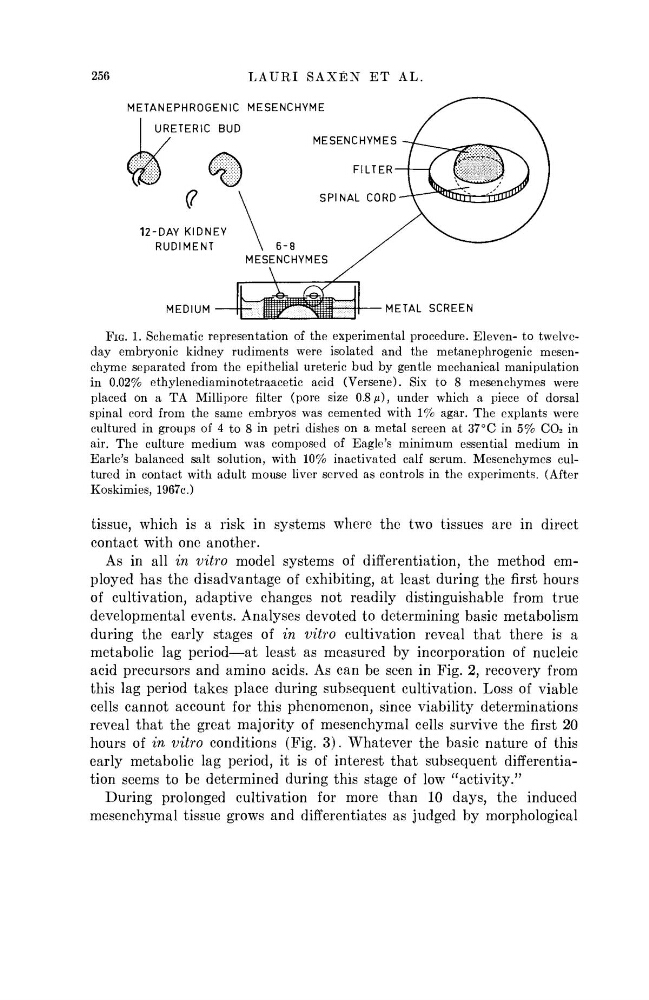
FIG. 1. Schematic representation of the experimental procedure. Eleven- to twelveday embryonic kidney rudiments were isolated and the metanephrogenic mesenchyme separated from the epithelial ureteric bud by gentle mechanical manipulation
in 0.02% ethylenediaminotetraacetic acid (Versene). Six to 8 mesenchymes were
placed on a TA Millipore filter (pore size 0.8 /i), under which a piece of dorsal
spinal cord from the same embryos was cemented with 1% agar. The explants were
cultured in groups of 4 to 8 in petri dishes on a metal screen at 37°C in 5% C0 2 in
air. The culture medium was composed of Eagle's minimum essential medium in
Earle's balanced salt solution, with 10% inactivated calf serum. Mesenchymes cultured in contact with adult mouse liver served as controls in the experiments. (After
Koskimies, 1967c.)
tissue, which is a risk in systems where the two tissues are in direct
contact with one another.
As in all in vitro model systems of differentiation, the method employed has the disadvantage of exhibiting, at least during the first hours
of cultivation, adaptive changes not readily distinguishable from true
developmental events. Analyses devoted to determining basic metabolism
during the early stages of in vitro cultivation reveal that there is a
metabolic lag period—at least as measured by incorporation of nucleic
acid precursors and amino acids. As can be seen in Fig. 2, recovery from
this lag period takes place during subsequent cultivation. Loss of viable
cells cannot account for this phenomenon, since viability determinations
reveal that the great majority of mesenchymal cells survive the first 20
hours of in vitro conditions (Fig. 3). Whatever the basic nature of this
early metabolic lag period, it is of interest that subsequent differentiation seems to be determined during this stage of low "activity."
During prolonged cultivation for more than 10 days, the induced
mesenchymal tissue grows and differentiates as judged by morphological
LAURI SAXEN ET AL.
FIG. 1. Schematic representation of the experimental procedure. Eleven- to twelveday embryonic kidney rudiments were isolated and the metanephrogenic mesenchyme separated from the epithelial ureteric bud by gentle mechanical manipulation
in 0.02% ethylenediaminotetraacetic acid (Versene). Six to 8 mesenchymes were
placed on a TA Millipore filter (pore size 0.8 /i), under which a piece of dorsal
spinal cord from the same embryos was cemented with 1% agar. The explants were
cultured in groups of 4 to 8 in petri dishes on a metal screen at 37°C in 5% C0 2 in
air. The culture medium was composed of Eagle's minimum essential medium in
Earle's balanced salt solution, with 10% inactivated calf serum. Mesenchymes cultured in contact with adult mouse liver served as controls in the experiments. (After
Koskimies, 1967c.)
tissue, which is a risk in systems where the two tissues are in direct
contact with one another.
As in all in vitro model systems of differentiation, the method employed has the disadvantage of exhibiting, at least during the first hours
of cultivation, adaptive changes not readily distinguishable from true
developmental events. Analyses devoted to determining basic metabolism
during the early stages of in vitro cultivation reveal that there is a
metabolic lag period—at least as measured by incorporation of nucleic
acid precursors and amino acids. As can be seen in Fig. 2, recovery from
this lag period takes place during subsequent cultivation. Loss of viable
cells cannot account for this phenomenon, since viability determinations
reveal that the great majority of mesenchymal cells survive the first 20
hours of in vitro conditions (Fig. 3). Whatever the basic nature of this
early metabolic lag period, it is of interest that subsequent differentiation seems to be determined during this stage of low "activity."
During prolonged cultivation for more than 10 days, the induced
mesenchymal tissue grows and differentiates as judged by morphological