

BLASTOGENESIS AND MORPHOGENESIS
191
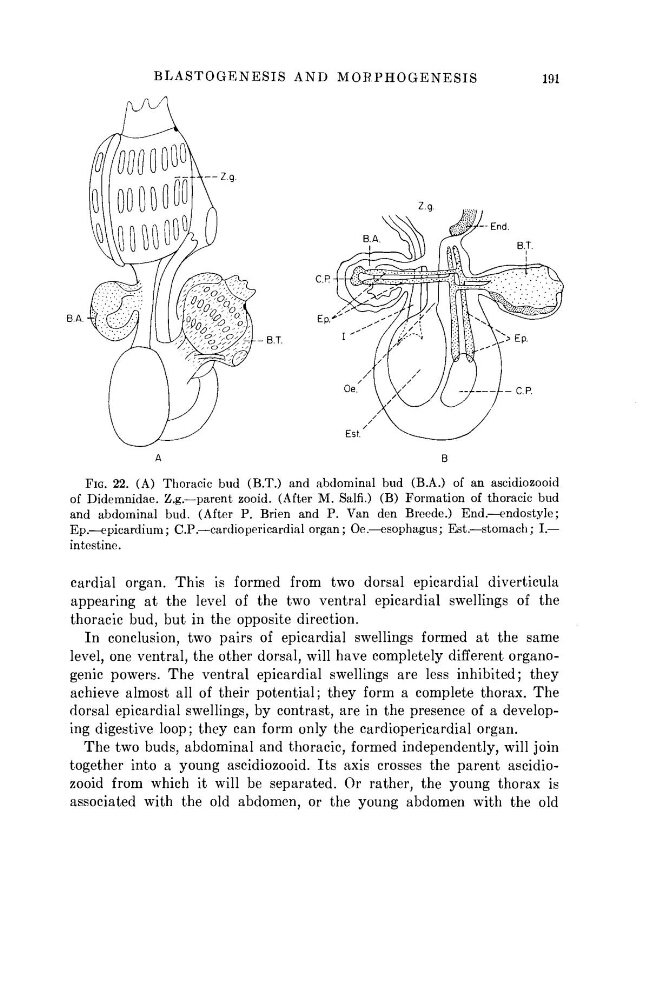
FIG. 22. (A) Thoracic bud (B.T.) and abdominal bud (B.A.) of an ascidiozooid
of Didemnidae. Z.g.—parent zooid. (After M. Salfi.) (B) Formation of thoracic bud
and abdominal bud. (After P. Brien and P. Van den Breede.) End.—endostyle;
Ep.—epicardium; CP.—cardiopericardial organ; Oe.—esophagus; Est.—stomach; I.—
intestine.
cardial organ. This is formed from two dorsal epicardial diverticula
appearing at the level of the two ventral epicardial swellings of the
thoracic bud, but in the opposite direction.
In conclusion, two pairs of epicardial swellings formed at the same
level, one ventral, the other dorsal, will have completely different organogenic powers. The ventral epicardial swellings are less inhibited; they
achieve almost all of their potential; they form a complete thorax. The
dorsal epicardial swellings, by contrast, are in the presence of a developing digestive loop; they can form only the cardiopericardial organ.
The two buds, abdominal and thoracic, formed independently, will join
together into a young ascidiozooid. Its axis crosses the parent ascidiozooid from which it will be separated. Or rather, the young thorax is
associated with the old abdomen, or the young abdomen with the old
A
B
191
FIG. 22. (A) Thoracic bud (B.T.) and abdominal bud (B.A.) of an ascidiozooid
of Didemnidae. Z.g.—parent zooid. (After M. Salfi.) (B) Formation of thoracic bud
and abdominal bud. (After P. Brien and P. Van den Breede.) End.—endostyle;
Ep.—epicardium; CP.—cardiopericardial organ; Oe.—esophagus; Est.—stomach; I.—
intestine.
cardial organ. This is formed from two dorsal epicardial diverticula
appearing at the level of the two ventral epicardial swellings of the
thoracic bud, but in the opposite direction.
In conclusion, two pairs of epicardial swellings formed at the same
level, one ventral, the other dorsal, will have completely different organogenic powers. The ventral epicardial swellings are less inhibited; they
achieve almost all of their potential; they form a complete thorax. The
dorsal epicardial swellings, by contrast, are in the presence of a developing digestive loop; they can form only the cardiopericardial organ.
The two buds, abdominal and thoracic, formed independently, will join
together into a young ascidiozooid. Its axis crosses the parent ascidiozooid from which it will be separated. Or rather, the young thorax is
associated with the old abdomen, or the young abdomen with the old
A
B