

BLASTOGENESIS
AND
MORPHOGENESIS
167
Origin in the Parent
Layers of Blastozooid
Ectoblast
ectoderm
pharynx, digestive loop
peribranchial cavity
Endoblast < epicardium
heart, pericardium
nervous system
mesenchyme
blood
Mesoblast
<
muscles
II Mesenchyme
germ cells
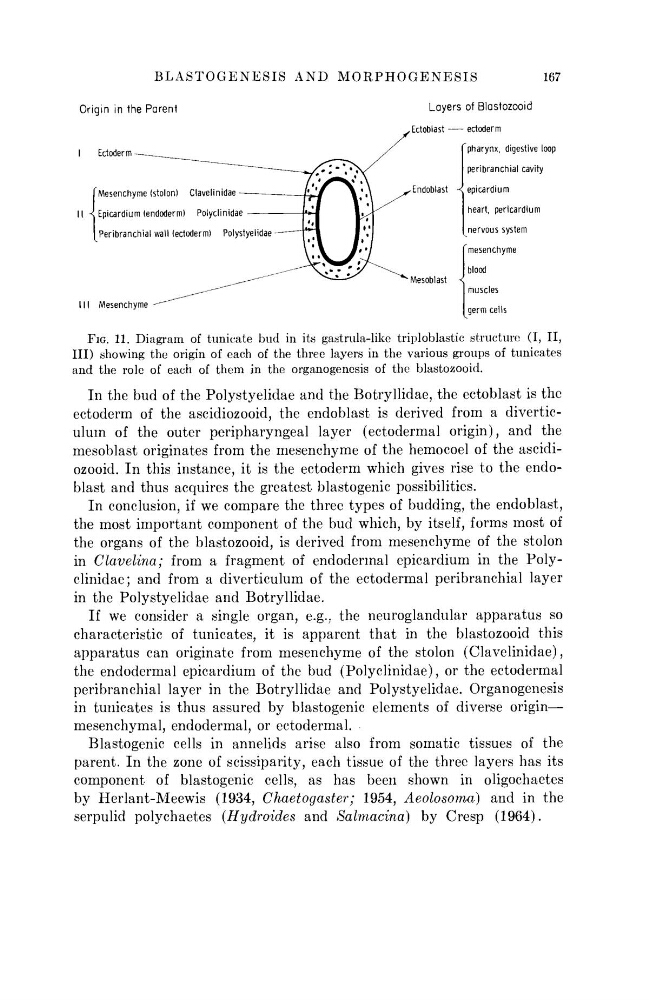
FIG. 11. Diagram of tunicate bud in its gastrula-like triploblastic structure (I, II,
III) showing the origin of each of the three layers in the various groups of tunicates
and the role of each of them in the organogenesis of the blastozooid.
In the bud of the Polystyelidae and the Botryllidae, the ectoblast is the
ectoderm of the ascidiozooid, the endoblast is derived from a diverticulum of the outer peripharyngeal layer (ectodermal origin), and the
mesoblast originates from the mesenchyme of the hemocoel of the ascidiozooid. In this instance, it is the ectoderm which gives rise to the endoblast and thus acquires the greatest blastogenic possibilities.
In conclusion, if we compare the three types of budding, the endoblast,
the most important component of the bud which, by itself, forms most of
the organs of the blastozooid, is derived from mesenchyme of the stolon
in Clavelina;
from a fragment of endodermal epicardium in the Polyclinidae; and from a diverticulum of the ectodermal peribranchial layer
in the Polystyelidae and Botryllidae.
If we consider a single organ, e.g., the neuroglandular apparatus so
characteristic of tunicates, it is apparent that in the blastozooid this
apparatus can originate from mesenchyme of the stolon (Clavelinidae),
the endodermal epicardium of the bud (Polyclinidae), or the ectodermal
peribranchial layer in the Botryllidae and Polystyelidae. Organogenesis
in tunicates is thus assured by blastogenic elements of diverse origin—
mesenchymal, endodermal, or ectodermal.
Blastogenic cells in annelids arise also from somatic tissues of the
parent. In the zone of scissiparity, each tissue of the three layers has its
component of blastogenic cells, as has been shown in oligochaetes
by Herlant-Meewis (1934, Chaetogaster;
1954, Aeolosoma)
and in the
serpulid polychaetes (Hydroides
and Salmacina)
by Cresp (1964).
[Mesenchyme (stolon) Clavelinidae
—
II < Epicardium (endoderm) Polyclinidae
I Peribranchial wall (ectoderm) Polystyelidae
I
Ectoderm-—_______
AND
MORPHOGENESIS
167
Origin in the Parent
Layers of Blastozooid
Ectoblast
ectoderm
pharynx, digestive loop
peribranchial cavity
Endoblast < epicardium
heart, pericardium
nervous system
mesenchyme
blood
Mesoblast
<
muscles
II Mesenchyme
germ cells
FIG. 11. Diagram of tunicate bud in its gastrula-like triploblastic structure (I, II,
III) showing the origin of each of the three layers in the various groups of tunicates
and the role of each of them in the organogenesis of the blastozooid.
In the bud of the Polystyelidae and the Botryllidae, the ectoblast is the
ectoderm of the ascidiozooid, the endoblast is derived from a diverticulum of the outer peripharyngeal layer (ectodermal origin), and the
mesoblast originates from the mesenchyme of the hemocoel of the ascidiozooid. In this instance, it is the ectoderm which gives rise to the endoblast and thus acquires the greatest blastogenic possibilities.
In conclusion, if we compare the three types of budding, the endoblast,
the most important component of the bud which, by itself, forms most of
the organs of the blastozooid, is derived from mesenchyme of the stolon
in Clavelina;
from a fragment of endodermal epicardium in the Polyclinidae; and from a diverticulum of the ectodermal peribranchial layer
in the Polystyelidae and Botryllidae.
If we consider a single organ, e.g., the neuroglandular apparatus so
characteristic of tunicates, it is apparent that in the blastozooid this
apparatus can originate from mesenchyme of the stolon (Clavelinidae),
the endodermal epicardium of the bud (Polyclinidae), or the ectodermal
peribranchial layer in the Botryllidae and Polystyelidae. Organogenesis
in tunicates is thus assured by blastogenic elements of diverse origin—
mesenchymal, endodermal, or ectodermal.
Blastogenic cells in annelids arise also from somatic tissues of the
parent. In the zone of scissiparity, each tissue of the three layers has its
component of blastogenic cells, as has been shown in oligochaetes
by Herlant-Meewis (1934, Chaetogaster;
1954, Aeolosoma)
and in the
serpulid polychaetes (Hydroides
and Salmacina)
by Cresp (1964).
[Mesenchyme (stolon) Clavelinidae
—
II < Epicardium (endoderm) Polyclinidae
I Peribranchial wall (ectoderm) Polystyelidae
I
Ectoderm-—_______