

162
PAUL BRIEN
N-4
N-3
N-2
N-l
N + l
z
Z
Z
\
t
/
*
?
^
1
B3
fi -
_a_
H Vr
B2
b
i \ }
B2
~B2 "
a
b
'
a
~B2 "
— Bl—-<
'
'
y— BI-H
' V
Bl-^
fcz:
B4
Z B3I
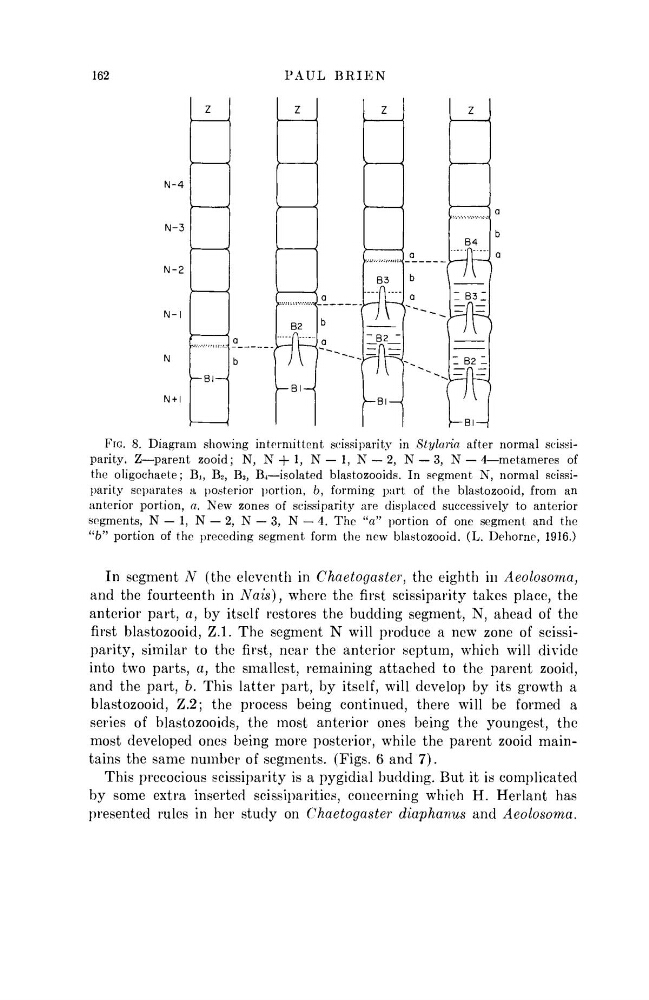
FIG. 8. Diagram showing intermittent scissiparity in Stylaria after normal scissiparity. Z—parent zooid; N, N + l, N — 1, N — 2, N — 3, N — 4—metameres of
the oligochaete; Bi, B>, B 3 , B 4 —isolated blastozooids. In segment N, normal scissiparity separates a posterior portion, b, forming part of the blastozooid, from an
anterior portion, a. New zones of scissiparity are displaced successively to anterior
segments, N — 1, N — 2, N — 3, N — 4. The "a" portion of one segment and the
"6" portion of the preceding segment form the new blastozooid. (L. Dehorne, 1916.)
In segment iV (the eleventh in Chaetogaster,
the eighth in
Aeolosoma,
and the fourteenth in Nais), where the first scissiparity takes place, the
anterior part, a, by itself restores the budding segment, N, ahead of the
first blastozooid, Z.l. The segment N will produce a new zone of scissiparity, similar to the first, near the anterior septum, which will divide
into two parts, a, the smallest, remaining attached to the parent zooid,
and the part, b. This latter part, by itself, will develop by its growth a
blastozooid, Z.2; the process being continued, there will be formed a
series of blastozooids, the most anterior ones being the youngest, the
most developed ones being more posterior, while the parent zooid maintains the same number of segments. (Figs. 6 and 7).
This precocious scissiparity is a pygidial budding. But it is complicated
by some extra inserted scissiparities, concerning which H. Herlant has
presented rules in her study on Chaetogaster
diaphanus and
Aeolosoma.
z
a
b
a
N
PAUL BRIEN
N-4
N-3
N-2
N-l
N + l
z
Z
Z
\
t
/
*
?
^
1
B3
fi -
_a_
H Vr
B2
b
i \ }
B2
~B2 "
a
b
'
a
~B2 "
— Bl—-<
'
'
y— BI-H
' V
Bl-^
fcz:
B4
Z B3I
FIG. 8. Diagram showing intermittent scissiparity in Stylaria after normal scissiparity. Z—parent zooid; N, N + l, N — 1, N — 2, N — 3, N — 4—metameres of
the oligochaete; Bi, B>, B 3 , B 4 —isolated blastozooids. In segment N, normal scissiparity separates a posterior portion, b, forming part of the blastozooid, from an
anterior portion, a. New zones of scissiparity are displaced successively to anterior
segments, N — 1, N — 2, N — 3, N — 4. The "a" portion of one segment and the
"6" portion of the preceding segment form the new blastozooid. (L. Dehorne, 1916.)
In segment iV (the eleventh in Chaetogaster,
the eighth in
Aeolosoma,
and the fourteenth in Nais), where the first scissiparity takes place, the
anterior part, a, by itself restores the budding segment, N, ahead of the
first blastozooid, Z.l. The segment N will produce a new zone of scissiparity, similar to the first, near the anterior septum, which will divide
into two parts, a, the smallest, remaining attached to the parent zooid,
and the part, b. This latter part, by itself, will develop by its growth a
blastozooid, Z.2; the process being continued, there will be formed a
series of blastozooids, the most anterior ones being the youngest, the
most developed ones being more posterior, while the parent zooid maintains the same number of segments. (Figs. 6 and 7).
This precocious scissiparity is a pygidial budding. But it is complicated
by some extra inserted scissiparities, concerning which H. Herlant has
presented rules in her study on Chaetogaster
diaphanus and
Aeolosoma.
z
a
b
a
N