

BLASTOGENESIS AND MORPHOGENESIS
159
spreads over the substrate and branches out. The buds appear at the
same time and at the same rate as the growth occurs and are equally
spaced along the stolon. Each bud arises at a specific distance from the
bud formed previously, as if the blastogenic location must have been far
enough away to escape from the influence of this bud and to commence
its own ontogenic proliferation (Brien, 1928).
Many other examples could be pointed out. The most convincing are
furnished by the stolon-forming annelids. As soon as the original zooid
grows larger and reaches the given number of segments characteristic for
each species, scissiparity occurs at the level of one of them or of certain
ones among them. Thus blastozooid zooids are formed, one behind the
other, in a chain from which they are successively detached.
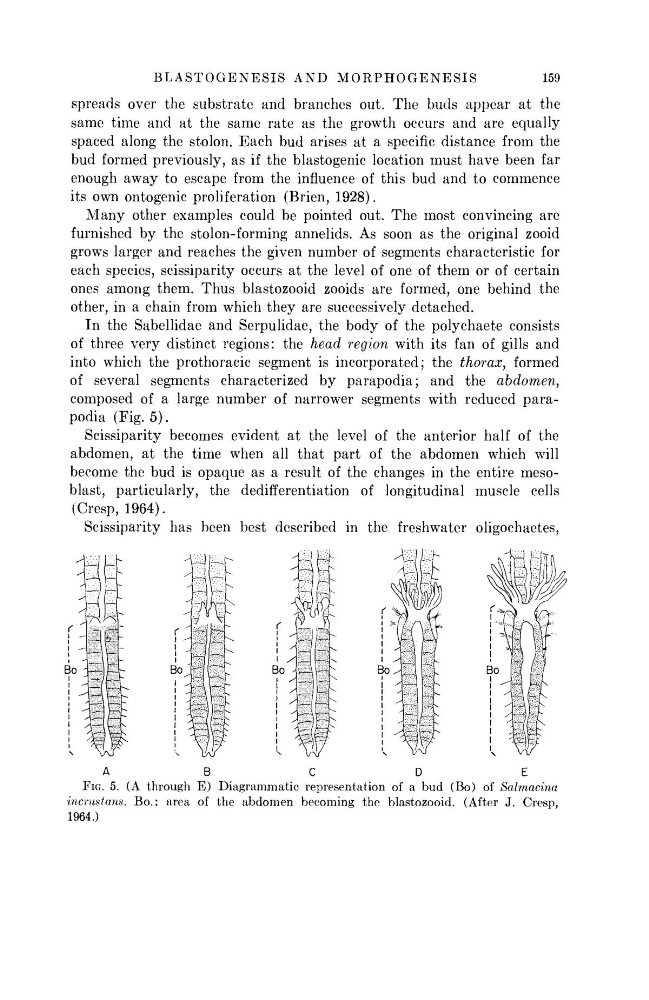
In the Sabellidae and Serpulidae, the body of the polychaete consists
of three very distinct regions: the head region with its fan of gills and
into which the prothoracic segment is incorporated; the thorax, formed
of several segments characterized by parapodia; and the
abdomen,
composed of a large number of narrower segments with reduced parapodia (Fig. 5).
Scissiparity becomes evident at the level of the anterior half of the
abdomen, at the time when all that part of the abdomen which will
become the bud is opaque as a result of the changes in the entire mesoblast, particularly, the dedifferentiation of longitudinal muscle cells
(Cresp, 1964).
Scissiparity has been best described in the freshwater oligochaetes,
A
B
C
D
E
FIG. 5. (A through E) Diagrammatic representation of a bud (Bo) of Salmacina
incrustans. Bo.: area of the abdomen becoming the blastozooid. (After J. Cresp,
1964.)
159
spreads over the substrate and branches out. The buds appear at the
same time and at the same rate as the growth occurs and are equally
spaced along the stolon. Each bud arises at a specific distance from the
bud formed previously, as if the blastogenic location must have been far
enough away to escape from the influence of this bud and to commence
its own ontogenic proliferation (Brien, 1928).
Many other examples could be pointed out. The most convincing are
furnished by the stolon-forming annelids. As soon as the original zooid
grows larger and reaches the given number of segments characteristic for
each species, scissiparity occurs at the level of one of them or of certain
ones among them. Thus blastozooid zooids are formed, one behind the
other, in a chain from which they are successively detached.
In the Sabellidae and Serpulidae, the body of the polychaete consists
of three very distinct regions: the head region with its fan of gills and
into which the prothoracic segment is incorporated; the thorax, formed
of several segments characterized by parapodia; and the
abdomen,
composed of a large number of narrower segments with reduced parapodia (Fig. 5).
Scissiparity becomes evident at the level of the anterior half of the
abdomen, at the time when all that part of the abdomen which will
become the bud is opaque as a result of the changes in the entire mesoblast, particularly, the dedifferentiation of longitudinal muscle cells
(Cresp, 1964).
Scissiparity has been best described in the freshwater oligochaetes,
A
B
C
D
E
FIG. 5. (A through E) Diagrammatic representation of a bud (Bo) of Salmacina
incrustans. Bo.: area of the abdomen becoming the blastozooid. (After J. Cresp,
1964.)