

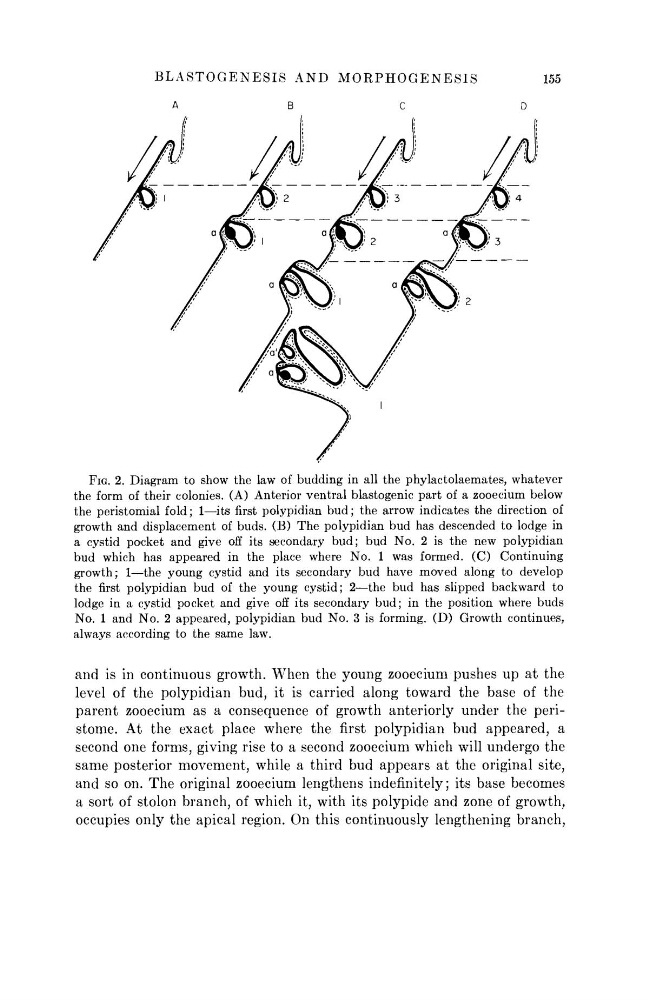
FIG. 2. Diagram to show the law of budding in all the phylactolaemates, whatever
the form of their colonies. (A) Anterior ventral blastogenic part of a zooecium below
the peristomial fold; 1—its first polypidian bud; the arrow indicates the direction of
growth and displacement of buds. (B) The polypidian bud has descended to lodge in
a cystid pocket and give off its secondary bud; bud No. 2 is the new polypidian
bud which has appeared in the place where No. 1 was formed. (C) Continuing
growth; 1—the young cystid and its secondary bud have moved along to develop
the first polypidian bud of the young cystid; 2—the bud has slipped backward to
lodge in a cystid pocket and give off its secondary bud; in the position where buds
No. 1 and No. 2 appeared, polypidian bud No. 3 is forming. (D) Growth continues,
always according to the same law.
and is in continuous growth. When the young zooecium pushes up at the
level of the polypidian bud, it is carried along toward the base of the
parent zooecium as a consequence of growth anteriorly under the peristome. At the exact place where the first polypidian bud appeared, a
second one forms, giving rise to a second zooecium which will undergo the
same posterior movement, while a third bud appears at the original site,
and so on. The original zooecium lengthens indefinitely; its base becomes
a sort of stolon branch, of which it, with its polypide and zone of growth,
occupies only the apical region. On this continuously lengthening branch,
BLASTOGENESIS AND MORPHOGENESIS
155
A
B
C
D
the form of their colonies. (A) Anterior ventral blastogenic part of a zooecium below
the peristomial fold; 1—its first polypidian bud; the arrow indicates the direction of
growth and displacement of buds. (B) The polypidian bud has descended to lodge in
a cystid pocket and give off its secondary bud; bud No. 2 is the new polypidian
bud which has appeared in the place where No. 1 was formed. (C) Continuing
growth; 1—the young cystid and its secondary bud have moved along to develop
the first polypidian bud of the young cystid; 2—the bud has slipped backward to
lodge in a cystid pocket and give off its secondary bud; in the position where buds
No. 1 and No. 2 appeared, polypidian bud No. 3 is forming. (D) Growth continues,
always according to the same law.
and is in continuous growth. When the young zooecium pushes up at the
level of the polypidian bud, it is carried along toward the base of the
parent zooecium as a consequence of growth anteriorly under the peristome. At the exact place where the first polypidian bud appeared, a
second one forms, giving rise to a second zooecium which will undergo the
same posterior movement, while a third bud appears at the original site,
and so on. The original zooecium lengthens indefinitely; its base becomes
a sort of stolon branch, of which it, with its polypide and zone of growth,
occupies only the apical region. On this continuously lengthening branch,
BLASTOGENESIS AND MORPHOGENESIS
155
A
B
C
D