

144
Stage 12
HERMAN DENIS
Stage 26 - 28
Stage 39-42
234
5.4
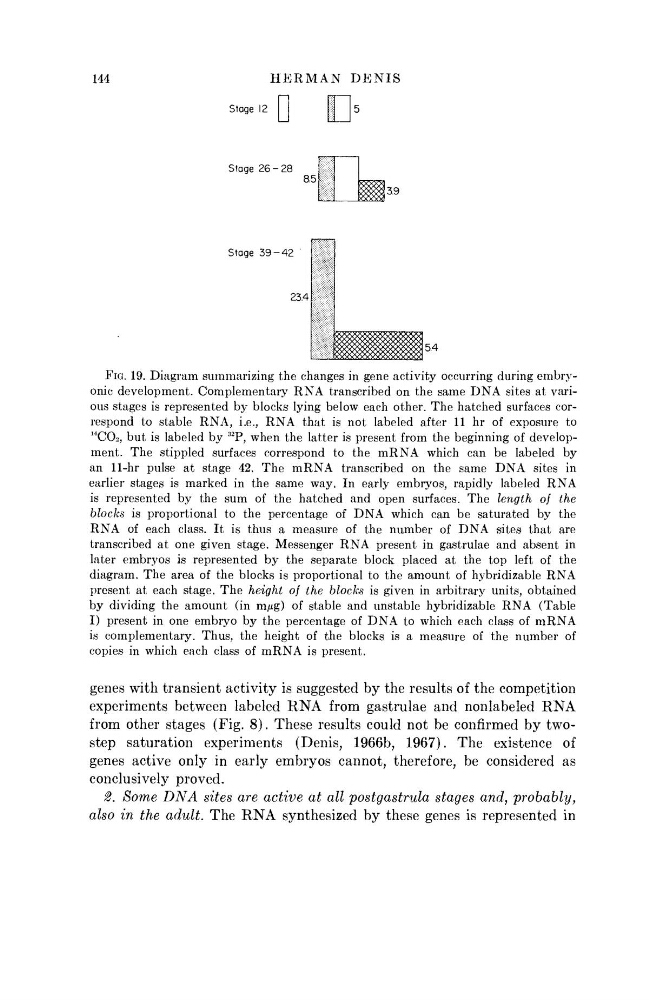
FIG. 19. Diagram summarizing the changes in gene activity occurring during embryonic development. Complementary RNA transcribed on the same DNA sites at various stages is represented by blocks lying below each other. The hatched surfaces correspond to stable RNA, i.e., RNA that is not labeled after 11 hr of exposure to
1 4
C0 2 , but is labeled by
3 2
P, when the latter is present from the beginning of development. The stippled surfaces correspond to the mRNA which can be labeled by
an 11-hr pulse at stage 42. The mRNA transcribed on the same DNA sites in
earlier stages is marked in the same way. In early embryos, rapidly labeled RNA
is represented by the sum of the hatched and open surfaces. The length of the
blocks is proportional to the percentage of DNA which can be saturated by the
RNA of each class. It is thus a measure of the number of DNA sites that are
transcribed at one given stage. Messenger RNA present in gastrulae and absent in
later embryos is represented by the separate block placed at the top left of the
diagram. The area of the blocks is proportional to the amount of hybridizable RNA
present at each stage. The height of the blocks is given in arbitrary units, obtained
by dividing the amount (in m/ig) of stable and unstable hybridizable RNA (Table
I) present in one embryo by the percentage of DNA to which each class of mRNA
is complementary. Thus, the height of the blocks is a measure of the number of
copies in which each class of mRNA is present.
genes with transient activity is suggested by the results of the competition
experiments between labeled RNA from gastrulae and nonlabeled RNA
from other stages (Fig. 8). These results could not be confirmed by twostep saturation experiments (Denis, 1966b, 1967). The existence of
genes active only in early embryos cannot, therefore, be considered as
conclusively proved.
2. Some DNA
sites are active at all postgastrula
stages and,
probably,
also in the adult. The RNA synthesized by these genes is represented in
5
Stage 12
HERMAN DENIS
Stage 26 - 28
Stage 39-42
234
5.4
FIG. 19. Diagram summarizing the changes in gene activity occurring during embryonic development. Complementary RNA transcribed on the same DNA sites at various stages is represented by blocks lying below each other. The hatched surfaces correspond to stable RNA, i.e., RNA that is not labeled after 11 hr of exposure to
1 4
C0 2 , but is labeled by
3 2
P, when the latter is present from the beginning of development. The stippled surfaces correspond to the mRNA which can be labeled by
an 11-hr pulse at stage 42. The mRNA transcribed on the same DNA sites in
earlier stages is marked in the same way. In early embryos, rapidly labeled RNA
is represented by the sum of the hatched and open surfaces. The length of the
blocks is proportional to the percentage of DNA which can be saturated by the
RNA of each class. It is thus a measure of the number of DNA sites that are
transcribed at one given stage. Messenger RNA present in gastrulae and absent in
later embryos is represented by the separate block placed at the top left of the
diagram. The area of the blocks is proportional to the amount of hybridizable RNA
present at each stage. The height of the blocks is given in arbitrary units, obtained
by dividing the amount (in m/ig) of stable and unstable hybridizable RNA (Table
I) present in one embryo by the percentage of DNA to which each class of mRNA
is complementary. Thus, the height of the blocks is a measure of the number of
copies in which each class of mRNA is present.
genes with transient activity is suggested by the results of the competition
experiments between labeled RNA from gastrulae and nonlabeled RNA
from other stages (Fig. 8). These results could not be confirmed by twostep saturation experiments (Denis, 1966b, 1967). The existence of
genes active only in early embryos cannot, therefore, be considered as
conclusively proved.
2. Some DNA
sites are active at all postgastrula
stages and,
probably,
also in the adult. The RNA synthesized by these genes is represented in
5