

ROLE OF mRNA IN EMBRYONIC DEVELOPMENT
119
fact
1 4
C0 2 is the only precursor that penetrates readily into amphibian
embryos; these embryos are almost completely impermeable to the substances normally used to label the nucleic acids (
3 2
P, nucleosides).
Ribonucleic acid is already labeled after a short exposure (30 minutes) to
1 4
C0 2 , and thus the
1 4
C0 2 method can be used for short landings (pulses)
of RNA.
Ribonucleic acid was extracted from the embryos and purified by a
procedure derived from those of Hiatt (1962) and Scherrer and Darnell
(1962). The extraction was carried out at pH 5 in the presence of polyvinyl sulfate (a powerful inhibitor of RNase). The proteins were eliminated by prolonged shaking with cold phenol (0°C). The RNA extracted
by this procedure was not degraded. For the analysis in sucrose gradient,
Tube no.
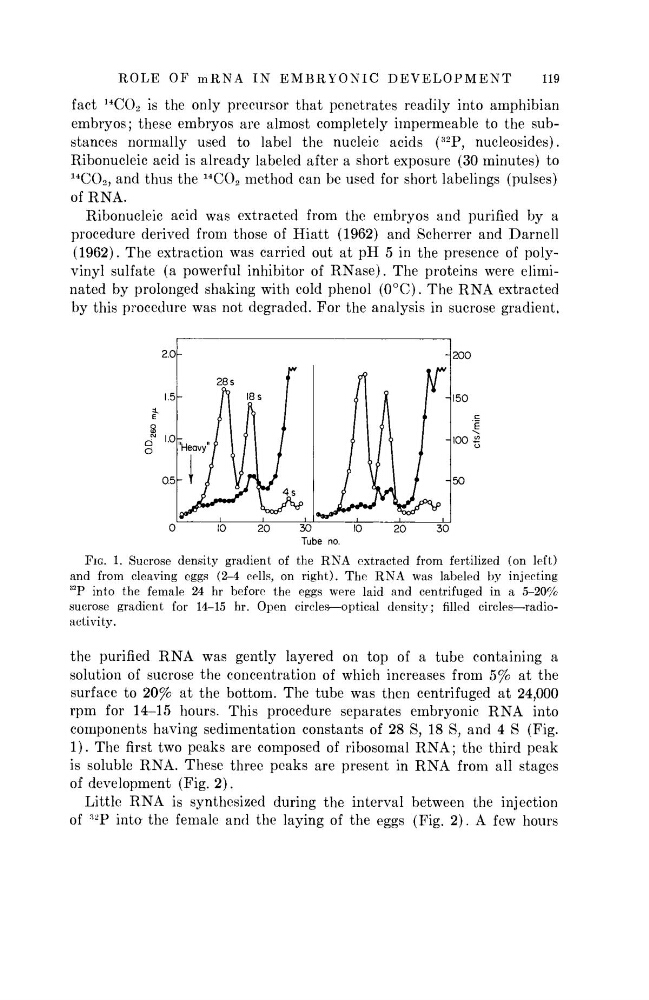
FIG. 1. Sucrose density gradient of the RNA extracted from fertilized (on left)
and from cleaving eggs (2-4 cells, on right). The RNA was labeled by injecting
3 2
P into the female 24 hr before the eggs were laid and centrifuged in a 5-20%
sucrose gradient for 14-15 hr. Open circles—optical density; filled circles—radioactivity.
the purified RNA was gently layered on top of a tube containing a
solution of sucrose the concentration of which increases from 5% at the
surface to 20% at the bottom. The tube was then centrifuged at 24,000
rpm for 14-15 hours. This procedure separates embryonic RNA into
components having sedimentation constants of 28 S, 18 S, and 4 S (Fig.
1). The first two peaks are composed of ribosomal RNA; the third peak
is soluble RNA. These three peaks are present in RNA from all stages
of development (Fig. 2).
Little RNA is synthesized during the interval between the injection
of
8 2
P into the female and the laying of the eggs (Fig. 2). A few hours
cts/min
QD
-260
m u
119
fact
1 4
C0 2 is the only precursor that penetrates readily into amphibian
embryos; these embryos are almost completely impermeable to the substances normally used to label the nucleic acids (
3 2
P, nucleosides).
Ribonucleic acid is already labeled after a short exposure (30 minutes) to
1 4
C0 2 , and thus the
1 4
C0 2 method can be used for short landings (pulses)
of RNA.
Ribonucleic acid was extracted from the embryos and purified by a
procedure derived from those of Hiatt (1962) and Scherrer and Darnell
(1962). The extraction was carried out at pH 5 in the presence of polyvinyl sulfate (a powerful inhibitor of RNase). The proteins were eliminated by prolonged shaking with cold phenol (0°C). The RNA extracted
by this procedure was not degraded. For the analysis in sucrose gradient,
Tube no.
FIG. 1. Sucrose density gradient of the RNA extracted from fertilized (on left)
and from cleaving eggs (2-4 cells, on right). The RNA was labeled by injecting
3 2
P into the female 24 hr before the eggs were laid and centrifuged in a 5-20%
sucrose gradient for 14-15 hr. Open circles—optical density; filled circles—radioactivity.
the purified RNA was gently layered on top of a tube containing a
solution of sucrose the concentration of which increases from 5% at the
surface to 20% at the bottom. The tube was then centrifuged at 24,000
rpm for 14-15 hours. This procedure separates embryonic RNA into
components having sedimentation constants of 28 S, 18 S, and 4 S (Fig.
1). The first two peaks are composed of ribosomal RNA; the third peak
is soluble RNA. These three peaks are present in RNA from all stages
of development (Fig. 2).
Little RNA is synthesized during the interval between the injection
of
8 2
P into the female and the laying of the eggs (Fig. 2). A few hours
cts/min
QD
-260
m u