

8
THOMAS S. ARGYRIS
ture composed of epithelium and connective tissue and its growth requires
the integrative action of both these tissues. This supports the notion held
for years by many students of wound healing that damage unleashes
substances that can stimulate normal growth, and, therefore, may be
similar to embryonic inducers, and may be important in the control of
growth of adult tissues (Argyris, 1964; Holtfreter, 1948; Saxen and
Toivonen, 1962; Teir, 1952).
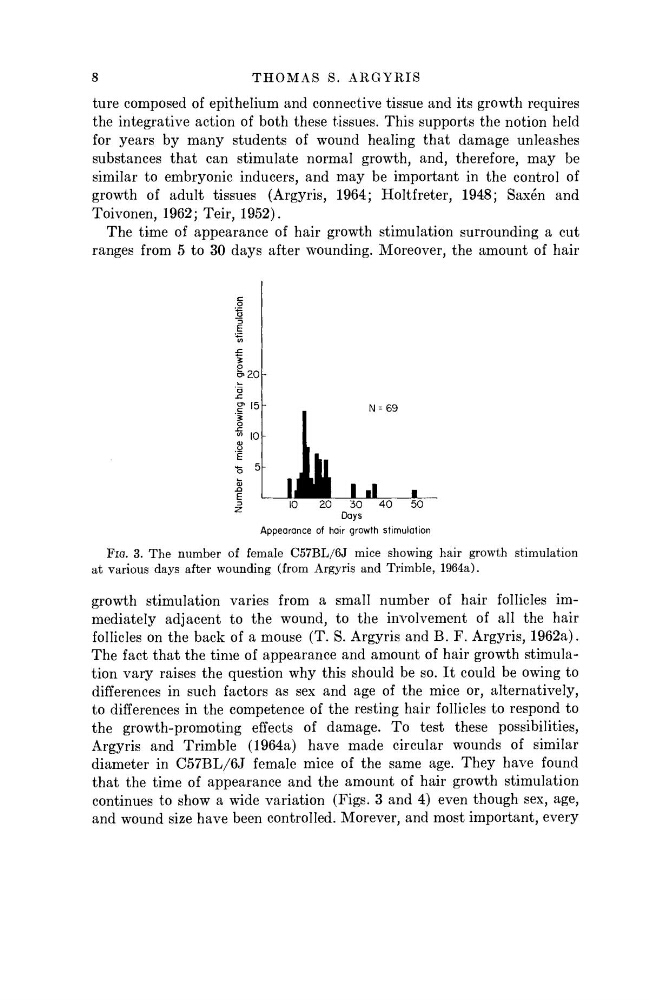
The time of appearance of hair growth stimulation surrounding a cut
ranges from 5 to 30 days after wounding. Moreover, the amount of hair
10
20
30
40
50
Days
Appearance of hair growth stimulation
FIG. 3. The number of female C57BL/6J mice showing hair growth stimulation
at various days after wounding (from Argyris and Trimble, 1964a).
growth stimulation varies from a small number of hair follicles immediately adjacent to the wound, to the involvement of all the hair
follicles on the back of a mouse (T. S. Argyris and B. F. Argyris, 1962a).
The fact that the time of appearance and amount of hair growth stimulation vary raises the question why this should be so. It could be owing to
differences in such factors as sex and age of the mice or, alternatively,
to differences in the competence of the resting hair follicles to respond to
the growth-promoting effects of damage. To test these possibilities,
Argyris and Trimble (1964a) have made circular wounds of similar
diameter in C57BL/6J female mice of the same age. They have found
that the time of appearance and the amount of hair growth stimulation
continues to show a wide variation (Figs. 3 and 4) even though sex, age,
and wound size have been controlled. Morever, and most important, every
Number of mice showing hair growth stimulation
THOMAS S. ARGYRIS
ture composed of epithelium and connective tissue and its growth requires
the integrative action of both these tissues. This supports the notion held
for years by many students of wound healing that damage unleashes
substances that can stimulate normal growth, and, therefore, may be
similar to embryonic inducers, and may be important in the control of
growth of adult tissues (Argyris, 1964; Holtfreter, 1948; Saxen and
Toivonen, 1962; Teir, 1952).
The time of appearance of hair growth stimulation surrounding a cut
ranges from 5 to 30 days after wounding. Moreover, the amount of hair
10
20
30
40
50
Days
Appearance of hair growth stimulation
FIG. 3. The number of female C57BL/6J mice showing hair growth stimulation
at various days after wounding (from Argyris and Trimble, 1964a).
growth stimulation varies from a small number of hair follicles immediately adjacent to the wound, to the involvement of all the hair
follicles on the back of a mouse (T. S. Argyris and B. F. Argyris, 1962a).
The fact that the time of appearance and amount of hair growth stimulation vary raises the question why this should be so. It could be owing to
differences in such factors as sex and age of the mice or, alternatively,
to differences in the competence of the resting hair follicles to respond to
the growth-promoting effects of damage. To test these possibilities,
Argyris and Trimble (1964a) have made circular wounds of similar
diameter in C57BL/6J female mice of the same age. They have found
that the time of appearance and the amount of hair growth stimulation
continues to show a wide variation (Figs. 3 and 4) even though sex, age,
and wound size have been controlled. Morever, and most important, every
Number of mice showing hair growth stimulation