

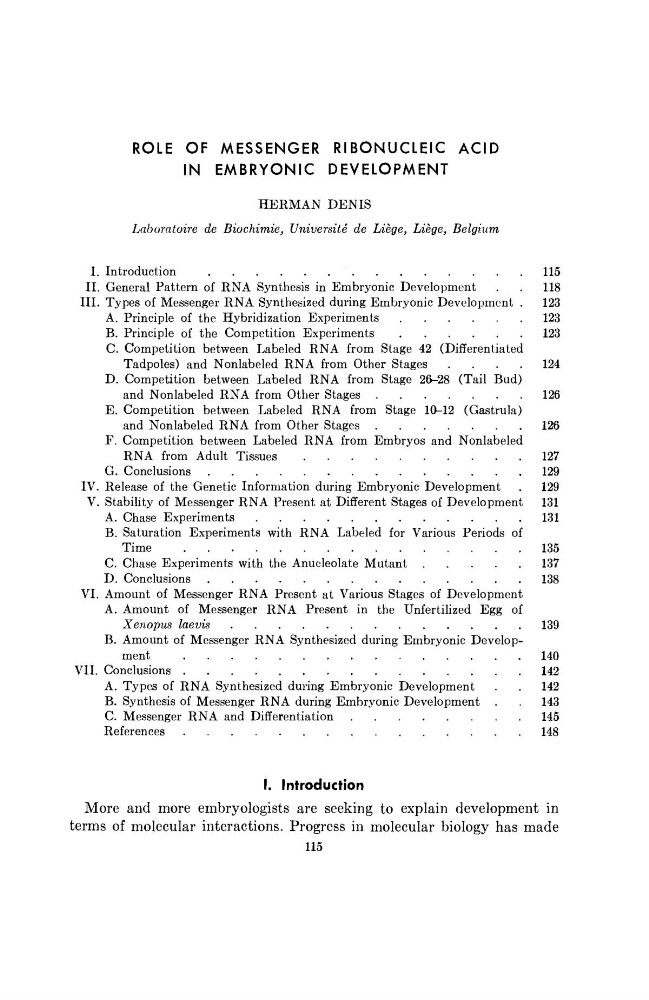
ROLE
OF MESSENGER
RIBONUCLEIC
ACID
IN
EMBRYONIC
DEVELOPMENT
HERMAN DENIS
Laboratoire de Biochimie, Universite de Liege, Liege,
Belgium
I. Introduction
115
II. General Pattern of RNA Synthesis in Embryonic Development
.
.
118
III. Types of Messenger RNA Synthesized during Embryonic Development .
123
A. Principle of the Hybridization Experiments
123
B. Principle of the Competition Experiments
123
C. Competition between Labeled RNA from Stage 42 (Differentiated
Tadpoles) and Nonlabeled RNA from Other Stages
.
.
.
.
124
D. Competition between Labeled RNA from Stage 26-28 (Tail Bud)
and Nonlabeled RNA from Other Stages
126
E. Competition between Labeled RNA from Stage 10-12 (Gastrula)
and Nonlabeled RNA from Other Stages
126
F. Competition between Labeled RNA from Embryos and Nonlabeled
RNA from Adult Tissues
127
G. Conclusions
129
IV. Release of the Genetic Information during Embryonic Development
.
129
V. Stability of Messenger RNA Present at Different Stages of Development
131
A. Chase Experiments
131
B. Saturation Experiments with RNA Labeled for Various Periods of
Time
135
C. Chase Experiments with the Anucleolate Mutant
137
D. Conclusions
138
VI. Amount of Messenger RNA Present at Various Stages of Development
A. Amount of Messenger RNA Present in the Unfertilized Egg of
Xenopus laevis
139
B. Amount of Messenger RNA Synthesized during Embryonic Development
140
VII. Conclusions
142
A. Types of RNA Synthesized during Embryonic Development
.
.
142
B. Synthesis of Messenger RNA during Embryonic Development
.
.
143
C. Messenger RNA and Differentiation
145
References
148
I. Introduction
More and more embryologists are seeking to explain development in
terms of molecular interactions. Progress in molecular biology has made
115
OF MESSENGER
RIBONUCLEIC
ACID
IN
EMBRYONIC
DEVELOPMENT
HERMAN DENIS
Laboratoire de Biochimie, Universite de Liege, Liege,
Belgium
I. Introduction
115
II. General Pattern of RNA Synthesis in Embryonic Development
.
.
118
III. Types of Messenger RNA Synthesized during Embryonic Development .
123
A. Principle of the Hybridization Experiments
123
B. Principle of the Competition Experiments
123
C. Competition between Labeled RNA from Stage 42 (Differentiated
Tadpoles) and Nonlabeled RNA from Other Stages
.
.
.
.
124
D. Competition between Labeled RNA from Stage 26-28 (Tail Bud)
and Nonlabeled RNA from Other Stages
126
E. Competition between Labeled RNA from Stage 10-12 (Gastrula)
and Nonlabeled RNA from Other Stages
126
F. Competition between Labeled RNA from Embryos and Nonlabeled
RNA from Adult Tissues
127
G. Conclusions
129
IV. Release of the Genetic Information during Embryonic Development
.
129
V. Stability of Messenger RNA Present at Different Stages of Development
131
A. Chase Experiments
131
B. Saturation Experiments with RNA Labeled for Various Periods of
Time
135
C. Chase Experiments with the Anucleolate Mutant
137
D. Conclusions
138
VI. Amount of Messenger RNA Present at Various Stages of Development
A. Amount of Messenger RNA Present in the Unfertilized Egg of
Xenopus laevis
139
B. Amount of Messenger RNA Synthesized during Embryonic Development
140
VII. Conclusions
142
A. Types of RNA Synthesized during Embryonic Development
.
.
142
B. Synthesis of Messenger RNA during Embryonic Development
.
.
143
C. Messenger RNA and Differentiation
145
References
148
I. Introduction
More and more embryologists are seeking to explain development in
terms of molecular interactions. Progress in molecular biology has made
115