

DEVELOPMENT OF INNERVATION IN TETRAPOD LIMBS
105
Atrophy of tail Innervation
begins
Extent Source
Atrophy of tail
Innervation
begins
Extent Source
H5-l4-l^2-IH0-9-8-7-6-5-4-3-2-l
days ^
Graft
Transplantation
oI4-I3-I2-IHO-9-8-7-6-5-4-3-2-I
Days
1 2 341
10-9-8-76-5-4-3-2-1 « | 2 34
h
Days
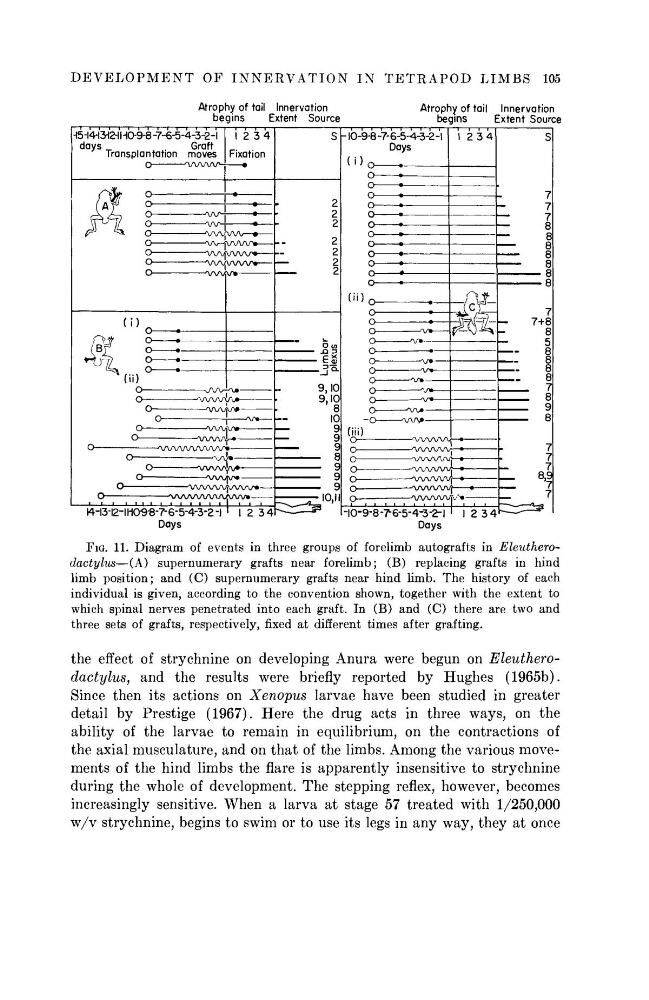
FIG. 11. Diagram of events in three groups of forelimb autografts in
Eleutherodactylus—(A)
supernumerary grafts near forelimb; (B) replacing grafts in hind
limb position; and (C) supernumerary grafts near hind limb. The history of each
individual is given, according to the convention shown, together with the extent to
which spinal nerves penetrated into each graft. In (B) and (C) there are two and
three sets of grafts, respectively, fixed at different times after grafting.
the effect of strychnine on developing Anura were begun on Eleutherodactylus,
and the results were briefly reported by Hughes (1965b).
Since then its actions on Xenopus larvae have been studied in greater
detail by Prestige (1967). Here the drug acts in three ways, on the
ability of the larvae to remain in equilibrium, on the contractions of
the axial musculature, and on that of the limbs. Among the various movements of the hind limbs the flare is apparently insensitive to strychnine
during the whole of development. The stepping reflex, however, becomes
increasingly sensitive. When a larva at stage 57 treated with 1/250,000
w/v strychnine, begins to swim or to use its legs in any way, they at once
105
Atrophy of tail Innervation
begins
Extent Source
Atrophy of tail
Innervation
begins
Extent Source
H5-l4-l^2-IH0-9-8-7-6-5-4-3-2-l
days ^
Graft
Transplantation
oI4-I3-I2-IHO-9-8-7-6-5-4-3-2-I
Days
1 2 341
10-9-8-76-5-4-3-2-1 « | 2 34
h
Days
FIG. 11. Diagram of events in three groups of forelimb autografts in
Eleutherodactylus—(A)
supernumerary grafts near forelimb; (B) replacing grafts in hind
limb position; and (C) supernumerary grafts near hind limb. The history of each
individual is given, according to the convention shown, together with the extent to
which spinal nerves penetrated into each graft. In (B) and (C) there are two and
three sets of grafts, respectively, fixed at different times after grafting.
the effect of strychnine on developing Anura were begun on Eleutherodactylus,
and the results were briefly reported by Hughes (1965b).
Since then its actions on Xenopus larvae have been studied in greater
detail by Prestige (1967). Here the drug acts in three ways, on the
ability of the larvae to remain in equilibrium, on the contractions of
the axial musculature, and on that of the limbs. Among the various movements of the hind limbs the flare is apparently insensitive to strychnine
during the whole of development. The stepping reflex, however, becomes
increasingly sensitive. When a larva at stage 57 treated with 1/250,000
w/v strychnine, begins to swim or to use its legs in any way, they at once