

DEVELOPMENT OF INNERVATION IN TETRAPOD LIMBS 103
o
Triceps
O Triceps, large fibers present
100
90 h
80
70
60
50
40
30
20
10
x Ileopsoas
o
o
o
o
o o
o
o
o
GO
0
x x x
Length of tail (mm)
3^
3
I
~i—
10
13
14
II
12
Days of development
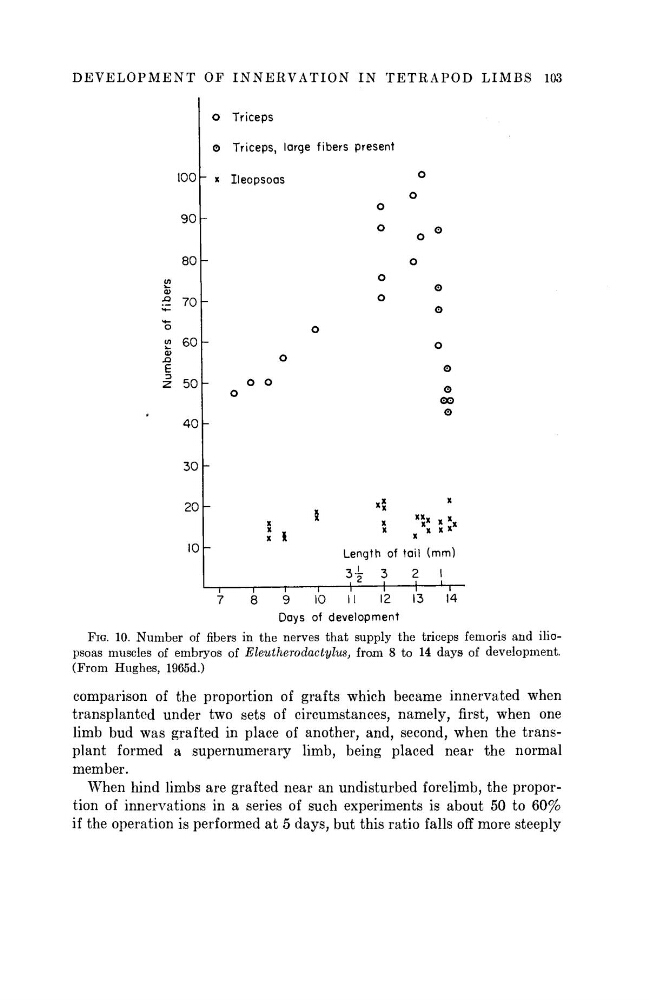
FIG. 10. Number of fibers in the nerves that supply the triceps femoris and iliopsoas muscles of embryos of Eleutherodactylus,
from 8 to 14 days of development.
(From Hughes, 1965d.)
comparison of the proportion of grafts which became innervated when
transplanted under two sets of circumstances, namely, first, when one
limb bud was grafted in place of another, and, second, when the transplant formed a supernumerary limb, being placed near the normal
member.
When hind limbs are grafted near an undisturbed forelimb, the proportion of innervations in a series of such experiments is about 50 to 60%
if the operation is performed at 5 days, but this ratio falls off more steeply
Numbers of fibers
—i
1
1——
7
8
9
o
Triceps
O Triceps, large fibers present
100
90 h
80
70
60
50
40
30
20
10
x Ileopsoas
o
o
o
o
o o
o
o
o
GO
0
x x x
Length of tail (mm)
3^
3
I
~i—
10
13
14
II
12
Days of development
FIG. 10. Number of fibers in the nerves that supply the triceps femoris and iliopsoas muscles of embryos of Eleutherodactylus,
from 8 to 14 days of development.
(From Hughes, 1965d.)
comparison of the proportion of grafts which became innervated when
transplanted under two sets of circumstances, namely, first, when one
limb bud was grafted in place of another, and, second, when the transplant formed a supernumerary limb, being placed near the normal
member.
When hind limbs are grafted near an undisturbed forelimb, the proportion of innervations in a series of such experiments is about 50 to 60%
if the operation is performed at 5 days, but this ratio falls off more steeply
Numbers of fibers
—i
1
1——
7
8
9