

100
ARTHUR HUGHES
of the whole limb on an arc in a vertical plane, a movement that never
occurs in the final pattern of motility. Opening and closing of the foot is
much more conspicuous at these larval stages than in the juvenile. It is
thus clear that muscles in the distal part of the limb are already excitable
through their nerves and that nerve-muscle contacts are not confined to
the hip flexors. Stimuli applied to the lumbar ganglia are usually without
effect at stage 54, though rotatory movements of the foot are occasionally
seen.
The flare phase of normal motility is succeeded by that of alternate
stepping movements. In the spinal larva, light touch then sets off a wide
range of movement in the limb; flexion at hip and knee, and spreading
of the toes. Such movements may continue for many seconds. In such
animals stimulation of the cord was seen to provoke exactly similar reactions. In some instances where the axial musculature was first excited
by the stimulus, this was followed by a typical alternate stepping of the
legs. At this time, stimuli applied to the lumbar ganglia also result in
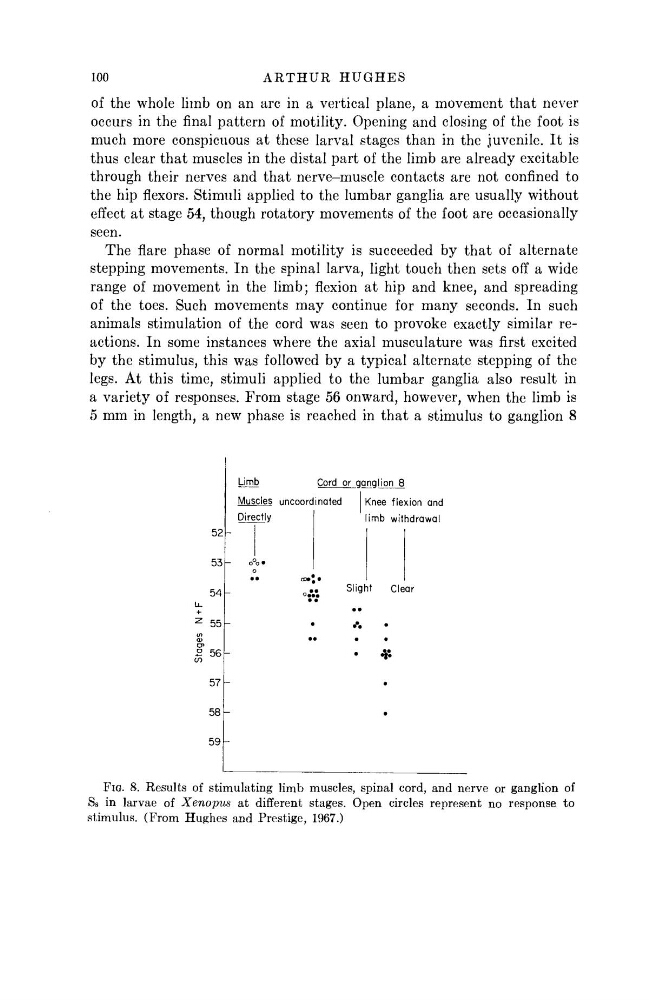
a variety of responses. From stage 56 onward, however, when the limb is
5 mm in length, a new phase is reached in that a stimulus to ganglion 8
Limb
Cord or ganglion 8
inated
| Knee flexion and
limb withdrawal
Muscles
uncoordinated
Directly
I
52
53
54
Slight
Clear
Stages N + F
Ol
(Jl
57
58
59
FIG. 8. Results of stimulating limb muscles, spinal cord, and nerve or ganglion of
S 8 in larvae of Xenopus at different stages. Open circles represent no response to
stimulus. (From Hughes and Prestige, 1967.)
ARTHUR HUGHES
of the whole limb on an arc in a vertical plane, a movement that never
occurs in the final pattern of motility. Opening and closing of the foot is
much more conspicuous at these larval stages than in the juvenile. It is
thus clear that muscles in the distal part of the limb are already excitable
through their nerves and that nerve-muscle contacts are not confined to
the hip flexors. Stimuli applied to the lumbar ganglia are usually without
effect at stage 54, though rotatory movements of the foot are occasionally
seen.
The flare phase of normal motility is succeeded by that of alternate
stepping movements. In the spinal larva, light touch then sets off a wide
range of movement in the limb; flexion at hip and knee, and spreading
of the toes. Such movements may continue for many seconds. In such
animals stimulation of the cord was seen to provoke exactly similar reactions. In some instances where the axial musculature was first excited
by the stimulus, this was followed by a typical alternate stepping of the
legs. At this time, stimuli applied to the lumbar ganglia also result in
a variety of responses. From stage 56 onward, however, when the limb is
5 mm in length, a new phase is reached in that a stimulus to ganglion 8
Limb
Cord or ganglion 8
inated
| Knee flexion and
limb withdrawal
Muscles
uncoordinated
Directly
I
52
53
54
Slight
Clear
Stages N + F
Ol
(Jl
57
58
59
FIG. 8. Results of stimulating limb muscles, spinal cord, and nerve or ganglion of
S 8 in larvae of Xenopus at different stages. Open circles represent no response to
stimulus. (From Hughes and Prestige, 1967.)