

E M B R Y O N I C H E M O G L O B I N S Y N T H E S I S
91
active Hb synthesis occurs after the polychromatic stage, a period when
RNA synthesis is absent. They concluded that Hb synthesis in later
stages was independent of concomitant RNA synthesis, suggesting a
rather stable RNA template for Hb synthesis.
Borsook et al. (1962) have studied the maturation of the rabbit red
cell in considerable detail by biochemical and autoradiographic methods.
The metabolic states of a given cell in a particular stage of erythropoiesis may vary considerably, although the average rate of Hb synthesis
changes in a predictable way. Hb synthesis persists in some cells
throughout the maturation, but Hb synthesis may be absent in some
cells of any given stage. Laszlo et al. (1966) have also recently shown
the extensive heterogeneity present in rabbit reticulocytes that are synthesizing Hb. Borsook et al. (1962) propose the rate of Hb synthesis
of a given cell is not governed by its Hb content, but by the length of
time it spends in different stages of maturation. A polychromatic erythroblast may divide to form two normoblasts, or pass directly to the
reticulocyte stage. According to these authors, basophilic erythroblasts
have the highest average rate of Hb synthesis, and the average rate then
gradually declines. An important finding is the demonstration that under
the stress of phenylhydrazine-induced anemia the usual progress of cells
from the basophilic erythroblast to reticulocyte stages may not occur,
and a large number of basophilic erythroblasts "panic" and pass directly
to the reticulocyte stage. The percentage of the total erythrocyte Hb
content synthesized in various prior stages, and the rate of synthesis
during these stages, may vary from cell to cell and be profoundly
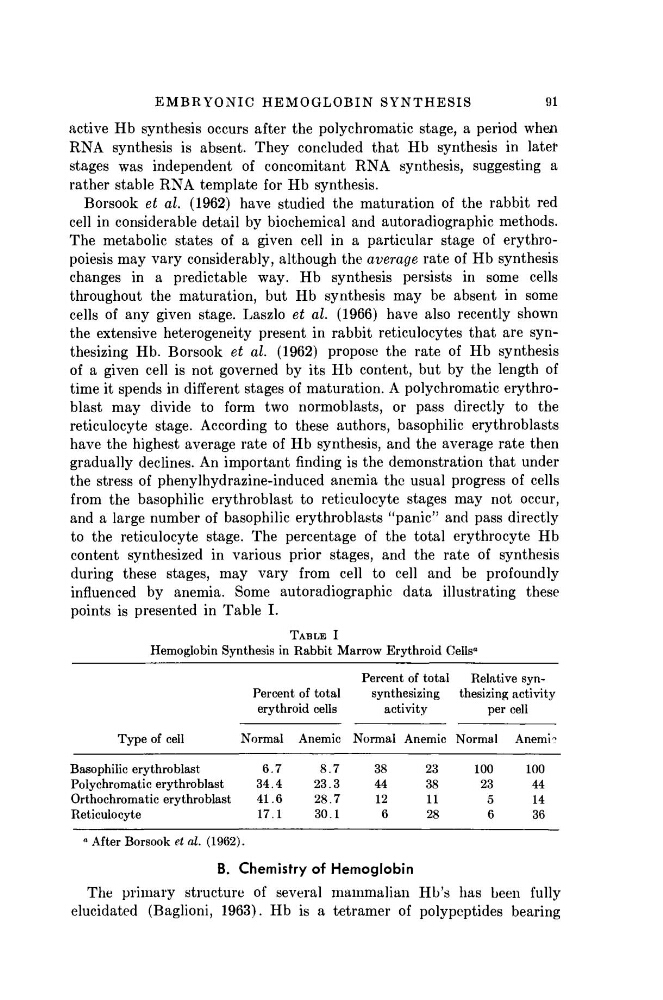
influenced by anemia. Some autoradiographic data illustrating these
points is presented in Table I.
TABLE I
Hemoglobin Synthesis in Rabbit Marrow Erythroid Cells"
Percent of total
Relative synPercent of total
synthesizing
thesizing activity
erythroid cells
activity
per cell
Type of cell
Normal Anemic Normal Anemic Normal
Anemi?
Basophilic erythroblast
6.7
8.7
38
23
100
100
Polychromatic erythroblast
34.4
23.3
44
38
23
44
Orthochromatic erythroblast
41.6
28.7
12
11
5
14
Reticulocyte
17.1
30.1
6
28
6
36
« After Borsook et al. (1962).
B. Chemistry of Hemoglobin
The primary structure of several mammalian Hb's has been fully
elucidated (Baglioni, 1963). Hb is a tetramer of polypeptides bearing
91
active Hb synthesis occurs after the polychromatic stage, a period when
RNA synthesis is absent. They concluded that Hb synthesis in later
stages was independent of concomitant RNA synthesis, suggesting a
rather stable RNA template for Hb synthesis.
Borsook et al. (1962) have studied the maturation of the rabbit red
cell in considerable detail by biochemical and autoradiographic methods.
The metabolic states of a given cell in a particular stage of erythropoiesis may vary considerably, although the average rate of Hb synthesis
changes in a predictable way. Hb synthesis persists in some cells
throughout the maturation, but Hb synthesis may be absent in some
cells of any given stage. Laszlo et al. (1966) have also recently shown
the extensive heterogeneity present in rabbit reticulocytes that are synthesizing Hb. Borsook et al. (1962) propose the rate of Hb synthesis
of a given cell is not governed by its Hb content, but by the length of
time it spends in different stages of maturation. A polychromatic erythroblast may divide to form two normoblasts, or pass directly to the
reticulocyte stage. According to these authors, basophilic erythroblasts
have the highest average rate of Hb synthesis, and the average rate then
gradually declines. An important finding is the demonstration that under
the stress of phenylhydrazine-induced anemia the usual progress of cells
from the basophilic erythroblast to reticulocyte stages may not occur,
and a large number of basophilic erythroblasts "panic" and pass directly
to the reticulocyte stage. The percentage of the total erythrocyte Hb
content synthesized in various prior stages, and the rate of synthesis
during these stages, may vary from cell to cell and be profoundly
influenced by anemia. Some autoradiographic data illustrating these
points is presented in Table I.
TABLE I
Hemoglobin Synthesis in Rabbit Marrow Erythroid Cells"
Percent of total
Relative synPercent of total
synthesizing
thesizing activity
erythroid cells
activity
per cell
Type of cell
Normal Anemic Normal Anemic Normal
Anemi?
Basophilic erythroblast
6.7
8.7
38
23
100
100
Polychromatic erythroblast
34.4
23.3
44
38
23
44
Orthochromatic erythroblast
41.6
28.7
12
11
5
14
Reticulocyte
17.1
30.1
6
28
6
36
« After Borsook et al. (1962).
B. Chemistry of Hemoglobin
The primary structure of several mammalian Hb's has been fully
elucidated (Baglioni, 1963). Hb is a tetramer of polypeptides bearing