

PATTERNS IN THE INTEGUMENT OF INSECTS
51
dicity which determines that of the ridges. There is no better speculation
to account for their distribution than Picken's analogy with the competition for precursors which takes place in crystal growth. The ridges
themselves arise from folds of cuticulin in much the same way as the
taenidial folds in tracheae. The cuticulin increases in area and at first
the plasma membrane follows the pattern of folds made by the cuticulin.
The bundles of fibers could act in two ways. First, the synthesis of
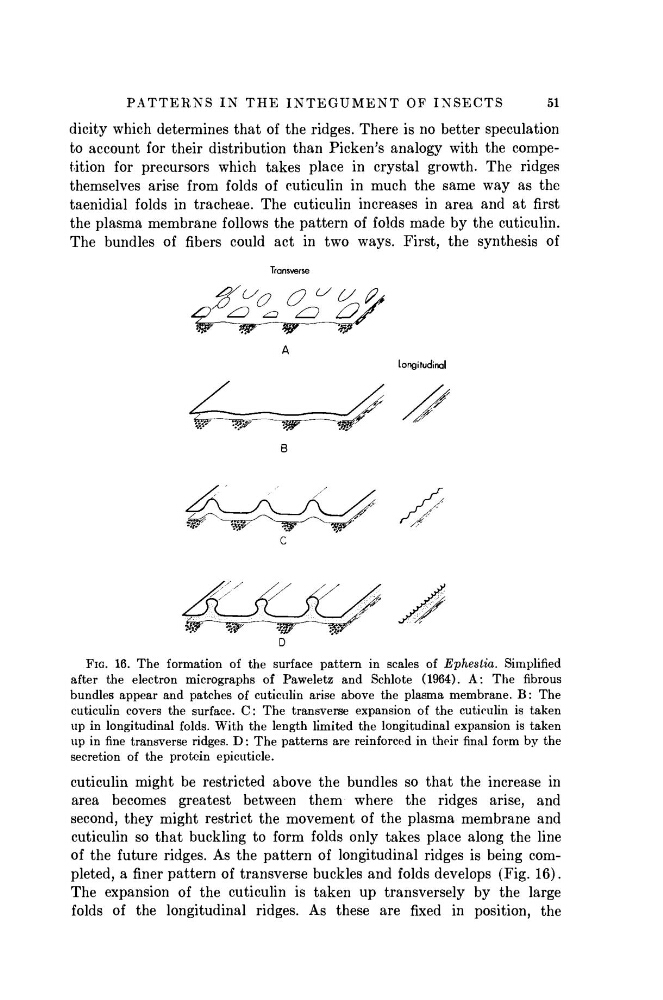
FIG. 16. The formation of the surface pattern in scales of Ephestia. Simplified
after the electron micrographs of Paweletz and Schlote (1964). A: The fibrous
bundles appear and patches of cuticulin arise above the plasma membrane. B: The
cuticulin covers the surface. C: The transverse expansion of the cuticulin is taken
up in longitudinal folds. With the length limited the longitudinal expansion is taken
up in fine transverse ridges. D : The patterns are reinforced in their final form by the
secretion of the protein epicuticle.
cuticulin might be restricted above the bundles so that the increase in
area becomes greatest between them where the ridges arise, and
second, they might restrict the movement of the plasma membrane and
cuticulin so that buckling to form folds only takes place along the line
of the future ridges. As the pattern of longitudinal ridges is being completed, a finer pattern of transverse buckles and folds develops (Fig. 16).
The expansion of the cuticulin is taken up transversely by the large
folds of the longitudinal ridges. As these are fixed in position, the
51
dicity which determines that of the ridges. There is no better speculation
to account for their distribution than Picken's analogy with the competition for precursors which takes place in crystal growth. The ridges
themselves arise from folds of cuticulin in much the same way as the
taenidial folds in tracheae. The cuticulin increases in area and at first
the plasma membrane follows the pattern of folds made by the cuticulin.
The bundles of fibers could act in two ways. First, the synthesis of
FIG. 16. The formation of the surface pattern in scales of Ephestia. Simplified
after the electron micrographs of Paweletz and Schlote (1964). A: The fibrous
bundles appear and patches of cuticulin arise above the plasma membrane. B: The
cuticulin covers the surface. C: The transverse expansion of the cuticulin is taken
up in longitudinal folds. With the length limited the longitudinal expansion is taken
up in fine transverse ridges. D : The patterns are reinforced in their final form by the
secretion of the protein epicuticle.
cuticulin might be restricted above the bundles so that the increase in
area becomes greatest between them where the ridges arise, and
second, they might restrict the movement of the plasma membrane and
cuticulin so that buckling to form folds only takes place along the line
of the future ridges. As the pattern of longitudinal ridges is being completed, a finer pattern of transverse buckles and folds develops (Fig. 16).
The expansion of the cuticulin is taken up transversely by the large
folds of the longitudinal ridges. As these are fixed in position, the