

PATTERNS IN THE INTEGUMENT OF INSECTS
49
diffraction and polarizing microscopy. The scales are flattened cuticular
envelopes with longitudinal and transverse ridges. He found that the
rudiments of all types of scale are biréfringent from the time of their
emergence. The earliest stages contain more oriented protein than chitin.
He supposed that the anisotropy of structure was due to the properties
of fibrillar aggregates, and that the pattern of ridges could be caused by
competition in situ for the material of which they are built ; their regular
distribution being a result of this competition. At this time, nothing was
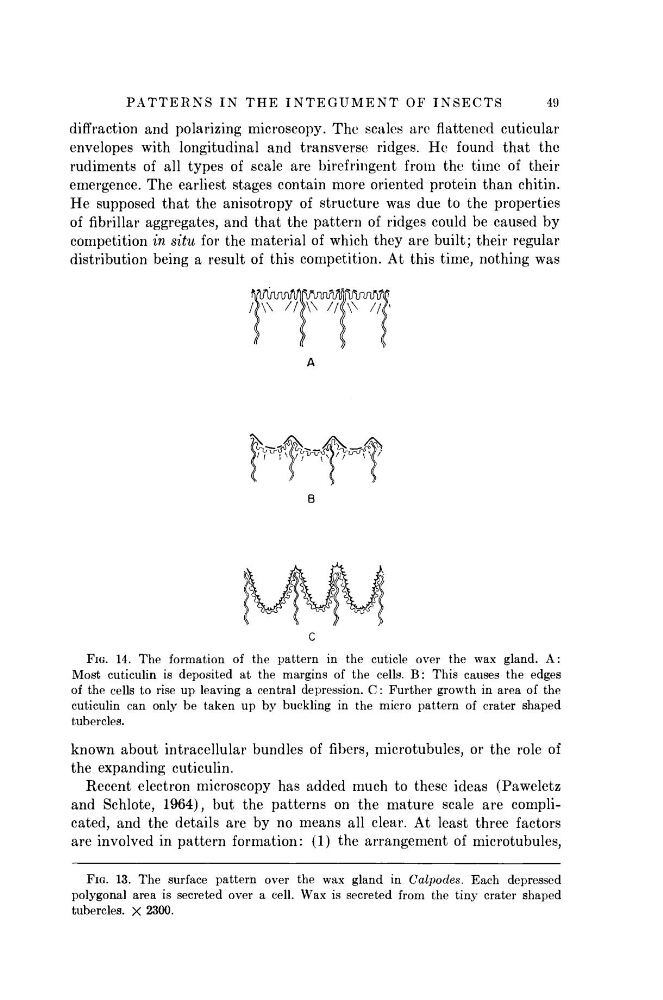
FIG. 14. The formation of the pattern in the cuticle over the wax gland. A:
Most cuticulin is deposited at the margins of the cells. B: This causes the edges
of the cells to rise up leaving a central depression. C : Further growth in area of the
cuticulin can only be taken up by buckling in the micro pattern of crater shaped
tubercles.
known about intracellular bundles of fibers, microtubules, or the role of
the expanding cuticulin.
Recent electron microscopy has added much to these ideas (Paweletz
and Schlote, 1964), but the patterns on the mature scale are complicated, and the details are by no means all clear. At least three factors
are involved in pattern formation: (1) the arrangement of microtubules,
FIG. 13. The surface pattern over the wax gland in Calpodes. Each depressed
polygonal area is secreted over a cell. Wax is secreted from the tiny crater shaped
tubercles. X 2300.
49
diffraction and polarizing microscopy. The scales are flattened cuticular
envelopes with longitudinal and transverse ridges. He found that the
rudiments of all types of scale are biréfringent from the time of their
emergence. The earliest stages contain more oriented protein than chitin.
He supposed that the anisotropy of structure was due to the properties
of fibrillar aggregates, and that the pattern of ridges could be caused by
competition in situ for the material of which they are built ; their regular
distribution being a result of this competition. At this time, nothing was
FIG. 14. The formation of the pattern in the cuticle over the wax gland. A:
Most cuticulin is deposited at the margins of the cells. B: This causes the edges
of the cells to rise up leaving a central depression. C : Further growth in area of the
cuticulin can only be taken up by buckling in the micro pattern of crater shaped
tubercles.
known about intracellular bundles of fibers, microtubules, or the role of
the expanding cuticulin.
Recent electron microscopy has added much to these ideas (Paweletz
and Schlote, 1964), but the patterns on the mature scale are complicated, and the details are by no means all clear. At least three factors
are involved in pattern formation: (1) the arrangement of microtubules,
FIG. 13. The surface pattern over the wax gland in Calpodes. Each depressed
polygonal area is secreted over a cell. Wax is secreted from the tiny crater shaped
tubercles. X 2300.